
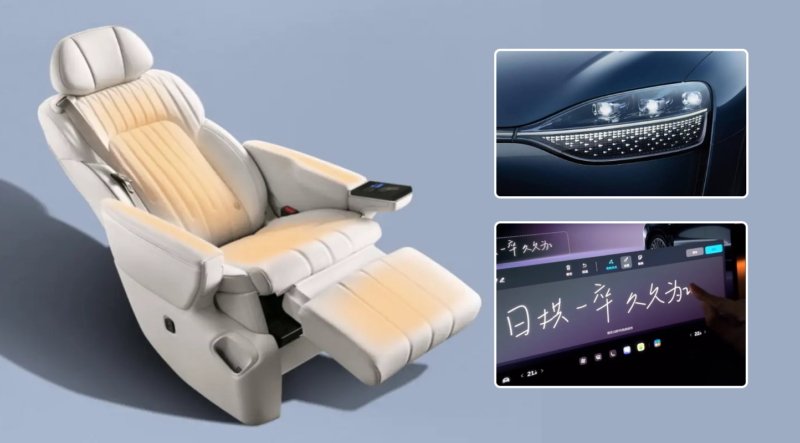
BEIJING, Oct 11 — China’s Ministry of Industry and Information Technology has opened a public consultation on draft rules aimed at tightening oversight of several emerging vehicle technologies, including zero-gravity seats, large in-car displays, user-defined lighting messages and hidden door handles.
The proposed regulations focus on vehicle safety, operation and user interaction, as increasingly complex technologies become more common in new cars.
One section targets so-called “Zero-G”, rotating and fold-flat seats, with the ministry proposing stricter crash, anti-pinch and reliability testing for such systems.
The draft also recommends limiting where and when movable-seat functions can be used and proposes banning them while a vehicle is in motion.
Another section focuses on in-car displays, including centre-mounted infotainment screens, large-surface displays and complex head-up displays.
Automakers would be required to assess the potential for these systems to distract drivers, as well as their reliability and safety during crashes and under extreme operating conditions.
The ministry has also proposed banning folding and flexible screens, a move that could affect technology-heavy brands such as Xiaomi and Huawei’s HIMA.
The draft regulations also address exterior lighting, including lighting assemblies, protruding light units and user-defined headlight and taillight messaging.
Some new-energy vehicles already use matrix LED systems that allow drivers to project text and graphics from their cars.
Under the proposed rules, automakers would be expected to moderate content displayed through these lighting systems and monitor what users are able to project.
The move reflects broader concerns over “unapproved” content being displayed on public roads.
Similar restrictions already exist in other areas of technology in China, where some Android smartphones use filtering and auditing systems that prevent users from assigning sensitive keywords to Wi-Fi hotspots and Bluetooth device names.
The ministry has also reiterated its proposal to ban fully hidden door handles.
That proposal was first published in late 2025 following a series of high-profile Xiaomi SU7 crashes.
MIIT has previously released diagrams showing what it considers preferable exterior and interior door-handle designs.
The latest draft also addresses other “innovative” handle designs, requiring automakers to verify their reliability and safety under extreme conditions.
It further proposes that new door-handle systems include redundant mechanical linkages and provide sufficient space for manual operation.