
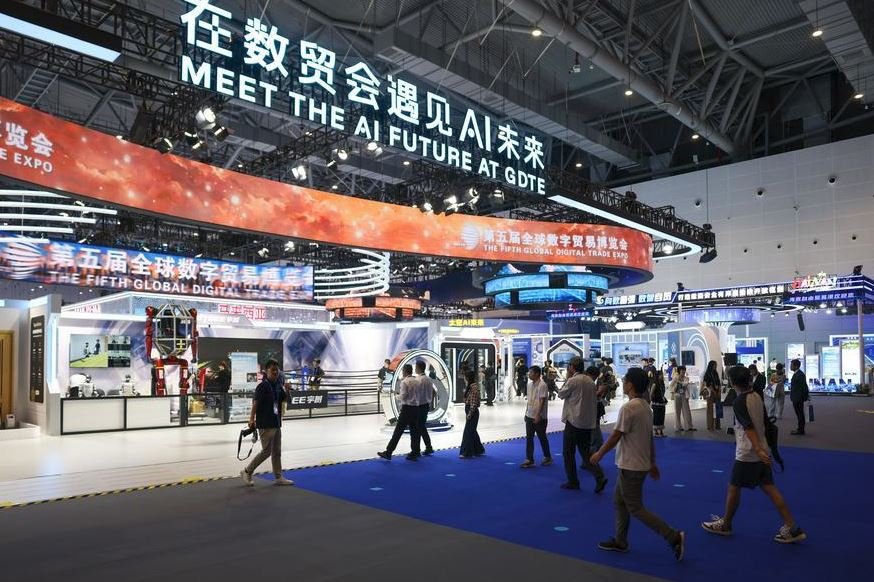
HANGZHOU, September 27 — Tesla’s fully autonomous Cybercab, AI-powered smart glasses and new business automation tools were among the technologies showcased at the fifth Global Digital Trade Expo in Hangzhou, highlighting the growing role of artificial intelligence in global commerce.
Held from September 23 to 27 in Hangzhou, Zhejiang Province, the Global Digital Trade Expo 2026 attracted more than 50,000 participants from 163 countries and regions. More than one-third of exhibitors focused on artificial intelligence, while international companies accounted for over 20 percent of exhibitors.
The five-day event covered 170,000 square metres and brought together technology companies, policymakers and business representatives as China seeks to expand international cooperation in digital trade.
Tesla Cybercab showcases autonomous driving
Tesla returned to the expo for a fifth consecutive year, this time displaying its two-seat Cybercab.
Designed without a steering wheel, pedals or rearview mirrors, the autonomous vehicle features butterfly doors and a large interactive touchscreen. It uses cameras and sensors to navigate without direct human control.
The vehicle was among a range of AI-based technologies displayed across areas including transportation, consumer electronics, business services and urban management.
AI moves deeper into everyday applications
Merit Interactive unveiled MUMO, an urban traffic large model combining high-resolution satellite imagery with ground-level traffic data.
According to company CEO Fang Yi, traffic authorities can use the technology to simulate different traffic signal arrangements and compare queue lengths and road capacity before adjusting signal-control plans.
Consumer technology company Rokid introduced its second-generation AI glasses, offering features including real-time navigation, instant translation and photography.
Alibaba also showcased Accio Work, an AI agent platform designed to automate business tasks. According to figures presented at the expo, more than 10 million small and medium-sized enterprises worldwide use the platform, with its user base growing more than 30-fold over the past year.
China targets bigger share of digitally delivered services
China has been expanding its digital trade sector as AI, cloud computing and other technologies reshape how services are produced and delivered internationally.
Under guidelines issued in November 2024, China aims for digitally deliverable services to account for more than 45 percent of its total services trade by 2029 and more than 50 percent by 2035.
This year’s expo also recorded an increase in international participation, with the number of overseas pavilions exceeding the combined total of previous editions.
Token economy emerges as new expo focus
A token-themed exhibition zone made its debut at the 2026 event, reflecting the rapid expansion of generative AI applications.
Tokens are basic units used by AI models to process information, and demand for them has increased alongside wider adoption of AI systems and autonomous agents.
Data presented by China’s National Data Administration showed that daily token calls nationwide had surpassed 140 trillion by March 2026, compared with around 100 billion at the beginning of 2024.
The dedicated zone featured computing infrastructure, large AI models including Qwen and DeepSeek, and smart hardware.
Organizers said token-based services could allow computing resources and AI capabilities to be measured and traded according to usage, potentially creating new forms of digitally delivered services.
China-Arab digital projects worth $255 million signed
The expo also served as a venue for international business and policy discussions.
More than 200 participants attended the China-Arab AI International Cooperation and first China-Arab Digital Dialogue, where seven cooperation projects valued at $255 million were signed.
The agreements covered areas including robotics and smart manufacturing.
The event also hosted discussions on cooperation among BRICS special economic zones. The number of Chinese enterprises recording trade with other BRICS members exceeded 300,000 in 2025, an increase of 8.8 percent from the previous year.
China established the China Center for Cooperation on Special Economic Zones in BRICS Countries in Hangzhou in 2025 to facilitate cooperation and knowledge sharing.
UN Trade and Development acting secretary-general Pedro Manuel Moreno said digital trade should remain open, fair and focused on development, with investment in connectivity, skills and rules that support innovation while protecting competition and consumers.
He also welcomed the expo’s role in promoting international dialogue and practical cooperation on digital trade.