
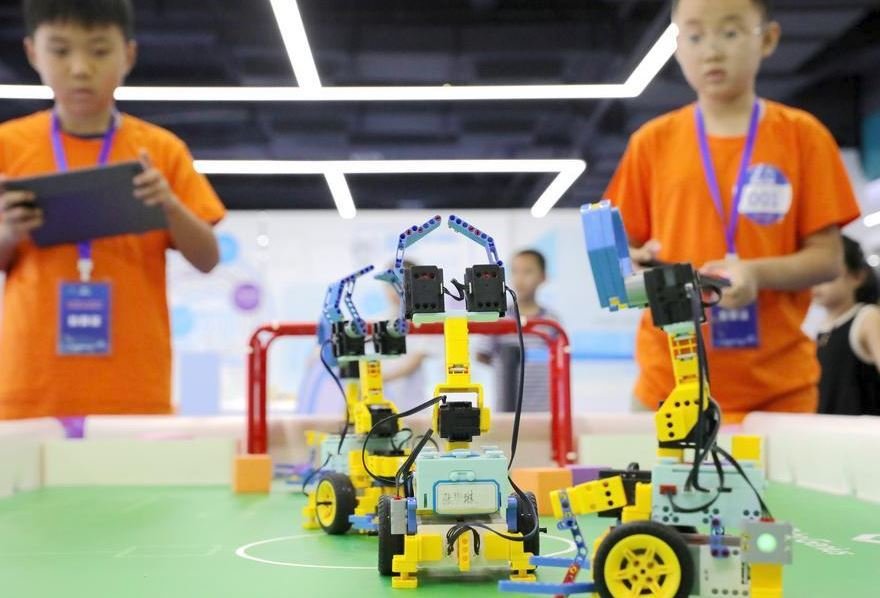
BEIJING: AI study tours are gaining momentum across China as students spend their summer holidays visiting technology companies, university laboratories and science centres to gain hands-on experience with artificial intelligence and robotics.
Bookings for AI-themed study tours rose 370 per cent year on year during this summer vacation, according to online travel platform Ctrip, reflecting growing interest among families in exposing children to emerging technologies outside the classroom.
At a science centre in Jiaxing, Zhejiang Province, children recently watched robots compete in soccer matches while others assembled machines of their own. Nine-year-old Zhang Qihang said the activity allowed him to experiment with ideas and build something independently.
The rise in AI-focused educational travel comes as artificial intelligence becomes increasingly visible in daily life across China, particularly among younger users familiar with domestic platforms such as DeepSeek, Kimi and Doubao.
China’s AI sector has expanded rapidly in recent years. The number of AI enterprises in the country surpassed 6,000 last year, while the output value of the core AI industry was projected to exceed 1.2 trillion yuan, or about $177 billion, representing annual growth of nearly 30 per cent.
China was also home to more than 140 humanoid robot developers in 2025, according to an industry research report, with shipments reaching 14,400 units and accounting for 84.7 per cent of the global market.
AI learning moves beyond the classroom
China introduced an “AI Plus Education” initiative earlier this year, encouraging schools to expand artificial intelligence learning through after-school programmes, practical activities and other forms of experiential education.
The initiative is aimed at helping students understand how AI works and use it responsibly, while strengthening creativity, critical thinking and problem-solving skills.
Primary and secondary schools are increasingly incorporating AI-related visits and study programmes into their educational activities, while parents are also taking children to technology companies and innovation centres to see how artificial intelligence is being applied in the real world.
Travel agencies have responded by expanding technology-focused itineraries. Zhu Ping, founder of a Nanjing-based travel agency, said AI-related activities now account for more than 80 per cent of its Shanghai-Hangzhou independent study tours.
China’s technology tourism sector is also attracting overseas visitors interested in robotics and other emerging technologies.
Since opening in Shanghai in May, Unitree Robotics’ first embodied intelligence experience store in Asia has drawn international visitors. Victoria, a visitor from Denmark, said seeing robots in person offered a different perspective from watching demonstrations online.
From AI users to AI creators
For many students, the purpose of these programmes is shifting from simple exposure to deeper participation.
Liang Yiduo, a middle school student from Beijing, said an AI summer camp run by internet company NetEase changed his understanding of large language models.
He said he had previously viewed them mainly as chatbots but came to see them as tools that could assist users in building customised applications and AI agents.
Wang Lijin, director and founder of Beijing Venus Future Education Consulting Center, which assists NetEase in running study camps, said the programmes are designed to help children move from merely using AI to understanding and creating with it.
Some organisers are tailoring courses to students’ interests and abilities.
Shanghai Qingbao Robot Co., Ltd., for example, allows students interested in engineering to assemble robotic arms and study the mechanics of shoulder and neck structures. The programmes also compare robotics and AI industries in China, the United States, Europe and Japan.
Company chairman Wang Lei said immersive study tours can help students think more independently about practical applications of robotics, including unmanned retail and automated pharmacies.
In Shenzhen, another group of students recently spent six days developing an AI-powered product based on real-world problems.
One participant said the experience had changed the way he viewed artificial intelligence, shifting his focus from simply demonstrating technical skills to using AI to solve problems for others.
The rapid growth of AI study tours reflects a broader effort in China to familiarise younger generations with emerging technologies while giving students practical exposure to the industries shaping the country’s digital economy.