
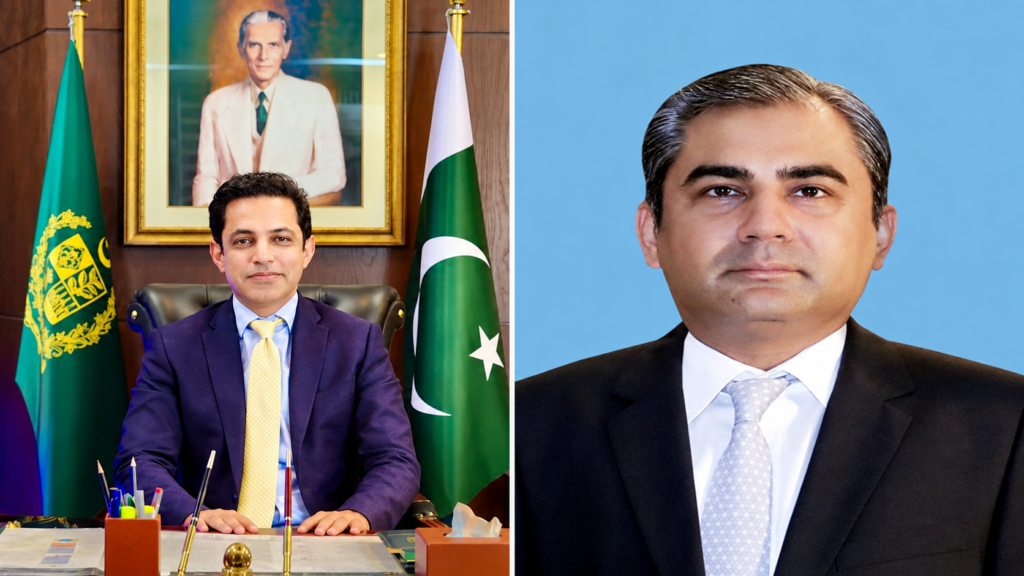
ISLAMABAD — The Capital Development Authority has intensified work on road infrastructure, landscaping, civic services, encroachment control and public-space management as part of a broader effort to improve Islamabad’s urban environment.
The initiatives are being pursued under the policy direction of Interior Minister Mohsin Naqvi and the administrative supervision of CDA Chairman Sohail Ashraf, with the authority focusing on both development projects and day-to-day municipal management.
The broader objective is to improve mobility, public spaces, sanitation, green areas and regulatory enforcement while preserving Islamabad’s planned character.
Road and Infrastructure Upgrades Remain a Priority
CDA is focusing on improvements to major roads and urban infrastructure, including development work along the Islamabad Expressway East corridor.
The authority’s priorities include better road surfaces, traffic management, drainage, pedestrian facilities and road safety.
Officials have also stressed the importance of completing projects on schedule and ensuring construction quality so that infrastructure improvements deliver long-term benefits rather than short-term fixes.
Green Belts, Parks and Landscaping in Focus
Islamabad’s tree-lined roads, green belts and landscaped public spaces remain central to the city’s identity, and horticulture has been identified as a key part of the beautification drive.
CDA’s work includes maintenance of parks and green belts, plantation, improvement of road medians and restoration of neglected public spaces.
The authority is also seeking to balance new development with environmental protection, particularly in areas where urban expansion could affect existing green cover.
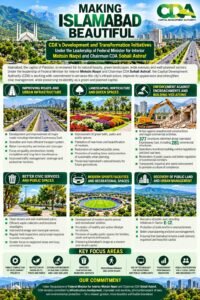
Action Against Encroachments and Building Violations
CDA has also continued enforcement against unauthorised structures, illegal commercial activity and land-use violations.
Action against identified structures along Islamabad Expressway East forms part of the authority’s broader building-control and anti-encroachment efforts.
The stated aim is to reclaim public space, improve traffic flow and ensure compliance with planning regulations.
At the same time, consistent enforcement, legal process and transparent procedures remain important to ensuring that regulatory action is seen as fair and credible.
Civic Services and Public Spaces Under Review
Beyond large development schemes, the authority is also focusing on routine municipal services such as sanitation, waste collection, streetlighting, drainage maintenance and upkeep of public spaces.
Regular field inspections, improved departmental coordination and faster responses to citizen complaints are being treated as important tools for improving service delivery.
Greater attention is also being placed on commercial areas and neighbourhoods where poor maintenance has a direct impact on residents and visitors.
Focus on Coordination and Accountability
The administration has emphasised closer coordination among CDA departments to improve implementation and reduce delays.
Regular project monitoring, clearer performance targets and stronger accountability are expected to play a greater role in tracking progress.
The authority is also looking at wider use of technology for project monitoring, complaint management and service delivery.
Long-term priorities include completion of development projects on schedule, protection of green areas, stronger enforcement of land-use rules, better sanitation and drainage, safer pedestrian infrastructure and improved public reporting on performance.
Officials maintain that sustained improvement will require not only administrative action but also cooperation from residents, traders and businesses in protecting public spaces, complying with building regulations and maintaining cleanliness.
The effectiveness of the current drive will ultimately be judged by visible improvements in road quality, green spaces, municipal services, regulatory compliance and the overall liveability of the capital.