
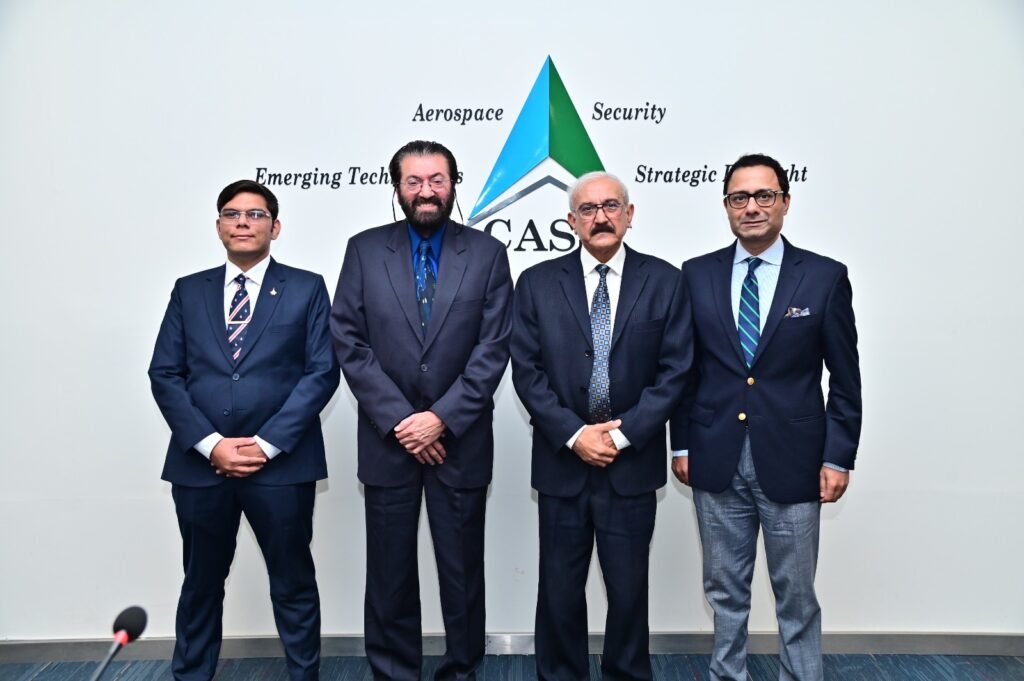
The Centre for Aerospace & Security Studies (CASS) has highlighted the importance of institutional reforms, constitutional adherence and effective governance in addressing Pakistan’s persistent economic challenges and ensuring sustainable national development.
The issues were discussed during a Catalyst Conversation titled “Institutions, Governance, and Economic Growth in Pakistan,” organised by CASS on November 24, 2026. The session examined the relationship between political and economic institutions, national prosperity, economic performance and political stability.
Moderating the discussion, Dr Aqdas Afzal, Director CASS, highlighted the role of institutional structures in shaping Pakistan’s economic trajectory. He drew attention to the country’s recurring boom-and-bust economic cycles, policy discontinuity and challenges to institutional autonomy.
He emphasised the need to examine how institutional arrangements influence economic stagnation and political instability, particularly as Pakistan continues to face structural challenges affecting long-term economic growth.
Delivering the keynote address, former Higher Education Commission (HEC) Chairman Dr Tariq Banuri discussed the evolution of economic thinking regarding the factors responsible for prosperity and poverty among nations.
He observed that economic growth was largely attributed to functional markets before the 1980s. However, subsequent economic research increasingly recognised the central role of institutions in determining development outcomes.
Referring to Pakistan’s historical experience, Dr Banuri said the colonial legacy of extractive institutions had hindered meaningful reforms and contributed to persistent governance challenges.
He stressed that introducing new policies alone would not ensure economic prosperity unless accompanied by fundamental changes in institutional culture and governance practices.
Dr Banuri also emphasised the importance of constitutional supremacy, stating that all state institutions must uphold the 1973 Constitution. He advocated adherence to the Constitution without amendments and identified accountability as an essential requirement for improving institutional effectiveness.
He maintained that good governance remained fundamental to economic development, underscoring the need for institutions capable of supporting economic progress and political stability.
In his concluding remarks, President CASS, Air Marshal Javaid Ahmed (Retd), emphasised that strong and effective institutions were essential for sustainable economic development and national stability.
He called for realistic and carefully sequenced institutional reforms, supported by effective leadership, to restore public confidence and strengthen governance.
He further stressed the importance of creating an enabling environment for inclusive and sustained economic growth through institutional improvements and responsible leadership.
The discussion reinforced the significance of institutional capacity, accountability and governance reforms in addressing Pakistan’s long-standing economic challenges.
CASS, an independent think tank, regularly organises policy discussions and expert forums to promote informed debate on important national and international issues.