
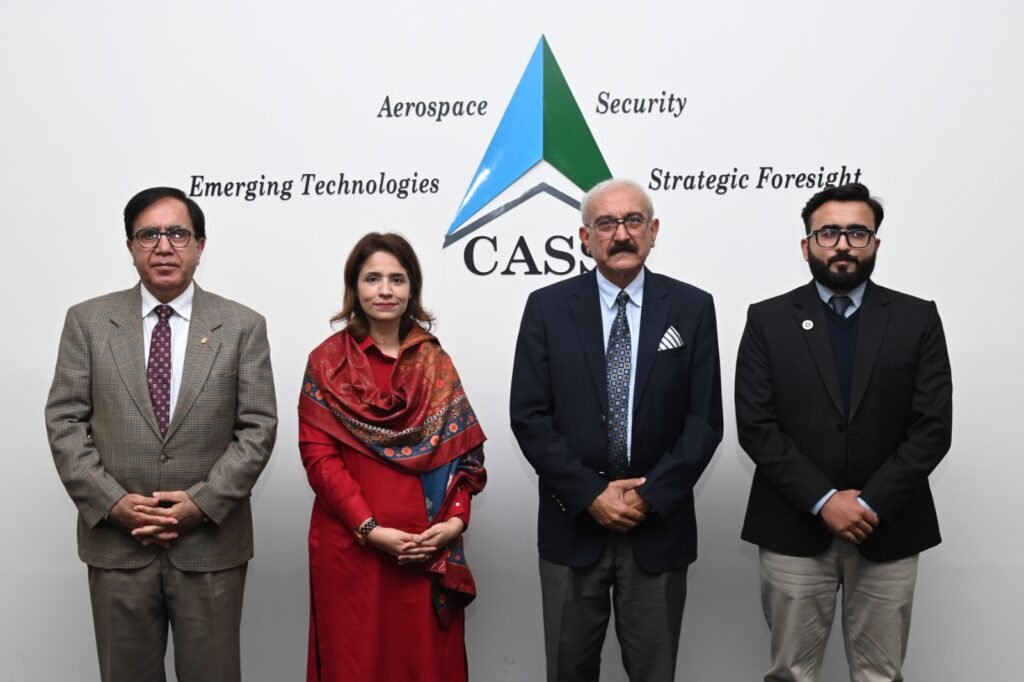
ISLAMABAD: The Centre for Aerospace and Security Studies (CASS) has called for a comprehensive and sustainable approach to Afghanistan’s evolving political, security and economic challenges, emphasising sustained diplomatic engagement and a broader policy framework to promote regional stability.
The recommendations emerged during a Catalyst Conversation organised by CASS on November 17, 2026, titled “Afghanistan, A Decade Ahead: Stability, Fragmentation or Strategic Reorientation? Implications for Pakistan & the Region.”
The session examined Afghanistan’s evolving domestic and regional dynamics, possible developments over the next decade and their implications for Pakistan and regional security.
Addressing Pakistan-Afghanistan Security Challenges
Moderating the discussion, CASS Director Air Vice Marshal Khawar Hussain (Retd) highlighted the gap between Pakistan’s expectations following the Taliban’s return to power in August 2021 and the subsequent deterioration in bilateral relations.
He highlighted persistent security concerns, particularly the threat posed by the Tehreek-e-Taliban Pakistan (TTP), and stressed the importance of assessing diplomatic, security and regional policy responses within a broader strategic framework.
Experts Advocate Comprehensive Bilateral Framework
Delivering the keynote address, Dr Amina Khan, Director of the Centre for Afghanistan, Middle East and Africa (CAMEA) at the Institute of Strategic Studies Islamabad (ISSI), examined Afghanistan’s domestic political and security dynamics alongside its regional relationships.
She observed that the Taliban administration had demonstrated selective pragmatism in domestic governance and service delivery, particularly through agricultural and economic reforms. However, she noted that significant shortcomings persisted in human rights, particularly women’s rights.
Dr Khan also identified gaps in Pakistan’s policy approach towards Afghanistan and emphasised the need for a comprehensive bilateral framework addressing outstanding security issues and economic cooperation.
She argued that the Doha Agreement should be regarded as an internationally binding instrument rather than merely a bilateral arrangement, particularly concerning commitments to prevent Afghan territory from being used by terrorist groups against other countries.
Drawing parallels with Iran and India’s engagement with Afghanistan, she underscored the importance of sustained diplomacy, noting that reliance on hard power alone could not deliver lasting solutions.
CASS Stresses Continued Policy Dialogue
In his concluding remarks, CASS President Air Marshal Javaid Ahmed (Retd) emphasised the importance of sustained diplomatic engagement with Afghanistan while accounting for its evolving political and security landscape.
He called for continued intellectual and policy engagement on these challenges, reaffirming the think tank’s commitment to providing an independent platform for informed discourse on national and international security issues.