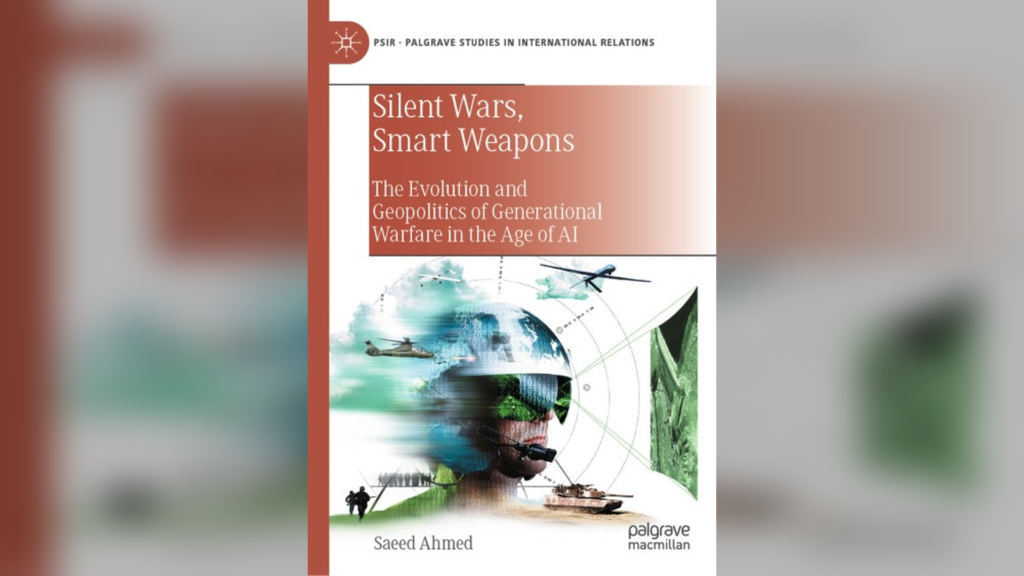
In Silent Wars, Smart Weapons, Saeed Ahmed traces the evolution of warfare from Napoleonic battlefields to artificial intelligence, revealing why the struggle for global power increasingly extends into information, human cognition, and technological sovereignty—with profound implications for South Asia.
Book Review | Books & Ideas
Book: Silent Wars, Smart Weapons: The Evolution and Geopolitics of Generational Warfare in the Age of AI
Author: Dr. Saeed Ahmed
Publisher: Palgrave Macmillan, 2026
For decades, South Asia’s security calculations have revolved around familiar questions: military strength, territorial disputes, nuclear deterrence, and the shifting balance of power between India, Pakistan, and China. But what happens when the instruments of warfare begin to move beyond borders, conventional arsenals, and even human decision-making?
This question gives particular regional relevance to Saeed Ahmed’s Silent Wars, Smart Weapons, an ambitious scholarly work that challenges readers to reconsider what constitutes war in an age increasingly shaped by artificial intelligence.
Published by Palgrave Macmillan under its Studies in International Relations series, the book offers considerably more than another account of technological innovation in military affairs. Ahmed constructs a historical and theoretical narrative tracing warfare through six generations, examining how the pursuit of power has evolved alongside changes in political institutions, industrial production, communication and human consciousness.
The journey begins with the disciplined armies of the Napoleonic era, moves through the industrial devastation of the two world wars, and examines the unconventional conflicts that exposed the limitations of conventional military superiority. It eventually reaches the digital battlefield, where algorithms, disinformation, predictive technologies and artificial intelligence are transforming the conduct of geopolitical competition.
What distinguishes Ahmed’s analysis is his argument that technological change does not simply produce new weapons. It also transforms the political and social structures through which power is exercised.
The book’s discussion of fifth-generation warfare is especially relevant to contemporary South Asia. Cyber operations, information manipulation, psychological influence and contested narratives can become strategic instruments capable of undermining trust and political stability without conventional military confrontation.
Ahmed pushes the argument further through his conception of sixth-generation warfare, where intelligent systems may increasingly influence perception, strategic judgement and the processes through which societies understand reality.
For a region accustomed to measuring deterrence through missiles, aircraft and nuclear capabilities, this conceptual shift deserves attention. Military preparedness may remain indispensable, but it cannot alone guarantee resilience against digital disruption, manipulated information or vulnerabilities in critical technological infrastructure.
The book’s geopolitical chapters provide another compelling dimension. Through detailed examinations of the United States, China and Russia, Ahmed explores how different strategic traditions are adapting to algorithmic power.
American technological and infrastructural dominance, China’s integration of economic influence with cognitive and information strategies, and Russia’s emphasis on disruption and reflexive control reveal a changing international order in which military capabilities increasingly intersect with digital ecosystems.
For Pakistan, situated at the crossroads of Chinese strategic partnerships, American global influence and longstanding regional tensions, these competing architectures carry implications that extend beyond conventional foreign policy.
The question is no longer simply which great power possesses superior technology, but how dependence on foreign-controlled digital infrastructure may shape a country’s strategic autonomy.
Ahmed’s treatment of quantum technologies adds another provocative layer. His exploration of quantum communication, computing and strategic uncertainty suggests that future technological breakthroughs could challenge established assumptions about intelligence, deterrence and decision-making.
These possibilities remain unevenly developed and, in important respects, speculative. Yet the book makes a persuasive case for examining their potential consequences before they become entrenched features of international competition.
Perhaps its most important contribution, however, is the attempt to reconnect strategic thinking with moral responsibility.
Through an interdisciplinary framework combining realism, idealism, constructivism and AI-centred cognitive theory, Ahmed challenges the assumption that technological superiority necessarily constitutes strategic wisdom.
His proposed concept of Epistemic Humanism places human judgement, accountability and cognitive freedom at the centre of an increasingly automated world.
This ethical dimension is particularly significant for South Asia, where miscalculation, misinformation and political mistrust can have consequences far beyond the immediate parties to a dispute.
The book is not without intellectual challenges. Its extensive theoretical vocabulary and ambitious generational classifications demand careful reading. Some propositions concerning autonomous cognitive systems and future quantum-enabled conflict require further empirical testing.
Nevertheless, these questions do not diminish the value of its central contribution: offering readers a broader framework through which to understand how technology, political authority and warfare are evolving together.
For scholars, policymakers and military strategists, Silent Wars, Smart Weapons offers an important invitation to rethink the foundations of security. For a wider readership, it provides a sobering reminder that the future of conflict cannot be understood solely by counting weapons or comparing military expenditures.
South Asia may continue to confront its historical disputes, but the technological transformation of international power is creating new vulnerabilities that traditional security thinking cannot afford to overlook.
Ahmed’s book ultimately leaves readers with an unsettling possibility: the most consequential battles of the future may not be fought over territory alone, but over the information, intelligence and human judgement upon which sovereignty itself depends.
The book can be viewed here: https://link.springer.com/book/10.1007/978-3-032-16585-5
Beyond Borders and Bombs: A New Book Rethinks the Future of War in the Era of Artificial Intelligence