
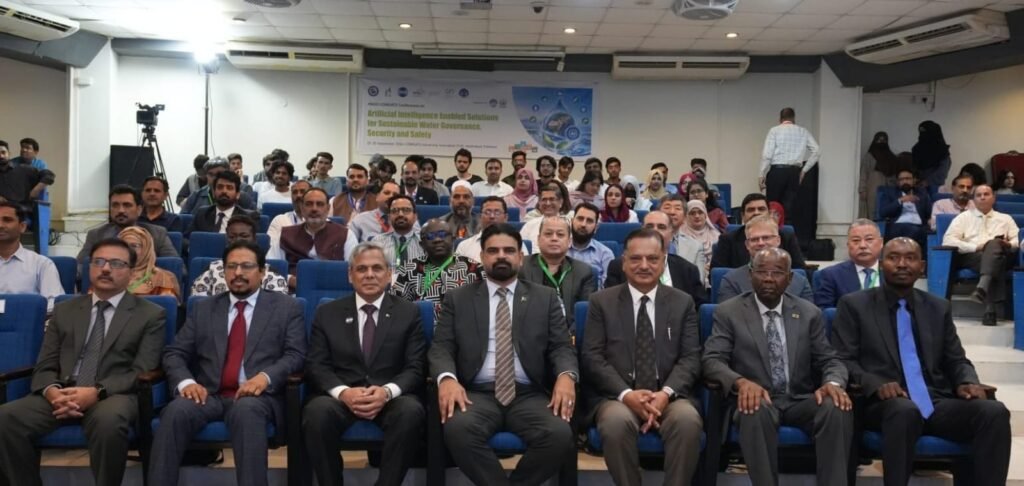
ISLAMABAD, Tuesday, September 22, 2026: A four-day international conference exploring how artificial intelligence can help tackle water scarcity, climate pressures and sustainable water management opened in Islamabad on Tuesday, bringing together experts from Pakistan and several other countries.
The “ANSO–COMSATS Conference on Artificial Intelligence Enabled Solutions for Sustainable Water Governance, Security and Safety” is being organised by the Commission on Science and Technology for Sustainable Development in the South (COMSATS) under a scientific activities grant scheme of the Alliance of National and International Science Organizations for the Belt and Road Regions (ANSO).
Hosted at COMSATS University Islamabad (CUI), the conference has been endorsed as an official activity of the International Decade of Sciences for Sustainable Development (IDSSD) 2024–2033, led by UNESCO.
The event is being held in collaboration with the Xinjiang Institute of Ecology and Geography of the Chinese Academy of Sciences, Egypt’s National Research Centre, Pakistan’s Global Change Impact Studies Centre and the Pakistan Council of Research in Water Resources.
Rana Ahmad Atteeq Anwer, Coordinator to the Prime Minister for Science and Technology and IT and Telecom, inaugurated the conference as chief guest.
Addressing the opening ceremony, Anwer warned that water systems were coming under unprecedented pressure from climate change, rapid urbanisation, industrial expansion, population growth and pollution.
Referring to Pakistan’s devastating 2022 floods, he said developing countries were increasingly confronting a combination of extreme weather, prolonged droughts, groundwater depletion and deteriorating water quality.
He highlighted the government’s water-security agenda, including implementation of the National Water Policy, water harvesting and other sustainability measures, while calling for a cohesive national approach to addressing Pakistan’s water challenges.
AI Seen As Tool To Tackle Water Challenges
COMSATS Executive Director Ambassador Dr Mohammad Nafees Zakaria said the conference had strategic significance given growing water-related challenges around the world.
He said artificial intelligence could serve as a transformative tool in tackling water-related problems and noted that the conference directly supported Sustainable Development Goal 6, which focuses on clean water and sanitation.
The four-day programme includes technical presentations, hands-on training involving AI tools, panel discussions and technical visits.
Zakaria also paid tribute to Nobel laureate Prof Abdus Salam for his vision behind COMSATS.
COMSATS University Islamabad Rector Prof Dr Raheel Qamar highlighted the growing importance of emerging technologies, including artificial intelligence and cloud computing.
He stressed that AI solutions should be developed and deployed within an ethical framework and retain meaningful human oversight.
Qamar also highlighted CUI’s digitalisation initiatives, including efforts to move towards a paperless working environment to conserve resources and reduce environmental impact.
International Experts Join Islamabad Conference
ANSO Deputy Executive Director Dr Zhijun Yi reaffirmed the organisation’s commitment to international scientific cooperation, joint research, capacity building and knowledge exchange for sustainable development.
He also expressed confidence in COMSATS’ scientific activities and acknowledged the contribution of partner institutions to the conference.
The inaugural ceremony was attended by Zimbabwe’s ambassador and senior diplomats representing COMSATS member states.
Experts from Bangladesh, Belgium, China, Egypt, Germany, Indonesia, Jordan, Jamaica, Nigeria, Saudi Arabia and Türkiye are participating in the conference.
More than 50 participants representing Pakistani organisations are attending in person, while over 100 participants are joining the proceedings online.
The conference aims to examine how AI, data-driven tools and international scientific cooperation can improve water governance, security and safety at a time when climate change is placing increasing pressure on water resources in Pakistan and other developing countries.