
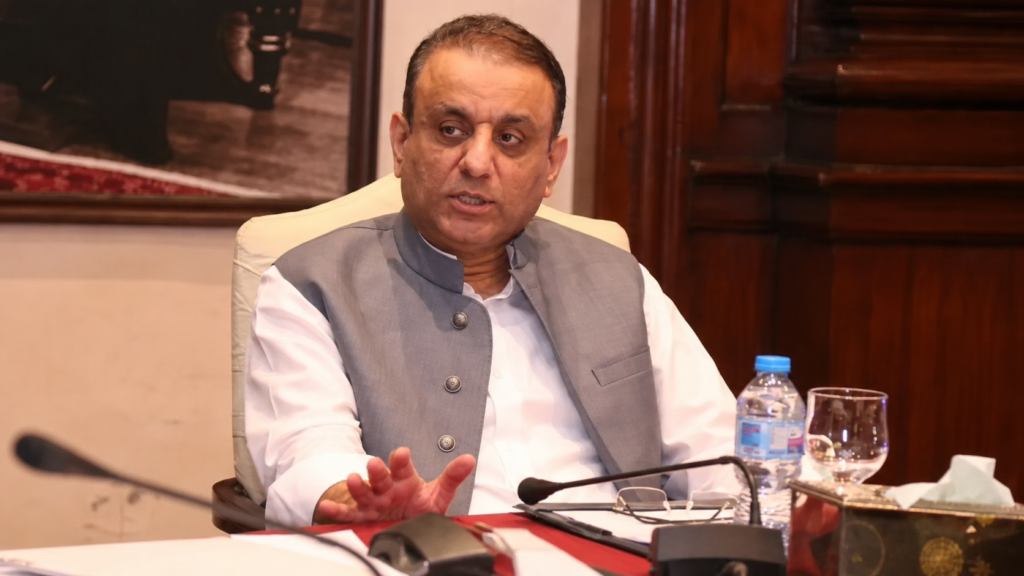
ISLAMABAD, November 20, 2026: Federal Minister for Communications Abdul Aleem Khan has called for stronger regional transport connectivity and alternative trade routes to strengthen supply chains and ensure uninterrupted trade amid global uncertainties.
Addressing virtually the United Nations Economic and Social Commission for Asia and the Pacific (ESCAP) Ministerial Conference on Transport, held in Bangkok from November 17 to 20, the minister emphasised the importance of facilitating the seamless movement of goods, people and services.
He said regional economies should develop alternative trade routes rather than depend on a single corridor or country, adding that removing trade barriers would strengthen regional supply chains.
Highlighting Pakistan’s strategic geographical position, Aleem Khan described the country as a natural bridge connecting Central Asia, South Asia, China and the Middle East.
He said Karachi Port, Port Qasim and Gwadar Port offered viable maritime access to landlocked Central Asian countries.
The minister highlighted the Quadrilateral Traffic in Transit Agreement (QTTA) as an important framework for regional cargo movement.
He said cooperation was underway on the Kazakhstan-Turkmenistan-Afghanistan-Pakistan railway project, while feasibility studies for the Uzbekistan-Afghanistan-Pakistan railway link were progressing.
Regarding road infrastructure, Aleem Khan said year-round operations of the Karakoram Highway had strengthened trade connectivity with China and Central Asia, while construction on the Thakot–Raikot section under the China-Pakistan Economic Corridor (CPEC) was advancing.
Pakistan has also secured funding from the OPEC Fund and the Islamic Development Bank for three sections of the M-6 Motorway, he added.
Discussing trade facilitation, the minister highlighted digital reforms introduced through the Web-Based One Customs (WeBOC) system and Pakistan Single Window (PSW).
He said modern facilities had been established at the Chaman and Torkham border crossings under the Central Asia Regional Economic Cooperation (CAREC) programme.
According to the minister, modern scanners and electronic gates are expected to reduce border clearance times by 65 percent, while passenger facilitation measures aim to reduce processing times by up to 90 percent.
Aleem Khan stressed that an integrated, safe and sustainable regional transport network was essential for economic resilience, regional stability and shared prosperity.