
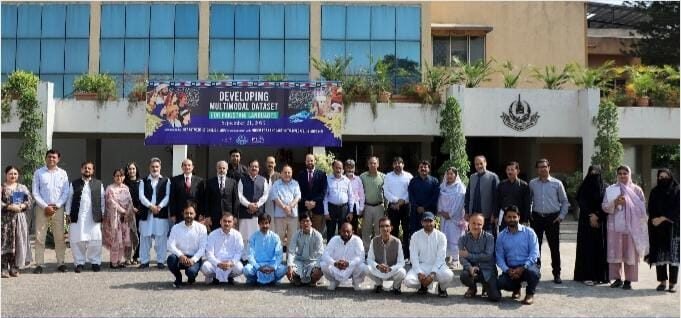
ISLAMABAD, Monday, September 21, 2026: Allama Iqbal Open University (AIOU) is advancing efforts to bring Pakistani languages into the artificial intelligence ecosystem through the development of multimodal datasets, with researchers warning that many local languages risk being left behind as AI technologies rapidly evolve.
The issue came under discussion at a one-day international workshop on the “Development of Multimodal Datasets for Pakistani Languages,” organised by AIOU’s Department of English in collaboration with the Forum for Language Initiatives (FLI).
Experts at the workshop stressed that high-quality linguistic datasets covering text, speech and other forms of language data are increasingly important for ensuring Pakistani languages can be effectively represented in AI systems and other emerging digital technologies.
Professor Dr Syed Amir Shah, Dean of the Faculty of Social Sciences and Humanities, chaired the inaugural session and said standardised multimodal datasets could provide a foundation for linguistic research, education and the development of language technologies.
He said such initiatives could help Pakistani languages gain greater representation in the digital world and adapt to rapidly changing technological requirements.
Fakhruddin Akhunzada, Executive Director of FLI, said around 80 languages are spoken across Pakistan, with many facing challenges to their long-term survival.
He said data for six Pakistani languages had already been collected under the project, while local communities were also being trained in language documentation and preservation techniques.
Dr Muhammad Kamal Khan, Chairman of AIOU’s Department of English, said multimodal data had been collected for Pashto, Punjabi, Hazaragi, Saraiki and other Pakistani languages.
The collected material, he said, would support linguistic research as well as potential artificial intelligence applications.
Dr Maisam Ali of Indiana University in the United States, the project’s principal investigator, said researchers had gathered extensive linguistic data within a relatively short period by combining teamwork with modern research methodologies.
He said the resulting dataset could contribute to the preservation and promotion of local languages while helping integrate them into future AI systems.
Dr Rashida Imran stressed that documenting Pakistani languages and creating standardised datasets had become increasingly important as AI-based technologies expand globally.
She said cooperation among universities, research institutions and local communities could help protect Pakistan’s linguistic heritage while ensuring local languages are represented in future technologies.
The initiative also highlights a broader challenge facing languages with limited digital resources. Modern AI and language technologies depend heavily on large, structured datasets, meaning languages with insufficient digital material can have weaker representation in tools such as speech recognition, translation and other language-based applications.
The workshop formed part of AIOU’s ongoing professional training programme and brought together researchers and language experts working on the intersection of linguistics, digital preservation and artificial intelligence.