
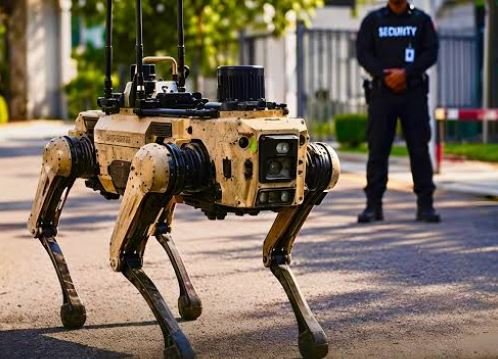
HANGZHOU: China’s Yiwu International Trade Market has deployed 16 robot dogs to patrol its vast trading complex, using the four-legged machines to monitor security, detect heat sources and reach areas that are difficult for human guards to inspect.
The robot security guards began operating last month at the market in Yiwu, Zhejiang Province, one of the world’s largest hubs for small commodities. The market covers more than 6.4 million square metres and contains tens of thousands of stalls, making routine patrols a demanding task.
According to the market’s management, the robots conduct both daytime and nighttime patrols and can automatically return to charging stations when their batteries run low.
A single quadruped robot can cover in about 1.5 hours an area that previously took human patrol staff around 2.5 hours to inspect, said Zhu Weijie from the market’s management company.
Robots use cameras and thermal imaging
The robots are equipped with high-definition cameras and infrared thermal imaging systems.
During the day, they can assist security teams in monitoring crowd movement. At night, the same systems can help identify unusual heat sources, including possible fires or intruders.
The machines are also designed to move across uneven surfaces, navigate narrow passageways and reach blind spots that may be harder for human personnel to inspect.
Market merchant Xu Yan said the robots had added another layer of security, beyond their novelty value.
Yiwu expands automation at global trade hub
Yiwu is widely known as a major sourcing centre for small goods sold around the world.
The city recorded foreign trade worth 836.5 billion yuan, or about $124 billion, in 2025, while its export value ranked first among China’s county-level regions.
Market management said data gathered from robotic patrols would also be used to improve recognition algorithms and strengthen coordination between robots and human security staff.
The deployment reflects a broader push in China to use robots for repetitive, physically demanding and high-risk tasks.
Earlier this year, Chinese authorities launched an action plan aimed at expanding real-world training for humanoid robots and embodied artificial intelligence across more than 100 high-value application scenarios.
Chinese-developed quadruped robots accounted for nearly 70% of global sales in the first half of 2026, according to the Ministry of Industry and Information Technology.