
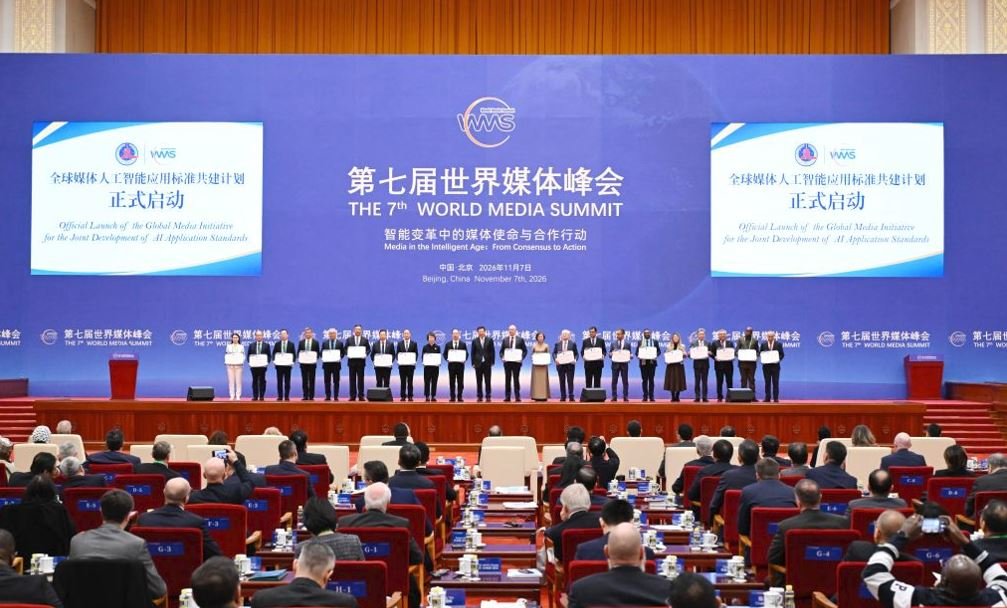
BEIJING, November 8, 2026: The 7th World Media Summit opened in Beijing on Saturday, bringing together nearly 500 representatives from 112 countries and regions to discuss artificial intelligence, digital transformation and the future of journalism.
Organised jointly by Xinhua News Agency and the Beijing municipal government, the summit is being held from November 5 to 9 under the theme “Media in the Intelligent Age: From Consensus to Action.”
Representatives from nearly 330 media organisations, think tanks, government institutions and international bodies, including the United Nations, are participating in the event.
Li Shulei, a member of the Political Bureau of the Communist Party of China (CPC) Central Committee and head of its Publicity Department, delivered a keynote address at the opening ceremony. Yin Li, secretary of the CPC Beijing Municipal Committee, also addressed participants.
The discussions focused on how artificial intelligence is transforming news production, distribution and verification, while creating challenges involving misinformation, data security and journalistic ethics.
Beijing Consensus calls for inclusive AI development
Delegates adopted the 7th World Media Summit Beijing Consensus, calling for international cooperation to support responsible and inclusive AI adoption across the global media industry.
The consensus emphasised that technological advances should benefit media organisations in both developed and developing countries, helping narrow digital and technological gaps.
Addressing the ceremony, Xinhua President Fu Hua urged media organisations to share AI technologies, applications and practical experience.
He stressed the importance of ensuring that media professionals worldwide have equitable access to the opportunities created by artificial intelligence.
AFP Chairman Fabrice Fries also called for broader access to AI technologies, warning against allowing the benefits of technological progress to remain concentrated among a limited number of companies or countries.
He encouraged cooperation among media organisations, governments, businesses and universities to develop a more diverse global information environment.
Fries also emphasised the importance of training AI systems on datasets representing different societies, cultures and perspectives.
Global media organisations launch AI standards initiative
A major development at the summit was the launch of the Global Media Initiative for the Joint Development of AI Application Standards.
Introduced by Xinhua, the initiative aims to establish common standards for responsible AI use in journalism, including information authenticity, data protection and professional ethics.
The initiative initially brings together 22 participating organisations, including Russia’s TASS News Agency, Malaysia’s Bernama, South Africa’s Independent Media, People’s Daily and China Media Group.
Participating organisations intend to develop and test AI application standards over approximately two years, alongside establishing a global database of AI applications in the media sector.
Xinhua Editor-in-Chief Lyu Yansong said artificial intelligence was rapidly reshaping news production but also increasing risks associated with misinformation and unethical technological practices.
He called for greater sharing of technological expertise, open-source models and training resources to help news organisations manage emerging challenges.
Global South seeks stronger digital cooperation
Representatives from developing countries highlighted the importance of international partnerships in strengthening digital journalism and improving access to advanced technologies.
Abdishakur Ali Ahmed, director of communication strategy at Somalia’s Ministry of Information, Culture and Tourism, said the summit offered opportunities to exchange experience and strengthen cooperation on digital transformation.
Mozambique’s senior information official Luis Alves do Rosario Canhemba similarly called for increased technological exchanges and cooperation to address AI-related risks.
Dejan Jazvic, editor-in-chief of the Federal News Agency of Bosnia and Herzegovina, welcomed efforts to establish common AI standards, stressing that technology should strengthen journalism rather than replace professional reporting or facilitate public manipulation.
Mohammed Alyami, Director General of the Union of News Agencies of the Organization of Islamic Cooperation, proposed an international framework for responsible journalism based on transparency, reliability and information verification.
He said media organisations must ensure that technological innovation supports public trust and strengthens journalism’s role in promoting mutual understanding.
Established in 2009, the World Media Summit serves as an international platform for cooperation among news organisations. Its previous edition was held in Urumqi, Xinjiang, in 2024.