
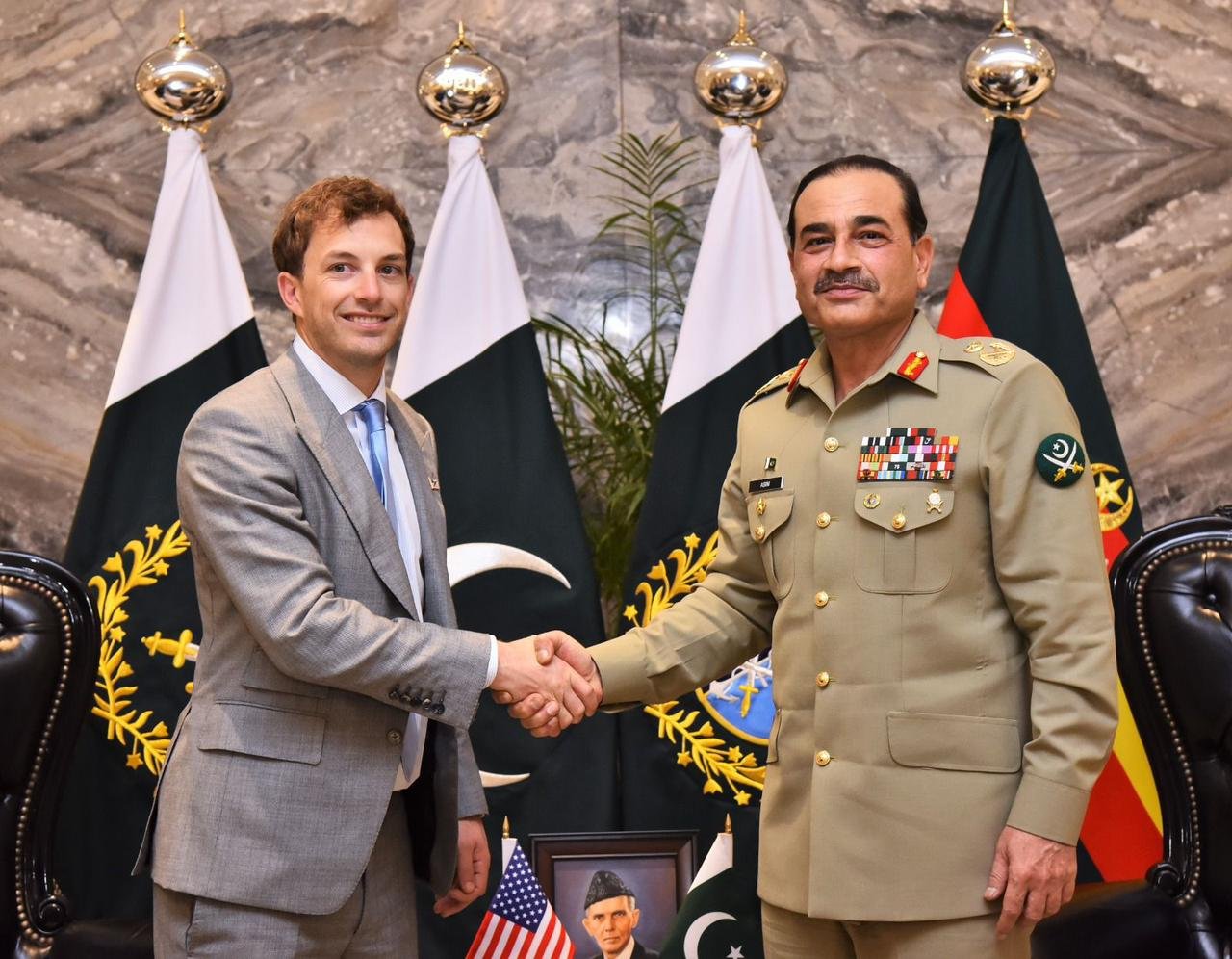
RAWALPINDI: A delegation from World Liberty Financial USA, led by its Chief Executive Officer Zachary Witkoff, met Chief of Army Staff and Chief of Defence Forces Syed Asim Munir on Tuesday, reflecting growing international interest in Pakistan’s fintech sector and evolving economic landscape.
According to ISPR, the meeting focused on Pakistan’s digital finance potential, financial inclusion initiatives, and opportunities for cross-border digital transactions. The visiting delegation highlighted Pakistan’s market size and reform trajectory, noting that technology-driven financial services could play a key role in supporting economic growth and integration with global payment networks.
The engagement follows Pakistan’s recent signing of a memorandum of understanding with SC Financial Technologies LLC, an affiliated entity of World Liberty Financial, aimed at developing digital payment architectures for cross-border transactions, including remittances, trade settlements, and foreign exchange flows. The agreement was witnessed by Prime Minister Shehbaz Sharif and Field Marshal Syed Asim Munir, underscoring the strategic importance attached to modernising the country’s financial infrastructure.
Pakistan signs digital payments MoU with World Liberty Financial
Officials have said the cooperation framework focuses on designing secure, transparent, and efficient payment systems, alongside technical collaboration, knowledge sharing, and regulatory-compliant innovation. The broader objective is to reduce transaction costs, improve payment speed, and strengthen confidence among international investors and financial institutions.
Field Marshal Syed Asim Munir welcomed the exchange of views and reiterated Pakistan’s commitment to economic stability, investor confidence, and fostering an environment conducive to responsible private sector participation in national development. He emphasized that sustainable economic progress required strong institutional coordination and adherence to national laws and international standards.
While the engagement does not involve a binding financial commitment, officials described it as part of Pakistan’s wider push to digitise payments, reduce reliance on cash, and strengthen financial transparency as the country positions itself within evolving global financial networks.




 Today's E-Paper