
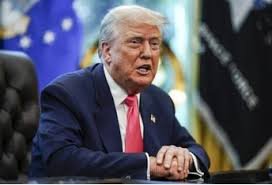
WASHINGTON: U.S. President Donald Trump has called on allied nations to help secure the Strait of Hormuz and warned that NATO could face a “very bad” future if partners do not contribute naval support to address disruptions along the key global shipping route.
Speaking to reporters aboard Air Force One, Trump said countries that rely heavily on energy shipments passing through the Strait of Hormuz should take a greater role in protecting it. The waterway is one of the world’s most critical maritime corridors, carrying a large share of global oil exports from the Gulf region.
Trump said the United States should not bear the main responsibility for securing the route when other countries depend more heavily on it for energy supplies. He specifically pointed to China, arguing that Beijing imports far more oil through the passage than the United States.
The U.S. president also warned that NATO allies should send warships to help ensure safe passage through the strait, saying the alliance could face a difficult future if partners fail to support such efforts.
Trump further suggested he could delay a planned summit with Chinese President Xi Jinping if China does not play a more active role in addressing the situation.
Energy analysts note that China has spent years diversifying its energy sources and building strategic reserves to reduce the impact of potential disruptions in key maritime routes.
Asked about Trump’s remarks on Monday, Chinese Foreign Ministry spokesperson Lin Jian reiterated Beijing’s position that all parties should immediately halt military operations and avoid further escalation that could destabilize the region and affect the global economy, according to the state news agency Xinhua.
Markets have been closely monitoring the developments. Oil prices hovered near the $100 per barrel mark on Monday, with U.S. West Texas Intermediate futures trading at $99.32 per barrel while the global benchmark Brent crude was priced at $104.84.
Also Read: Iran warns of oil blockade if attacks continue as Trump threatens stronger US response
The Strait of Hormuz connects the Persian Gulf to international waters and is widely regarded as a strategic chokepoint for global energy supplies, making any disruption to shipping there a major concern for global markets.



 Today's E-Paper