
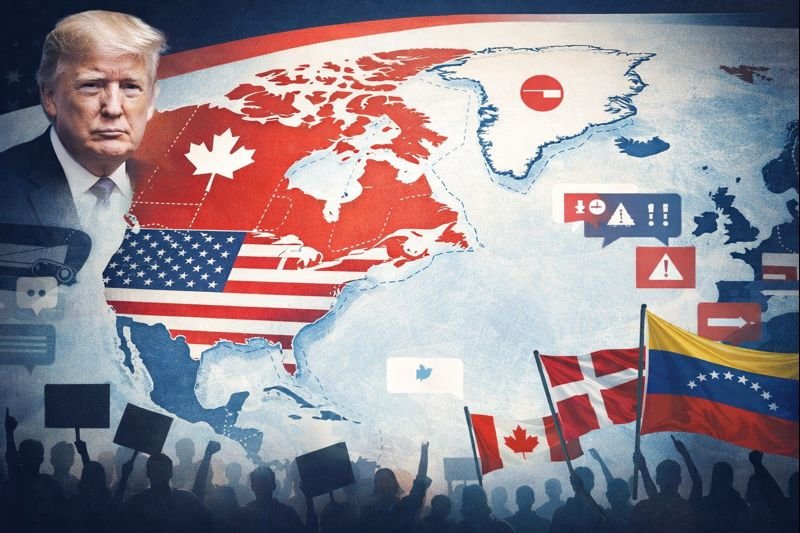
WASHINGTON: Former U.S. President Donald Trump has sparked international criticism after sharing digitally altered maps portraying Canada, Greenland, and Venezuela as part of U.S. territory, prompting swift reactions from foreign governments and renewed debate over U.S. geopolitical messaging.
The images, posted on Truth Social at 12:58 a.m. ET, showed Trump gesturing before a redesigned map of North America and symbolically planting a U.S. flag in Greenland alongside Vice President JD Vance and Secretary of State Marco Rubio.
The imagery reflects Trump’s long-standing interest in Greenland, which he publicly floated purchasing in 2019, as well as his repeated rhetorical references to Canada as the “51st state.” Venezuela’s inclusion aligns with the Trump administration’s previous sanctions and confrontational stance toward the country’s leadership.
Denmark moved quickly to reject any suggestion that Greenland’s status could be altered, reiterating that the island’s sovereignty is non-negotiable. Copenhagen also announced the deployment of additional troops to Greenland, citing security considerations. In Canada, several provincial leaders dismissed the posts as unserious and “absurd,” though Ottawa has yet to issue a formal response.
Also Read: Khamenei rebukes Trump as Iran protests intensify
In Latin America, the depiction of Venezuela reignited debate over Washington’s historical involvement in the region. Critics described the imagery as reflecting imperialistic overtones, while supporters characterized it as symbolic political messaging. Regional analysts warned that such portrayals could heighten diplomatic tensions across South America.
Greenland’s strategic location near emerging Arctic shipping routes and its rare earth mineral resources have increased its geopolitical importance amid growing competition between the United States, Russia, and China. Analysts noted that while the maps carry no legal or policy authority, they underscore continued strategic interest in contested regions.
Public reaction has been sharply divided, with critics accusing Trump of promoting expansionist rhetoric and supporters framing the posts as a display of strength. No official clarification has been issued by the White House regarding whether the images were intended as political symbolism or indicative of policy thinking.



 Today's E-Paper