
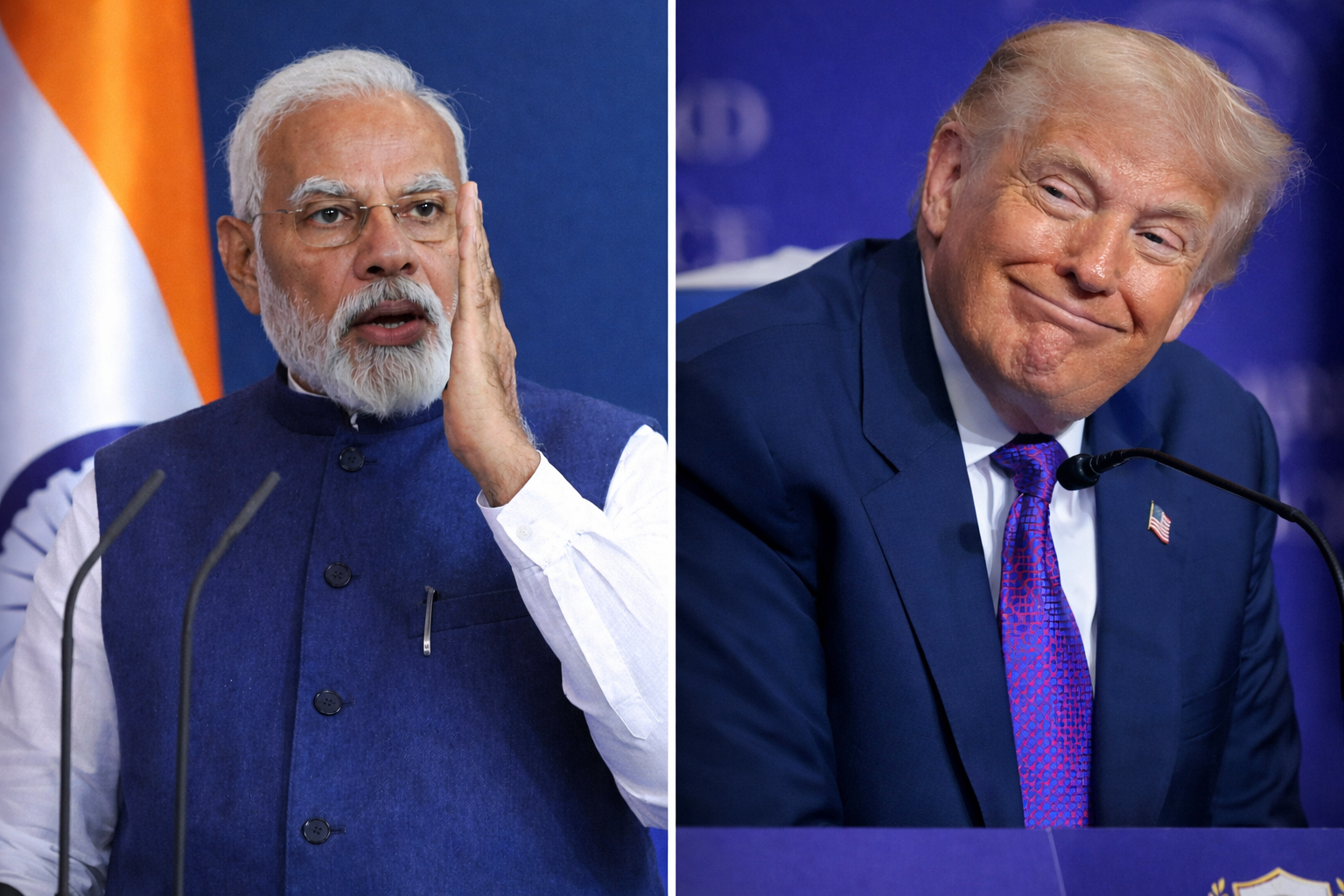
Washington, D.C. — U.S. President Donald Trump said during the inaugural Board of Peace meeting that he called Indian Prime Minister Narendra Modi during the 2025 India-Pakistan military escalation and told him the United States would impose a 200% tariff if a ceasefire was not reached.
Trump said the strategy “worked,” adding that nothing is more important than money, indicating that economic pressure was central to his approach. He presented the tariff leverage as a key factor in moving the situation toward de-escalation.
In the same address, Trump claimed that 11 jets were shot down during the confrontation, describing them as “very expensive” aircraft. He did not provide additional operational details in his remarks.
The 2025 escalation between India and Pakistan had drawn international concern due to the scale of cross-border exchanges and the risks associated with tensions between two nuclear-armed states.
India’s position
India has previously maintained that the ceasefire resulted from bilateral military engagement and established communication channels, and has not acknowledged third-party mediation in ending the escalation.
Trump’s remarks renew attention on Washington’s asserted diplomatic role during the crisis, particularly regarding the use of economic leverage in high-level discussions with New Delhi, even as India continues to emphasize bilateral mechanisms in resolving disputes.
Broader context: Board of Peace meeting
The comments were delivered at the first operational session of the Board of Peace in Washington on February 19. The initiative, introduced earlier this year at the World Economic Forum in Davos, has been positioned as a U.S.-led multilateral platform aimed at coordinating conflict stabilization and reconstruction efforts, initially focused on Gaza.
During the meeting, Trump also announced a $10 billion U.S. contribution to support the Board’s initiatives, alongside additional pledges from participating countries for humanitarian and rebuilding efforts.
Trump praises Shehbaz Sharif, Asim Munir at first Board of Peace meeting, announces $10B US pledge
Discussions included the potential formation of a multinational International Stabilization Force, though no immediate deployments were confirmed.
The inaugural session brought together leaders from several countries and placed regional security, reconstruction financing, and diplomatic coordination at the center of discussions. As the framework moves toward implementation, questions remain regarding governance structures, oversight mechanisms, and coordination with existing international institutions.




 Today's E-Paper