

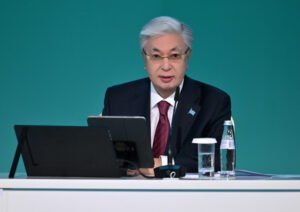
Distinguished participants,
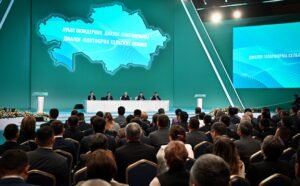
Today’s meeting, which has brought together representatives of executive authorities at all levels of our country, is of special significance. The overwhelming majority, 80 percent of akims of rural districts are present here. Overall, this is the first time we have convened in such a broad and inclusive format.
The topic of our discussion is indeed extremely relevant. The state of affairs in rural areas is a matter of strategic importance for Kazakhstan. The roots of our people lie in the village (aul). Strong villages are the foundation of the well-being and prosperity of the entire country.
For this reason, the requirements placed on rural akims and the responsibilities entrusted to them are always of particular importance.
An akim is, first and foremost, a public servant who works directly with society. This is an extremely responsible mission. A rural akim must be a truly competent professional, with a deep understanding of both the specific characteristics of the village and the needs and aspirations of its residents.
We have just heard presentations by several akims. The ideas and proposals expressed must be carefully studied and duly taken into account in our future work.
As you know, since 2019 Kazakhstan has been implementing large-scale political reforms. By fundamentally reshaping all spheres of life, our country has made a historic turn. First of all, we created a legal framework for profound transformations. Nearly 20 laws aimed at modernizing the political system have been adopted. Through a nationwide referendum, amendments to the Constitution were approved. The powers of Parliament have been expanded, the accountability of the executive branch strengthened, and the role of political parties has increased, accompanied by greater political activity.
The requirements for party registration have been significantly simplified, resulting in a larger number of political parties represented in the Mazhilis. New institutions have emerged within the system of governance. A Constitutional Court has been established, the Human Rights Ombudsman has been granted constitutional status, and cassation courts have begun operating.
Thus, we have embarked on the implementation of unique reforms unprecedented in the country’s political history. It can be stated with confidence that Kazakhstan is the only country in this political space that has undertaken reforms of such scale. As a result, our citizens now enjoy broader access to decision-making on matters of national importance.
As you are aware, in my 2020 Address to the Nation I proposed the introduction of direct elections of rural akims. This became a key step toward the fundamental modernization of the public administration system, as local akims constitute the backbone of the entire vertical of power.
We avoided excessive haste: the process of electing rural akims was carried out gradually over five years. Across the country, 2,334 rural akims were elected. Their average age is 43. One-third of the elected akims had not previously worked in the civil service. Elections in villages gave new momentum to the activities of political parties in the regions, which nominated candidates and actively participated in the electoral process. More than 1,500 representatives of political organizations were elected as akims, representing six different parties. In addition, more than 700 self-nominated candidates won elections.
The elected akims have assumed office, and overall the results can be described as positive. Most importantly, they are well aware of the needs, expectations, and unresolved problems of the local population.
Budget funds allocated for rural and regional development are now being utilized more effectively. Rural revenues are increasing, and dependence on state subsidies is declining. According to a recent sociological survey, 84 percent of rural residents trust their akims. This is a very strong indicator. Therefore, the process of electing rural akims will continue.
As for the elections of district akims, there are differing viewpoints. A number of public figures and active citizens have proposed revisiting the necessity of electing district akims. This issue has also been raised by members of Parliament led by Yerlan Sairov, Albert Rau, and Markhabat Zhaiymbetov. They point out that the number of elections in the country is becoming excessive and that citizens are growing weary of constant political campaigns. This position is also shared by residents of villages and districts.
There is also the view that electoral campaigns may hinder practical work on the ground. This perspective must be taken into account. To date, 52 district akims have been elected through elections. Their performance now requires careful analysis. We must weigh the advantages and disadvantages of the elective system for district akims. The issue is not the mandatory conduct of elections as such, but the achievement of tangible and positive outcomes.
The Government, together with Members of Parliament, must comprehensively review this issue and make a fair and well-balanced decision. The key principle is that every reform must be carried out prudently. As is well known, ongoing transformations are bringing entirely new personnel into the civil service.
In this context, special mention should be made of the Presidential Youth Personnel Reserve. Out of nearly 30,000 applicants, 450 individuals were selected, and 72 percent of them have been appointed to managerial positions. Personnel renewal is taking place across all branches and levels of government. This is a requirement of our time. However, such responsible work must not turn into political campaigning. Above all, public service must attract individuals capable of proposing effective solutions, advancing useful initiatives, and acting decisively, in other words, highly qualified professionals. We will continue this important work.
Dear akims,
The aul is the golden cradle of our unique civilization. The development of rural areas is our shared responsibility. The state approaches this issue with particular seriousness. As you know, rural development occupied a central place in my 2022 election program. After the presidential election, the very first decree I signed concerned rural development. Pursuant to this decree, the Concept for the Development of Rural Territories of the Republic of Kazakhstan for 2023-2027 was adopted, and concrete measures are currently being implemented.
Recently, we held the second Forum of Agricultural Workers, where pressing issues in this sector were discussed. Today, we will outline the key vectors for rural development. This is one of the strategic objectives facing the state.
In recent years, comprehensive efforts have been undertaken to improve the quality of life of rural residents. In 2022, a Comprehensive Plan to Increase Household Incomes was adopted. This year, the Government approved the Concept of Regional Development for the next five years. Significant investments have been mobilized to support rural areas. Since 2021, 864 primary healthcare facilities have been built, and 388 new schools have opened. Last year, nearly 2,000 rural schools were provided with high-quality internet access.
The potential of our villages continues to grow year by year. The number of rural settlements with a high level of self-sufficiency has increased. Over six years, gross agricultural output has grown by more than 1.5 times, reaching 8.3 trillion tenge. This year alone, the state allocated 1 trillion tenge to support farmers. Only a few countries in the world provide such extensive support to agriculture; in many states, such assistance is simply unavailable.
We have ambitious goals. The situation in rural areas must be improved through systematic and well-coordinated work. In this regard, I would like to outline several key priorities.
First. Rural akims must be competent professionals.
Nearly 60 percent of current rural akims were elected to office for the first time, reflecting a significant renewal of local governance. However, winning an election is only the beginning of serious work. Akims must demonstrate in practice that they are capable managers. As the saying goes, “The true calling of a leader is to serve the people.”
An akim must earn the trust of residents, work to improve their well-being, and guide them toward common goals. He or she must be able to implement national reforms at the local level. Therefore, it is essential to enhance the professional skills of rural akims in public administration.
Many of them have no prior experience in government service. To address this, the School of Akims project was launched at the initiative of the Amanat Party. However, short-term courses cannot replace higher education. The university program in public and local administration must be adapted to modern realities. Issues such as regional governance and leadership development also require greater attention. This work should be actively pursued by the Agency for Civil Service Affairs together with the relevant ministry.
Second. The powers of rural akims must be strengthened, but thoughtfully and effectively.
Local authorities have been gradually granted additional powers, increasing their autonomy. This is my principled position, as rural akims deal with many issues directly affecting people’s daily lives.
The Mazhilis is currently considering amendments to the Law on Local Public Administration and Self-Government. These amendments envisage expanding akims’ powers in areas such as monitoring street trade, improving public spaces, and acquiring specialized equipment. However, there remain vague provisions in legislation that limit akims’ ability to positively influence local governance.
Today, Akim Irina Shishkina raised the issue of rural akims lacking access to state databases. This matter must be addressed. Without such access, akims are unable to provide concrete answers to residents and may find themselves powerless in certain situations. This is unacceptable, it reflects a weakness of the state.
The division of responsibilities between different levels of local government remains blurred. I believe the powers of rural akims must be clearly defined. I ask Members of Parliament to take this into account, along with the proposals voiced today.
Certain non-core functions are currently imposed on rural akims. There is no justification for assigning to akims responsibilities that legally belong to law enforcement bodies. The Government, together with the Agency for Civil Service Affairs, must conduct a detailed analysis of redundant, non-core, and missing powers at the district and rural levels and submit proposals within one month.
The status of rural akims within the civil service system also requires attention. The Government, Parliament, and the Agency for Civil Service Affairs must comprehensively review this issue and present concrete proposals within one month.
Special attention should be paid to supporting staff of rural akimats. Work in local administrations is often a true “school of life” for public servants, as it develops real management skills and constructive dialogue with society. Improving working conditions and professional growth opportunities for these employees is essential.
Third. Along with expanding powers, the accountability of akims must be strengthened.
Current legislation does not establish accountability of akims to voters. This is incorrect. Akims must regularly report to residents on the implementation of their election programs. This requirement should be enshrined in law. Mechanisms must also be developed to terminate the powers of akims who fail to fulfill their promises or perform their duties properly.
Such measures will prevent unrealistic promises and populism, which undermine public trust not only in akims but in the electoral institution as a whole. The Government should establish clear requirements for the economic component of akims’ election programs and align them with regional development plans.
These steps will enhance accountability and increase the responsibility of political parties nominating candidates. I attach great importance to the concept of a “Listening State.” Every citizen’s appeal must receive a clear response. Most requests concern local infrastructure: roads, courtyards, and playgrounds, and must be addressed locally.
Akims must engage respectfully and patiently with citizens, maintaining open dialogue and resolving issues promptly and effectively. Criticism is a path to improvement, but decisions must be balanced and guided by national interests.
Fourth. The financial independence of fourth-level budgets must be increased.
The redistribution of powers and responsibilities must be accompanied by rational allocation of financial resources. Since 2018, revenues of rural budgets have quadrupled, exceeding 130 billion tenge. However, rural districts still depend on regional support.
A balanced approach is needed so that taxes are paid where economic activity takes place. The Government must ensure that at least part of these revenues remains at the local level. This issue should be linked to regional standards aimed at reducing disparities.
Digitalization is also crucial. A fully digital Kazakhstan cannot be built without rural areas. In the age of artificial intelligence, rural akims must be actively involved in this process. Achieving a fully digital country within the next three years is one of our most important goals, it is, without exaggeration, a matter of national survival.
Fifth. Special attention must be given to supporting rural business.
Agricultural cooperatives must be developed nationwide to ensure tangible benefits for rural residents. The Auyl Amanaty project has already created around 20,000 jobs, with 600 billion tenge allocated through 2029. Social-entrepreneurial corporations must become effective development institutions.
Infrastructure essential for rural business: livestock facilities, logistics centers, irrigation systems must be strengthened. The Government should prepare concrete proposals to give new impetus to the rural economy.
Distinguished participants,
Today we discussed key issues concerning rural development and outlined specific tasks. I am confident that with a systematic and high-quality approach, we will achieve our goals. Rural akims must lead this work. I would like to express my gratitude to Akim Zhanar Nurmuratkyzy for raising an important issue related to the Taza Kazakhstan initiative.
The primary mission of an akim is to improve the quality of life of the population. The well-being of each resident is the foundation of the prosperity of the entire village. The state will always support rural areas, as they are the backbone of our nation.
Peace and prosperity to our Motherland.
I wish you all well-being and success.
Astana
28/11/2025



 Today's E-Paper