
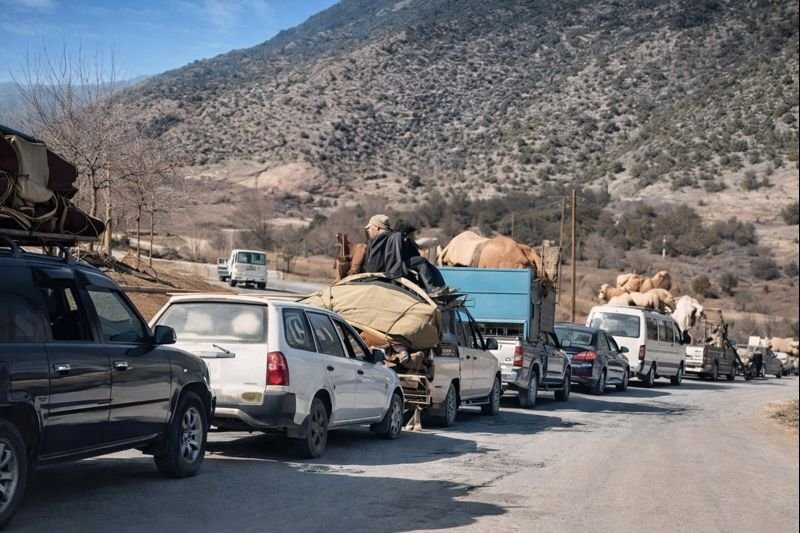
Tirah has emerged as a hotbed of terrorism with high-profile incidents due to its geographical advantages. Exploiting this terrain, a terror–crime nexus developed with alleged links to Afghan Taliban elements and narcotics networks. Over time, this nexus gained political backing, creating what officials describe as a political–terror–crime nexus operating in the area.
To eliminate terrorist presence, intelligence-based operations (IBOs) were conducted regularly. However, because militants were residing within populated areas, the risk of collateral damage became a serious concern.
Also Read: Temporary Evacuation in Tirah Based on Consensus, Not Military Operation Claims
To prevent harm to civilians, multiple meetings of local tribal jirgas were convened with the Tirah administration, where various options were discussed to clear the area of militant influence.
Local elders (mishrans) were given three months to propose a solution of their choice. During this period, they approached militants residing in Tirah and urged them to leave the area to avoid civilian casualties during anticipated security operations.
These requests were reportedly rejected, after which local elders approached the provincial government with the option of temporarily vacating their homes to allow security forces to conduct operations against militants.
Initial interactions with the local administration were followed by several jirgas at the provincial level. On December 26, 2025, local elders submitted their demands to the provincial government and agreed to vacate the area. Officials note that the jirga itself opted for displacement.
Following this decision, the provincial government approved Rs 4 billion for the displacement of Tirah residents. However, authorities allege that mismanagement of the sanctioned funds led to serious administrative issues, increasing hardship for affected residents.
Clarification on displacement and operations
Officials state that the army did not demand displacement. Rather, displacement was discussed as an option to prevent collateral damage, which was ultimately chosen by local elders.
An estimated 19,000 families from the Bagh Maidan area were identified for displacement. So far, around 65 percent of residents have relocated, while approximately 35 percent remain in Tirah.
Authorities further clarify that no timeline for displacement was set by security forces. The schedule was decided by local notables, taking into account factors such as the completion of the harvesting season.
Officials say large-scale military operations were never planned. Instead, the focus remains on intelligence-based operations, which they describe as a proven and effective method.
According to official data, 75,175 intelligence-based operations were conducted nationwide in 2025, resulting in the killing of 2,597 militants. Security forces have also enhanced surveillance and strike capabilities to support targeted operations.
Based on past experience, officials say large-scale operations often create humanitarian challenges for displaced populations. They add that no significant troop build-up has been observed in Tirah, reinforcing claims that large-scale operations are not underway. Severe weather conditions in the area also restrict such operations.
Authorities say the security approach in Tirah follows the Bagh Joint Action Plan, which combines security measures with development initiatives, law enforcement infrastructure, and socio-economic uplift to ensure lasting peace after the return of displaced families.
Political narrative
Officials accuse the provincial government led by Pakistan Tehreek-e-Insaf (PTI) of politicising the displacement issue and launching a campaign to criticise the federal government and the army.
They allege that despite the approval of Rs 4 billion, mismanagement of funds worsened the situation for displaced residents, which was later portrayed as a humanitarian crisis for political purposes.
Authorities claim this narrative was promoted to create mistrust between the public and state institutions. They further allege that vested political and financial interests opposed counter-terrorism efforts, as such operations threatened their influence.
Officials say they remain committed to restoring peace in Tirah through a coordinated strategy combining security, governance, and development, while ensuring the safe and dignified return of displaced residents.




 Today's E-Paper