

“Verily, We have granted you a clear victory.”
(Sūrah al-Fatḥ 48:1)
Yet today the ummah watches not a clear opening, but a choking smoke rising over seas and deserts. The verse that once descended to console a wounded Prophet ﷺ now echoes as both promise and warning: victory is Allah’s to grant — never man’s to manufacture through fleets and fire.
The world arena is ablaze once more. Iran stands at the centre of the furnace, defiant; America circles with steel and thunder; Israel presses the bellows. Behind the curtain, calculations multiply like sparks: Trump’s bombastic manoeuvring, the fear of shameful retreat if Iran does not bend, the dread of wider humiliation if it does not break. And through it all moves the quiet, heavy silence of neighbouring Pakistan — a silence louder than any cannon.
Yet piercing through this spectacle is a far more sinister truth — a lethal dagger held ruthlessly at the back of the self-styled peace lover, Donald Trump. Israeli Prime Minister Benjamin Netanyahu grips it with unyielding resolve, drawing its edge from the forbidden Epstein files: those buried archives of elite compromise, sexual blackmail, and political ruin that could topple even the mightiest.
With this hidden blade, Netanyahu steers the American leader’s hand toward total confrontation with Iran, exploiting old alliances and unspoken vulnerabilities. The man who once promised to end endless wars now appears confused, torn, and propelled into escalation — not by conviction alone, but by the cold calculus of survival under Israeli pressure. What the world sees as Trump’s fire is, in reality, the shadow of a dagger that refuses to be ignored.
BLACKMAIL OVER THE WHITE HOUSE- NETANYAHU’S EPSTEIN DAGGER IS DRIVING TRUMP TO WAR.
“And whoever fears Allah — He will make for him a way out.”
(Sūrah al-Ṭalāq 65:2)
Whoever remembers this ayah in the hour of encirclement understands why Islamabad has not rushed to shout. Pakistan feels every degree of the heat — Baloch borders, refugee tides, economic arteries running through the Strait of Hormuz — yet it has chosen restraint over noise. That restraint is not cowardice; it is taqwā dressed in strategy.
America’s military ring around Iran is formidable, almost theatrical in its display of power. The USS Abraham Lincoln Carrier Strike Group prowls the waters east of the Strait of Hormuz, its deck alive with Super Hornets and Growlers. Arleigh Burke-class destroyers — Porter, Sterett, William P. Lawrence — glide through the Bab al-Mandab and the Gulf of Oman.
Littoral combat ships sweep for mines in the Persian Gulf shallows. Ashore the arc is no less iron: Al Udeid Air Base in Qatar houses the forward headquarters of CENTCOM; Al Dhafra in the UAE hosts F-35s and MQ-9 Reapers; Prince Sultan Air Base in Saudi Arabia bristles with Patriot and THAAD batteries; bases in Bahrain, Kuwait, Jordan and Iraq complete the encirclement. Tens of thousands of American troops, airborne tankers, surveillance drones, cyber units — the posture is less defence and more siege.
For Pakistan, sitting atomic-armed next door, the mathematics are stark. A single misfired munition, a widening refugee exodus through Balochistan, a strike that ripples across porous borders — any of these could place unbearable pressure on our strategic depth and nuclear red lines. The presence of such an overwhelming foreign power so close is not merely regional politics; it is an intimate existential heat.
Yet in this same furnace another alignment quietly strengthens. China and Russia have moved from rhetoric to concrete support: air-defence radars, electronic warfare systems, oil purchase guarantees, joint naval exercises in the Gulf of Oman, mutual briefings on nuclear negotiations. Beijing and Moscow do not hide their tilt. Pakistan, feeling every flame on its western frontier, has not publicly joined the chorus — but neither has it echoed the Western line. That measured distance is itself a statement. In the language of states, silence can be the loudest alignment.
PAKISTAN’S DEAFENING SILENCE IS SCREAMING ONE WORD: WE CHOOSE THE LONG GAME
“And when there comes to them information about [public] security or fear, they spread it around. But if they had referred it back to the Messenger or to those of authority among them, then the ones who [can] draw correct conclusions from it would have known about it.”
(Sūrah an-Nisā’ 4:83)
In an age of instant noise, the discipline to hold one’s tongue until clarity emerges is itself a form of jihād.
And standing tall amid the heavyweights is a figure impossible to ignore: Field Marshal General Syed Asim Munir. Elevated to the rank that history reserves for the rarest of moments, he commands not only an army but a quiet, growing respect across capitals. He has sat with President Trump, coordinated with regional players, and kept Pakistan’s posture steady when others lost balance. Together with President Recep Tayyip Erdoğan — another leader who speaks both the language of power and the language of the ummah — General Munir is uniquely positioned to serve as a bridge when the temperature threatens to ignite everything. Not every mediator needs to shout; some calm the storm simply by entering the room.
The arena today carries echoes of an earlier age of titans. Once there stood de Gaulle, Nasser, Churchill, Zulfikar Ali Bhutto, Sukarno, Mao — each carving space for their people in a world that did not wish to grant it. Today the constellation reads differently: Trump with his disruptive hammer, Xi with his patient horizon, Putin with his winter endurance, Erdoğan with his neo-Ottoman compass — and yes, Field Marshal General Asim Munir. The central file before them all is the Iran–US–Israel triangle. Will it end in a decisive American pushback against Tehran’s governing order, or in overreach that leaves Washington wounded and credibility burned?
Worse still is the rumour that circulates in shadows: a billionaire vision (or network of visions) that sees Gaza not as a wound to be healed but as a beachfront to be seized — reimagined as a Western-style urban jewel with zero Muslim presence. The original inhabitants? Offered “voluntary” relocation to a distant land — Somaliland is the name whispered most often — where a 100% Muslim society would supposedly welcome them. Economic feasibility studies have been quietly circulated, port deals discussed, migration pathways sketched. The stage, behind the curtain, is being dressed. Land, once again, is the oldest prize; only the costumes have changed.
Amid all this thunder, a single ḥadīth keeps returning to mind:
“Whoever believes in Allah and the Last Day, let him speak good or remain silent.”
(Ṣaḥīḥ al-Bukhārī & Muslim)
How many voices today speak neither good nor silence?
And so one turns, almost by instinct, to the poets who saw through empires long before they fell:
“We are those who light lamps even in the wilderness,
and when the storm arrives — we ourselves become the lamp.”
Pakistan’s silence is not darkness. It is the pause before the lamp is raised.
The fire spreads. The heavyweights circle. Yet the Qur’ān reminds, the Sunnah guides, the poets warn — and somewhere in the smoke a few disciplined hands still hold the possibility of de-escalation.
History does not belong to the loudest. It belongs to those who, in the hour of greatest noise, still remember when to speak and when to become the flame that does not consume.



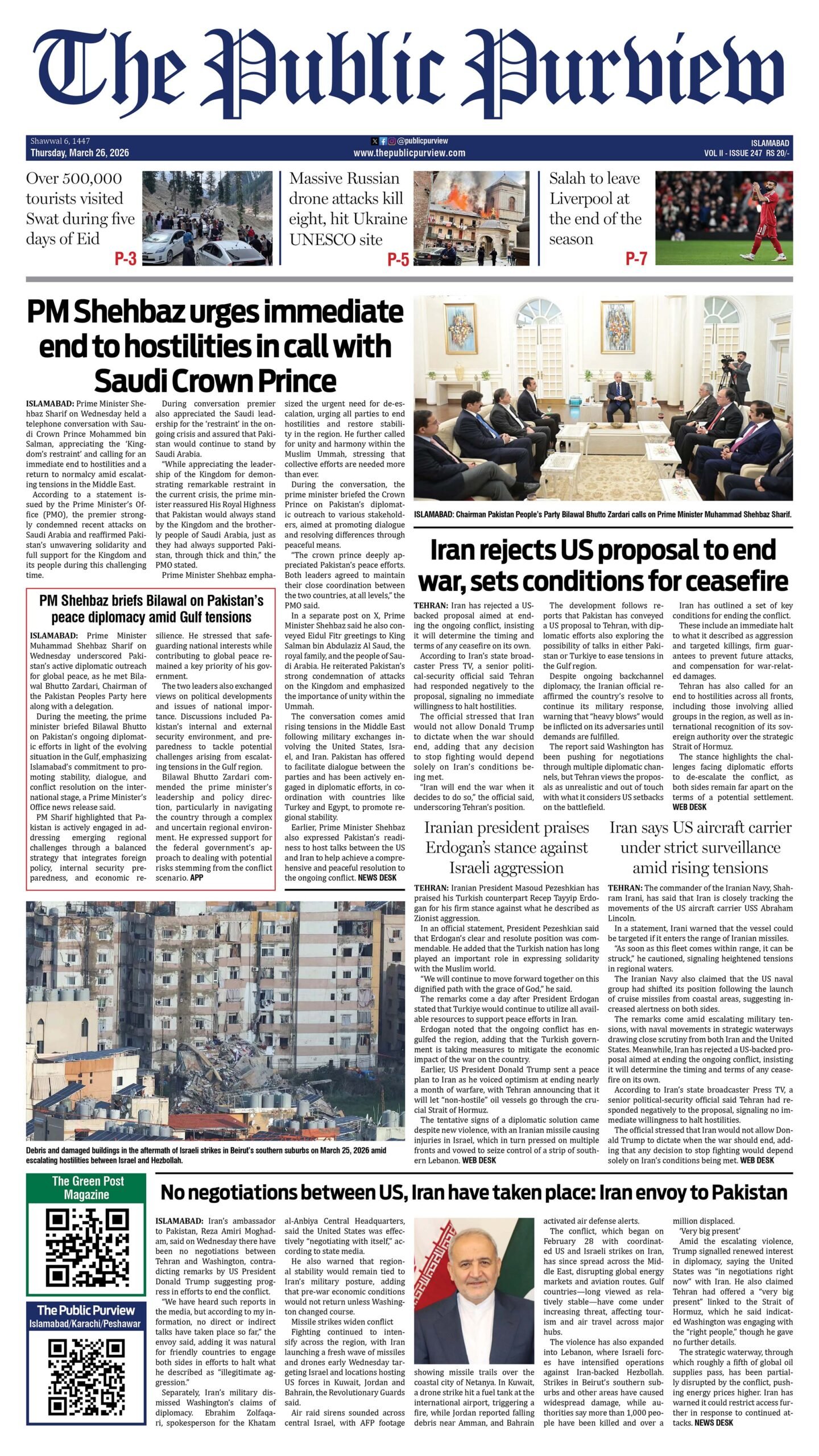 Today's E-Paper