
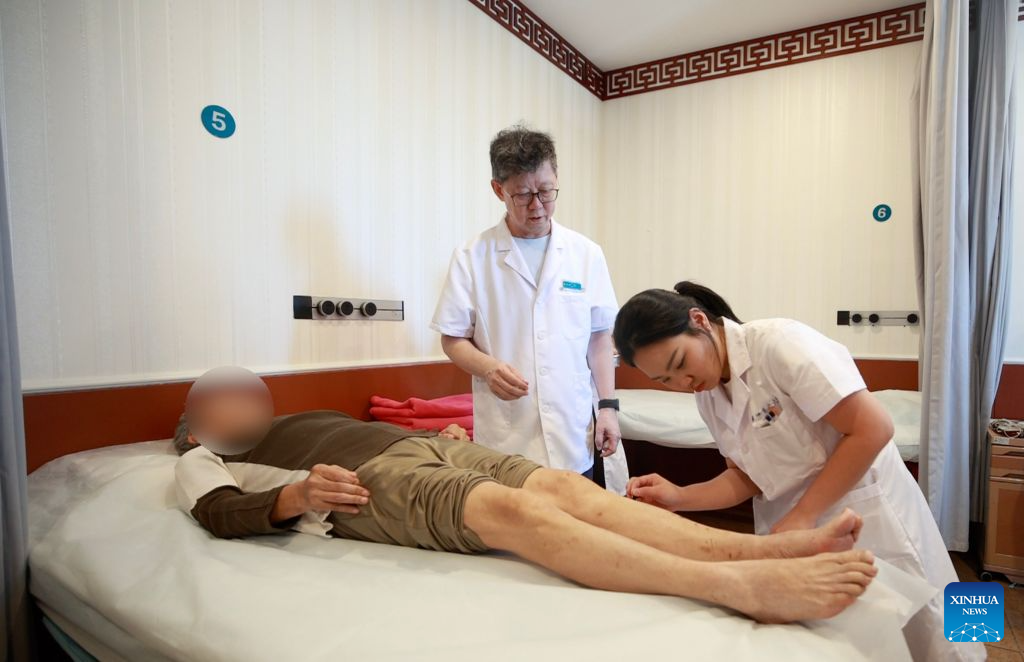
TIANJIN: A Thai medical student studying traditional Chinese medicine (TCM) in China is preparing to bring her acupuncture expertise back to Thailand after gaining clinical experience at a leading teaching hospital in Tianjin.
Salocha Techawanwanitchakorn, a graduate student specialising in acupuncture at Tianjin University of Traditional Chinese Medicine, is completing her clinical internship at the university’s First Teaching Hospital while preparing for China’s physician licensing examination.
Her interest in acupuncture developed from childhood exposure to Chinese herbal medicine in Bangkok and grew into a professional ambition after she moved to China for her education.
During a recent clinical session, Techawanwanitchakorn inserted an acupuncture needle into the leg of a patient experiencing paralysis on one side of the body. As she adjusted the needle, the patient’s leg moved slightly.
The experience reinforced her decision to pursue traditional Chinese medicine.
“At that moment, I knew I had made the right choice to study TCM,” she recalled.
Growing up near Bangkok’s Chinatown, Techawanwanitchakorn was familiar with herbal medicine through her Chinese grandmother, who regularly purchased traditional remedies for the family.
Although she initially associated Chinese medicine with bitter herbal preparations and acupuncture needles, her understanding changed after she moved to Tianjin for high school.
A school visit to the First Teaching Hospital of Tianjin University of Traditional Chinese Medicine introduced her to the clinical practice of TCM and encouraged her to pursue formal medical studies.
She subsequently enrolled at Tianjin University of Traditional Chinese Medicine, where she encountered the challenges of learning a medical system rooted in centuries-old Chinese traditions.
Concepts such as meridians and qi, traditionally described as vital energy, were initially difficult to understand. Classical medical texts written in traditional Chinese characters presented another obstacle.
Despite these difficulties, she continued her studies and began practical acupuncture training during her second year.
Techawanwanitchakorn initially practised needling techniques on herself to understand the sensations patients might experience during treatment.
She said the exercises helped her recognise feelings of soreness, numbness, pressure and tingling associated with acupuncture.
The experience also taught her the importance of explaining procedures to patients and helping them feel comfortable.
As her training progressed, she learned that acupuncture required more than identifying the correct points on the body.
Needle placement, insertion depth and angle must be adjusted according to individual patients, while practitioners also need to develop sensitivity to the physical response during treatment.
During her internship, she carried a notebook containing observations in both Chinese and Thai, recording acupuncture points, prescriptions and guidance from her instructors.
Her clinical mentors also emphasised the importance of understanding patients beyond their immediate symptoms.
“A good doctor sees not only the disease but also the person,” one of her teachers told her.
Techawanwanitchakorn said her interactions with Chinese patients had strengthened both her clinical confidence and her understanding of patient care.
Some patients initially assumed she was from southern China because of her accent. After learning that she was Thai, several greeted her in Thai and thanked her in her native language following treatment.
Others praised her acupuncture skills, encouraging her to continue developing her expertise.
“Experience is built needle by needle,” she said.
Her interest in traditional Chinese medicine also reflects its growing presence in Thailand, where some hospitals offer TCM services and younger patients are increasingly exploring traditional treatment options.
Techawanwanitchakorn has already introduced aspects of her training to family members during visits home.
Last summer, she administered acupuncture to her sister, who was experiencing back pain. Although initially nervous about the needles, her sister later reported feeling more relaxed.
She also used cupping equipment brought from China to provide treatment to her mother.
Beyond clinical practice, Techawanwanitchakorn has incorporated traditional Chinese wellness habits into her daily routine, including drinking chrysanthemum tea and maintaining a more structured lifestyle.
She now hopes to remain in China after completing her studies to gain further experience treating patients with different medical conditions.
According to Techawanwanitchakorn, China’s large patient population and variety of clinical cases provide valuable opportunities for developing her practical skills.
Her long-term goal is to return to Thailand and contribute to the development of traditional Chinese medicine services.
“China has more patients and more complex cases, so there is more to learn,” she said.
“I will bring what I learned in China back to Thailand and let more people see the charm of TCM.”
For Techawanwanitchakorn, acupuncture has become more than an academic specialisation, offering a professional path that connects her family’s Chinese heritage with her ambition to serve patients in Thailand.