
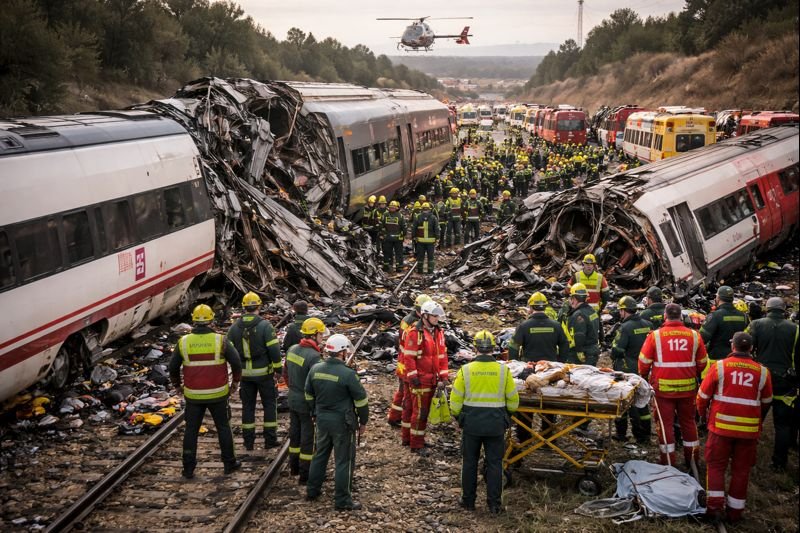
At least 39 people were killed and dozens injured when two high-speed passenger trains collided near Adamuz in southern Spain’s Córdoba province on Saturday evening, triggering a nationwide investigation into rail safety on one of Europe’s most advanced rail networks.
The accident occurred on January 18, when two passenger trains derailed and collided on a section of track linking central and southern Spain. Authorities said the crash happened on a straight stretch of railway, raising urgent questions about how such a catastrophic failure occurred without warning.
How the collision unfolded near Córdoba
According to preliminary findings, a high-speed train operated by private rail company Iryo, traveling from Málaga to Madrid, derailed and crossed onto the opposite track, where it struck an oncoming Renfe Alvia service heading from Madrid toward Huelva.
The violent impact caused multiple carriages to overturn, trapping passengers inside twisted wreckage. Emergency responders described chaotic scenes as injured travelers called for help while rescue teams worked through the night under floodlights.
Spain’s emergency services deployed helicopters, ambulances, firefighters, and civil guard units to the remote crash site. Hospitals across Córdoba and nearby cities were placed on emergency alert to handle the influx of injured passengers.
Casualties and survivors
Officials confirmed that at least 39 people lost their lives, including one of the train drivers. More than 150 passengers were treated for injuries, with dozens remaining hospitalized and several listed in critical condition. The injured included children and elderly travelers, many of whom were returning home after weekend journeys.
Families gathered at railway stations in Madrid and Córdoba as authorities established assistance centers to help relatives obtain information about missing loved ones.
Spain launches investigation as families seek answers
Prime Minister Pedro Sánchez expressed deep sorrow over the tragedy, offering condolences to the victims’ families and pledging full government support for the investigation. Senior transport officials traveled to the crash site, and rail services between Madrid and Andalusia were temporarily suspended.
Flags were lowered at public buildings in several regions as messages of sympathy poured in from across Europe. Spain’s royal family also conveyed condolences, describing the incident as one of the country’s gravest rail disasters in recent years.
Transport authorities have opened a formal investigation to determine the cause of the derailment. Early reports indicate the track section had recently undergone maintenance, raising concerns about potential technical faults, signaling issues, or human error. Officials warned that the inquiry could take several weeks.
Rail unions and passenger advocacy groups have called for a transparent and independent investigation, stressing that public confidence in Spain’s high-speed rail system depends on clear answers and accountability.
A nation on edge
Spain operates one of Europe’s largest high-speed rail networks, widely regarded as safe and efficient. However, Saturday’s disaster has reignited debate over infrastructure oversight, private operator regulation, and emergency preparedness.
As investigators analyze wreckage and black-box data, families across Spain continue to grieve lives cut short in a tragedy that has shaken public confidence in the country’s modern transport system. For now, the nation waits — for answers, accountability, and assurances that such a disaster will not happen again.




 Today's E-Paper