
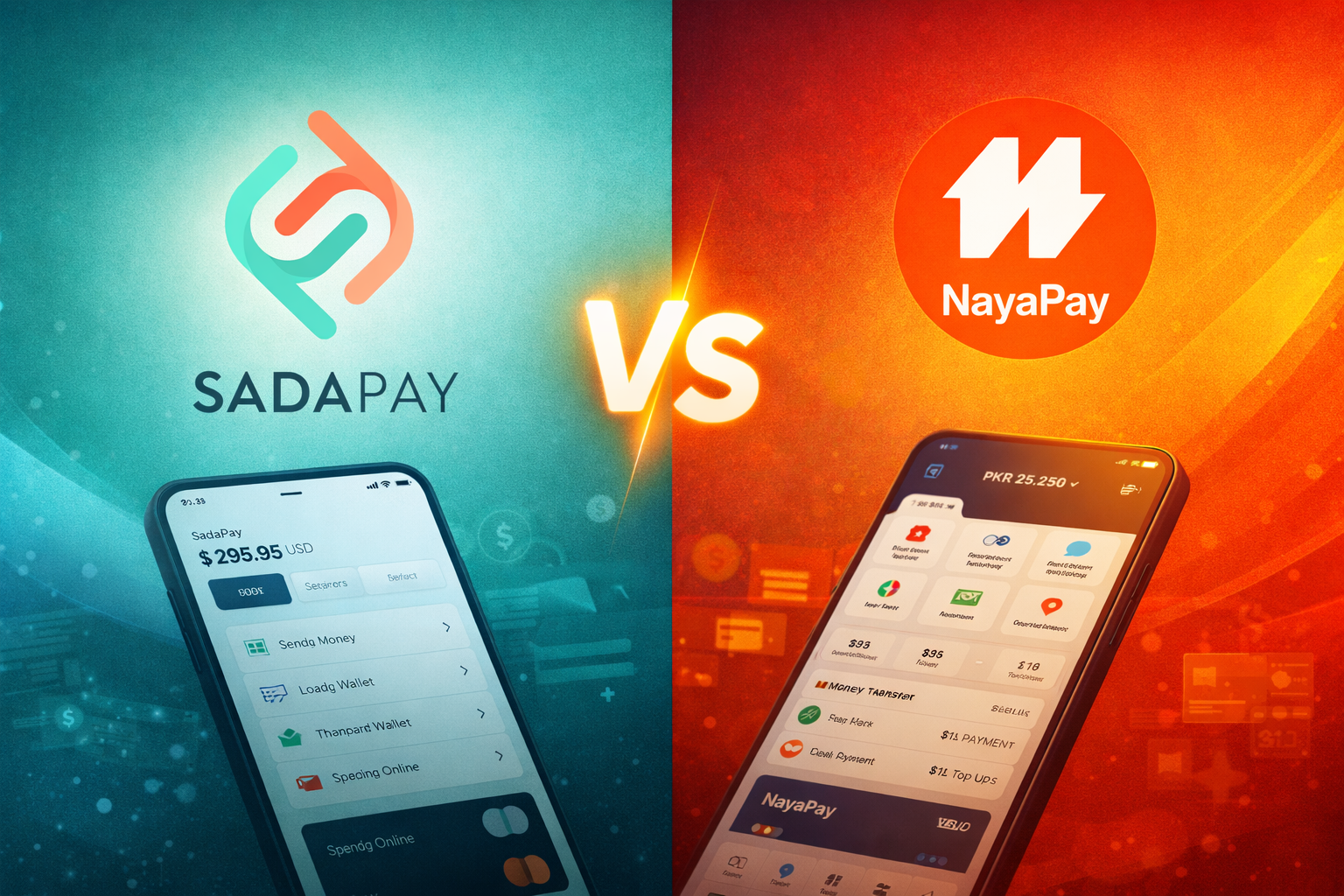
Pakistan’s digital payments space is evolving rapidly, and two names frequently compared by users are SadaPay and NayaPay. Both operate as branchless banking solutions under regulatory frameworks and offer app-based financial services without the need for a traditional bank account.
For users choosing between the two, the decision often comes down to how they plan to use the app — whether for everyday payments, international transactions, or a combination of both.
Different approaches to digital banking
While both platforms provide similar core services such as money transfers, debit cards, and mobile apps, their approach is notably different.
SadaPay focuses on simplicity and low-cost usage, offering a clean interface with minimal features. It is designed for users who want a straightforward financial tool without complexity.
NayaPay, on the other hand, positions itself as a feature-rich, all-in-one digital wallet, allowing users to manage bills, payments, and transactions within a single app.
Features: NayaPay offers more functionality
NayaPay provides a broader set of services for everyday use. These include utility bill payments, mobile top-ups, QR-based payments, and even bill-splitting options among users. It also supports payments for education and other services, making it closer to a complete financial ecosystem.
SadaPay offers essential features such as sending and receiving money, along with virtual and physical debit cards. However, it lacks many of the integrated services that are available on NayaPay.
For users looking for an app to manage most daily financial needs in one place, NayaPay has a clear advantage in terms of functionality.
Costs and fees: SadaPay remains more economical
Both apps offer free account registration and do not require a minimum balance. However, SadaPay generally stands out for its lower cost structure.
It typically offers free virtual cards and a limited number of free ATM withdrawals each month, making it attractive for users who want to minimize transaction costs.
NayaPay may involve slightly higher charges in some cases, particularly for ATM usage or certain services. For cost-sensitive users, SadaPay is often seen as the more economical option.
International usage: SadaPay has an edge
For freelancers and users who rely on international transactions, SadaPay is often the preferred choice.
It is widely used for online subscriptions and global payments, with competitive currency conversion rates and smoother cross-border usability.
NayaPay also supports international payments, but it is generally not considered as cost-effective or optimized for frequent global transactions.
User experience: simplicity vs versatility
SadaPay’s interface is widely regarded as clean and easy to navigate, making it suitable for users who prefer a straightforward experience.
NayaPay, while slightly more complex due to its broader feature set, offers greater versatility. Its interface supports multiple services, which can be beneficial for users who want more control within a single app.
Daily usage: NayaPay fits everyday needs better
For routine financial activities such as paying electricity bills, purchasing mobile packages, or managing small payments, NayaPay is better equipped.
SadaPay’s limited feature set makes it less suitable as a primary financial tool for daily life, although it performs well for basic transactions.
Reliability and support
User feedback on both platforms is mixed, though NayaPay is generally perceived as more consistent for daily operations.
Also read: SadaPay vs JazzCash: Which digital wallet is better for users in Pakistan?
SadaPay has faced occasional concerns regarding customer support and transaction handling, while NayaPay is often viewed as more stable in regular use.
Final comparison: which one should users choose?
The choice between SadaPay and NayaPay depends largely on user needs:
- Choose SadaPay if your priority is low-cost transactions, international payments, and a simple interface.
- Choose NayaPay if you want a feature-rich app for everyday financial activities, including bills and payments.
For many users, using both platforms for different purposes can offer a more complete digital banking experience.




 Today's E-Paper