

Ramadan not only tests the patience of the fasting; it tests the conscience of those who govern.
Yesterday, we spoke of the cobra — the venomous surge of prices that coils around Lahore’s bazaars, Rawalpindi’s markets, and the humble iftar tables of daily-wage families.
We invoked the Prophetic market walk, that luminous model where leadership did not rule from a distance but moved through the suqs of Madinah with watchful eyes and moral authority. We reminded ourselves that justice in trade is not administrative routine; it is spiritual responsibility.
Today, the question shifts.
When a society cries out against profiteering, and when that cry echoes from mosques to drawing rooms — what must follow? Complaint is easy. Correction is harder. Governance is hardest of all.
In recent public briefings during this Ramadan, Punjab’s Information Minister Uzma Bukhari has reiterated the provincial government’s commitment to price monitoring, action against hoarders, and enforcement of official rate lists under the leadership of Chief Minister Maryam Nawaz. Public statements have emphasised that profiteering will not be tolerated and that relief mechanisms are being implemented to ease the burden on citizens.
These are important declarations.
But declarations are not destinations. They are beginnings.
The cobra of inflation does not retreat from press conferences. It retreats from presence.
A printed rate list pinned to a wall cannot lower the price of tomatoes if no authority checks whether it is followed. A televised warning cannot prevent hoarding unless enforcement officers appear unannounced. The Prophet Muhammad (peace and blessings be upon him) did not supervise markets from afar. He walked among traders, examined scales, exposed deceit, and declared with clarity: “He who cheats is not from us.”
Public assurances signal awareness. But awareness must descend from podium to pavement.
This is not a criticism of intent; it is a reminder of expectation.
Punjab stands at a defining administrative moment. An ambitious provincial leadership carries both a political mandate and public scrutiny. In such moments, narrative matters. The information ministry becomes the voice explaining resolve, framing priorities, and defending policy direction.
Yet narrative must never outrun reality.
If enforcement teams are conducting checks, let them be seen. If fines are being imposed, let them be publicised. If profiteers are penalised, let the action be consistent and transparent. Fear of accountability is often more effective than fear of rhetoric.
Across cities and towns, citizens still whisper familiar complaints: “The rate list says one thing; the shopkeeper charges another.” “Quality is reduced.” “Portions are smaller.” These are not ideological claims — they are kitchen-table realities.
And realities do not bend to optimism; they bend to enforcement.
Here poetry must speak where policy pauses:
(If the fragrance of justice is absent from the market,
Even a circulating coin loses its honesty.)
And another reminder for this sacred month:
(Do not weigh the sanctity of fasting in profit and loss;
This is the month of mercy — do not turn it into a marketplace.)
These lines are not ornaments. They are warnings wrapped in rhythm.
In this unfolding test of governance, public statements from the provincial leadership indicate awareness of the urgency. If the government’s words are the lanterns of Ramadan nights, then Information Minister Uzma Bukhari carries one such lantern — and its light will be measured not by its glow in press briefings, but by how far it reaches into the narrow lanes of Anarkali, the crowded stalls of Raja Bazaar, and even the modest rows of Chhaparr Bazaar in Chakwal.
Ramadan offers a narrow window for redemption. Markets behave differently in sacred months. Demand rises. Emotions heighten. The temptation to exploit increases — but so does the opportunity to lead by example.
Imagine the impact if Deputy Commissioners quietly visited markets without protocol, blending into the crowd as ordinary customers. Imagine on-the-spot verification of prices. Immediate fines. Transparent reporting. Word would travel faster than any official announcement.
Justice is strongest when it is visible.
Islam does not condemn profit; it condemns exploitation. The Qur’anic warning in Surah Al-Mutaffifin was not abstract theology — it was economic regulation anchored in divine command: “Woe to those who give less than due…”
In a Muslim-majority province during Ramadan, governance carries not only constitutional responsibility but moral symbolism. Citizens will measure this month not by speeches, but by receipts.
Recognition appears present.
Response has been declared.
The result remains with the judge.
Ramadan will pass, as it always does. What remains afterwards is memory — memory of fairness or memory of neglect.
May this year be remembered not for the cobra’s strike, but for the custodian’s walk. May governance descend from podium to pavement. May the rate lists become reality. And may those entrusted with authority see in every market visit not a bureaucratic duty, but an act of service before Allah.
For in the end, leadership is not measured by the strength of its statements — but by the justice felt in the marketplace.



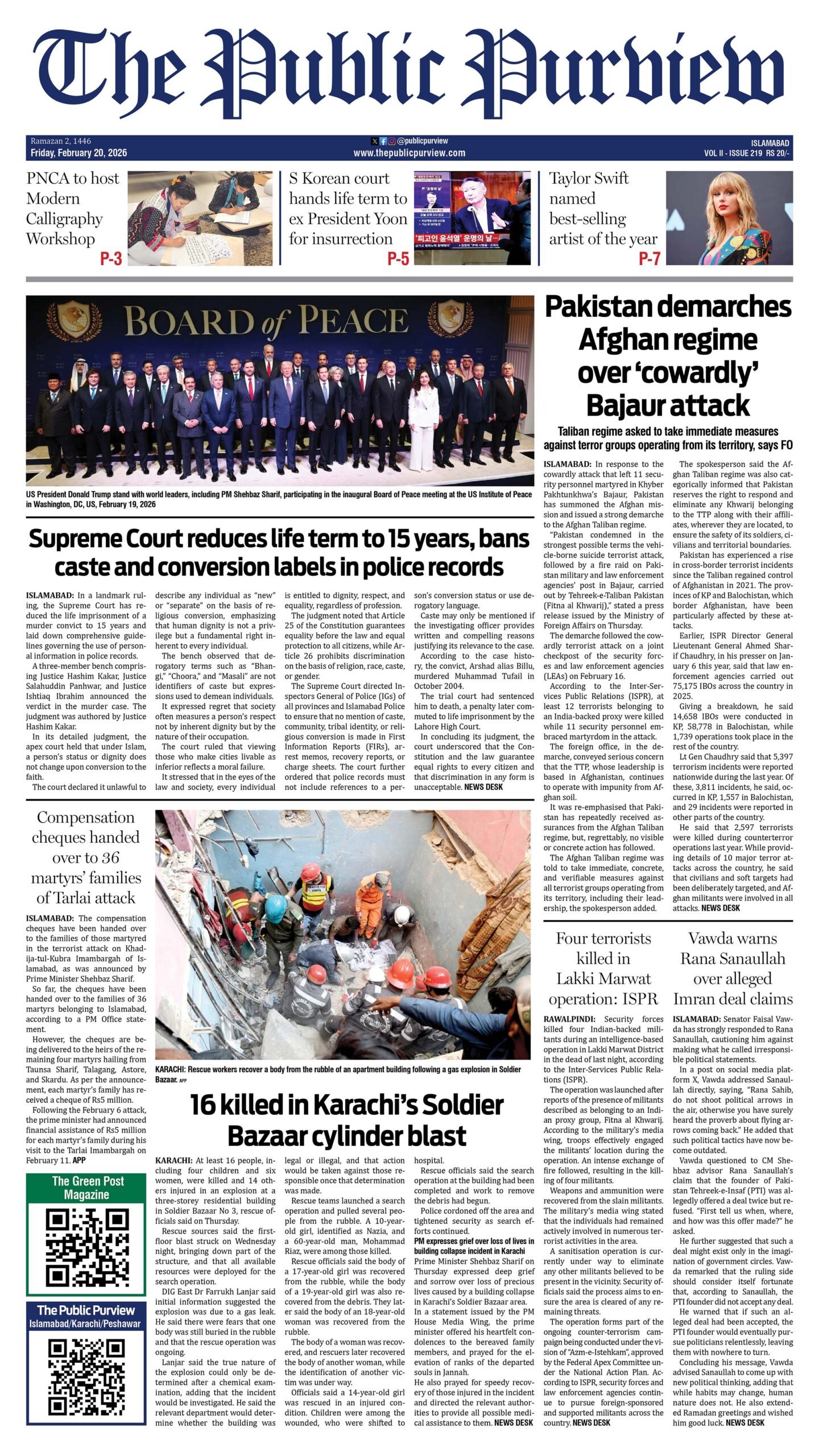 Today's E-Paper