
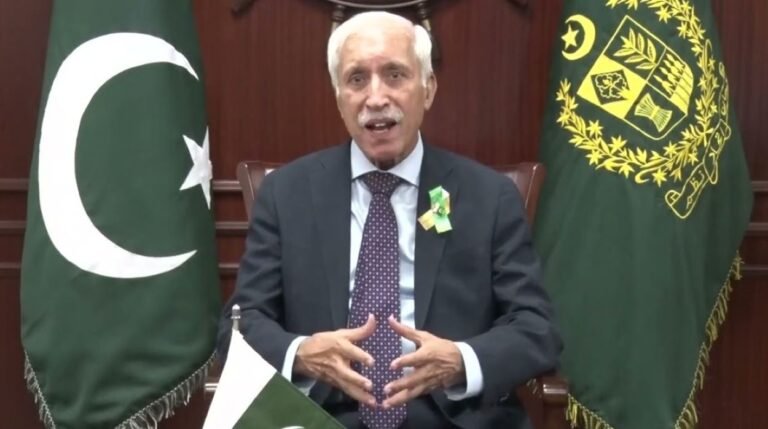
ISLAMABAD, September 9, 2026: Federal Minister for the Board of Investment Qaiser Ahmed Sheikh has called on young professionals and alumni to transform their academic knowledge, research and policy ideas into practical solutions for Pakistan’s economic challenges.
He was speaking at the concluding ceremony of the PUAN Economic Policy Challenge 2026, organized by the U.S. Embassy, United States Educational Foundation in Pakistan (USEFP), Pakistan-U.S. Alumni Network (PUAN) and Accountability Lab Pakistan.
The minister said knowledge was important, but its real value emerged when it was applied to practical problems. He urged participants to properly assess economic and business challenges before developing solutions and policy responses.
Drawing on his experience as former president of the Karachi Chamber of Commerce and Industry and his current government role, Sheikh emphasized the importance of evidence-based assessment in developing effective economic policies.
He also highlighted the longstanding educational, professional and people-to-people ties between Pakistan and the United States, appreciating the contribution of the U.S. toward Pakistan. He encouraged alumni to remain connected, exchange expertise and use their international exposure to develop partnerships in trade, investment, technology, entrepreneurship and policymaking.
Focus on Investment and Regulatory Reform
The minister highlighted economic reforms undertaken by the government over the past two years, particularly those carried out in cooperation with the International Monetary Fund (IMF), describing them as important steps toward strengthening Pakistan’s economic foundations.
According to the press release, the Board of Investment is working on regulatory reforms aimed at facilitating businesses and investors. Sheikh acknowledged the assistance and expertise provided by U.S. experts in regulatory reform.
He said excessive regulation, overlapping requirements and procedural bottlenecks had historically created difficulties for businesses. The ongoing reform process, he added, was focused on simplifying procedures, reducing unnecessary regulatory burdens, improving coordination among government institutions and creating a more predictable investment environment.
The minister also highlighted the Business Facilitation Centre (BFC) established by the Board of Investment in Islamabad, where various ministries and government departments have been brought together under one roof to provide coordinated services to businesses and investors.
SEZs, Exports and Pakistan-U.S. Trade
Sheikh emphasized the role of Special Economic Zones (SEZs) in promoting industrial development, investment and exports. He pointed to incentives available in SEZs, including income tax benefits and exemptions on imported machinery, as measures intended to encourage productive industrial investment.
He stressed the need for greater focus on value-added exports, industrialization, technology transfer, employment generation and productivity to ensure that investment contributes to sustainable economic growth.
The minister also highlighted Pakistan’s economic relationship with the United States, stating that the U.S. remains Pakistan’s largest export market and that bilateral trade is around $10 billion. He said there was considerable potential for further cooperation in trade, investment, technology, entrepreneurship, education and skills development.
The role of Pakistani-Americans and alumni networks was also highlighted as a potential bridge for stronger business-to-business connections, investment partnerships and knowledge exchange between the two countries.
Regional and Economic Challenges
Referring to Pakistan’s external position, Sheikh said the country’s foreign exchange reserves had reached around $18 billion, while noting that wars and geopolitical tensions were affecting economic activity across the region and globally.
He said rising costs and uncertainty associated with conflicts could affect investment, trade and broader economic activity.
The minister reiterated Pakistan’s stated commitment to maintaining constructive relations with both the United States and Iran, emphasizing diplomacy, dialogue and peaceful engagement in protecting the country’s national and economic interests.
He also praised the diplomatic capabilities of Field Marshal Syed Asim Munir and referred to his recent visit to the United Kingdom, saying Pakistan had received considerable appreciation there for its role and diplomatic efforts.
Winners Recognized
Later, U.S. Chargé d’Affaires Andy Halus addressed the gathering and appreciated the efforts of the participants, organizers and alumni. He also acknowledged the roles of Prime Minister Muhammad Shehbaz Sharif and Field Marshal Syed Asim Munir.
The ceremony included recognition of outstanding participants and winning teams. Federal Minister Qaiser Ahmed Sheikh presented shields and certificates to the winners and congratulated them on their achievements.
In his concluding remarks, Sheikh said the participants had the knowledge and expertise needed to make meaningful contributions to Pakistan’s future.
He stressed that the ultimate measure of their success would be their ability to apply the knowledge gained through initiatives such as the Economic Policy Challenge to practical settings, contribute to policy discussions and help develop solutions to Pakistan’s economic challenges.