
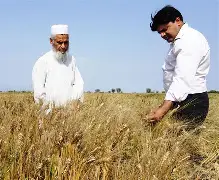
ISLAMABAD, Mar 31 (ABC): Agricultural scientists in Punjab are working to develop and promote new varieties of durum wheat to meet the growing demand of the rapidly expanding pasta industry.
The Punjab Agriculture Research Board (PARB) has tasked the Wheat Research Institute (WRI) Faisalabad with developing and popularizing durum wheat varieties.
“We have developed several durum wheat varieties alongside bread wheat,” Dr. Javed Ahmad, Chief Scientist at WRI, told Wealth Pakistan.
Owing to its high protein and gluten content, durum wheat in Pakistan is primarily used to produce high-quality flour and semolina for pasta products such as noodles, macaroni, spaghetti, and vermicelli.
Dr. Javed noted that durum wheat had been part of Punjab’s crop landscape before the 1960s. “It was one of around 25 wheat varieties cultivated in the region before the introduction of high-yielding bread wheat varieties during the Green Revolution like MexiPak,” he said.
The first durum wheat variety developed by WRI, Faisalabad, was Wadanak-85, followed by Durum-97. The latest variety, Durum-21, has recently been approved by the Punjab Seed Council for commercial cultivation. Meanwhile, the University of Agriculture, Faisalabad, has introduced a new variety, Chenab Pasta-24, designed specifically for the pasta industry. This variety can be grown in both irrigated and rain-fed areas, making it suitable for diverse agro-climatic zones.
Dr. Javed explained that while bread wheat has traditionally been used to produce pasta and related products, durum wheat is gradually replacing it due to its superior quality.
He added that a private industrial group in Multan district has established a durum wheat grinding plant and is purchasing the crop from local farmers at a premium price. However, the cultivation of durum wheat in Punjab remains limited due to the lack of a dedicated processing infrastructure.
“Its success depends on the establishment of more milling units across the province,” Dr. Ahmad emphasized.
Flour millers point to need for specialized milling facilities for the promotion of the durum wheat crop. “We need to modify existing milling processes to handle Durum Wheat. At present, not a single mill in Punjab is processing it,” Asim Raza Ahmad, former chairman of the Pakistan Flour Mills Association, told Wealth Pakistan.
He said most manufacturers of vermicelli, noodles, pasta, and spaghetti still rely on maida (fine flour) and suji (semolina) derived from bread wheat.
Farmers also cite marketing challenges as a key reason for the limited adoption of durum wheat. “Except for the industrial group in Multan, most flour mills do not purchase Durum Wheat because its flour is not suitable for making traditional bread,” said Khalid Mahmood Khokhar, Chairman of the Pakistan Kissan Ittehad.
He stressed that expanding durum wheat-based industries is essential to revive the crop, which was widely cultivated in the Punjab province some 60 years ago.


 Today's E-Paper