
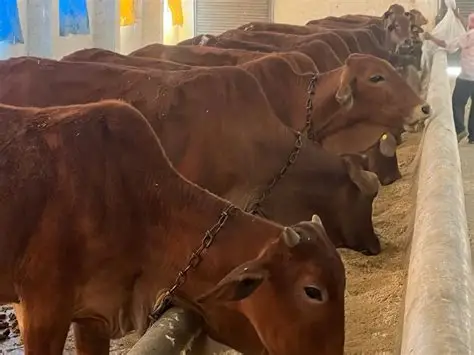
LAHORE, Mar 25 (ABC): The Punjab government has launched an initiative to preserve and promote indigenous livestock breeds including the Sahiwal cow and the Nili Ravi buffalo.
Out of the total allocation of Rs20 billion under Punjab Herd Transformation to Enhance Livestock Productivity programme, an amount of Rs4 billion has been earmarked for the Progeny Testing Programme (PTP) in order to improve genetic potential and breed quality.
“Schemes for the production of sex-sorted semen of indigenous breeds — Nili Ravi buffalo, Sahiwal, and Cholistani cattle — for animals registered under the PTP are underway,” Dr Khaliq Shafee, Director of the Punjab Livestock Department, told Wealth Pakistan. He noted that unchecked crossbreeding with exotic breeds has severely affected indigenous livestock, resulting in unpredictable genetic traits and compromised physical characteristics.
Punjab is home to approximately 500,000 Sahiwal cattle and 2-2.5 million Cholistani cattle, while the Nili Ravi buffalo population ranges between 13 and 15 million.
Dr Shafee said the programme is being implemented in collaboration with the Sahiwal Cattle Breeders Society and the Buffalo Breeders Association. Key interventions include establishing breed conservation units, expanding the PTP, a Bull Dam (bull mother) scheme, and structured breeding and bull selection based on lactation performance exceeding 3,000 litres.
The project is being executed by institutions, including the Buffalo Research Institute in Pattoki, the Livestock Production Research Institute Bahadurnagar (Okara), and the Research Centre for Conservation of Indigenous Breeds in Jhang.
Breeders have welcomed the initiative, describing it as an important step towards revitalising Pakistan’s indigenous livestock sector and unlocking its long-term potential.
“While this project comes at a crucial stage, it opens significant opportunities to fully harness the strength of our indigenous breeds,” Dr Muhammad Imran Basharat, Director Technical at the Sahiwal Cow Breeders Society told Wealth Pakistan.
He noted that with the right commercial framework and improved use of genetic resources, Pakistan can significantly enhance breed quality and productivity. “There is strong potential to further refine breeding systems, including better identification of superior bull dams to develop high-quality breeding stock,” he said.
Dr Basharat emphasised that adopting cooperative livestock and dairy farming models can play a transformative role in ensuring sustainable growth of the sector. He also pointed out that recent market fluctuations, including those linked to trade dynamics with Afghanistan, highlight the need for stronger market structures that can better support livestock farmers and stabilise returns.
According to him, Pakistan retains valuable high-yielding animals, including Nili Ravi buffalo producing around 4,000 litres annually and Sahiwal cows about 3,500 litres, offering a solid foundation for future growth.
He underscored the importance of promoting best practices in livestock management, noting that improved regulatory oversight can help protect animal health, fertility and long-term productivity.
“Indigenous breeds remain highly cost-effective and well-suited to Pakistan’s climate,” he said, adding that their natural resilience makes them key to sustainable dairy production.
He also highlighted growing international interest in Sahiwal breed semen and embryos in countries such as Bangladesh, Kenya and Sri Lanka, stressing that developing export systems can open new revenue streams for Pakistan’s livestock sector
Punjab launches initiative to promote indigenous livestock breeds

 Today's E-Paper