
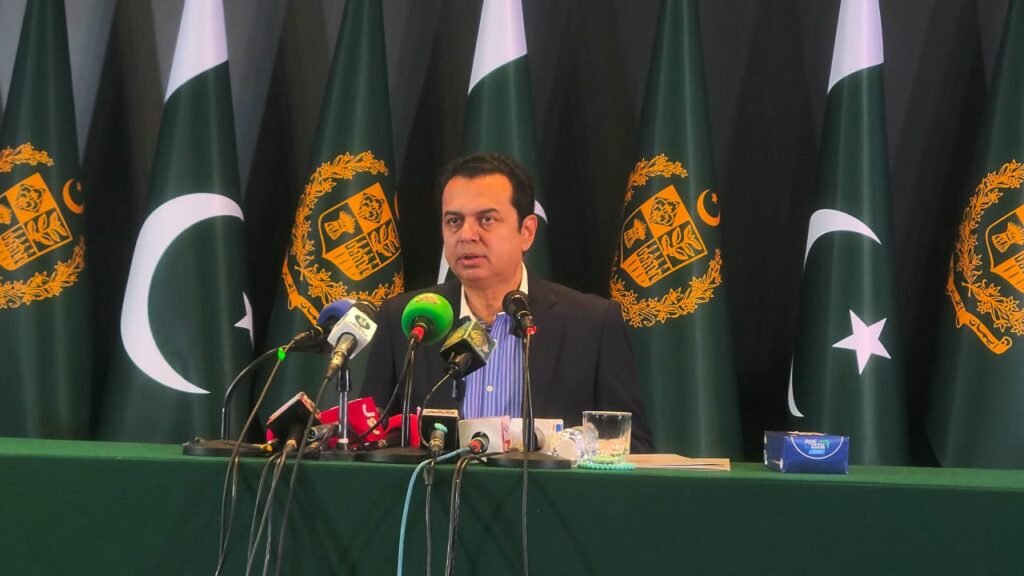
ISLAMABAD: Minister of State for Interior Talal Chaudhry on Sunday claimed that PTI’s long march and the Joint Action Committee’s protest campaign in Azad Jammu and Kashmir showed “multiple similarities”, including the timing of protest calls, methods of mobilisation and alleged links emerging from an investigation into illegal arms supply.
Addressing a press conference, Chaudhry said the Joint Action Committee had called for protest and a strike on the same day PTI had planned its long march, arguing that the overlap could not be treated as a mere coincidence. He said similarities had also emerged in the way both protest movements were organised and conducted. Pasted text
The minister alleged that a neighbouring country was seeking to destabilise Pakistan through proxy networks and said investigators were examining whether political actors were using such elements or whether destabilising groups were exploiting political networks for their own objectives.
Chaudhry said the latest phase of an investigation into an alleged illegal weapons network had led to three further arrests — Waqar Hameed, Muhammad Ali and Ammar Sohail.
He said the investigation had earlier focused on a man identified as Zia, who was allegedly involved in the illegal arms trade for eight years.
According to Chaudhry, investigators found alleged links between Zia, Sardar Aman and another individual named Majid. He claimed weapons had been sourced from Afghanistan through a man identified as Zarghoon and later moved through Pakistan’s tribal areas towards Kashmir.
The minister said additional phone calls, mobile phone data, statements, CCTV footage and forensic evidence had also emerged during the investigation.
He added that some of the evidence would not be made public at this stage because it was intended for submission before the courts.
During the press conference, alleged video statements of the three arrested men were also shown to the media.
According to the statement attributed to Waqar Hameed, he had been associated with the Action Committee for three years and had participated in its programmes and sit-ins.
Chaudhry said Hameed’s statement allegedly referred to contacts with senior Action Committee figures and to armed individuals being deployed during protest activity.
The minister also cited claims relating to firing on security personnel and alleged attempts to move armed men to particular protest points.
Muhammad Ali, in his alleged statement, said he had been associated with the Action Committee for around 18 months and had participated in protest activity since June 2026.
According to the account presented by Chaudhry, Ali and others were allegedly instructed to travel to Rawalpindi to collect weapons and ammunition for onward movement towards Kashmir.
Ammar Sohail, meanwhile, allegedly said he had participated in local Action Committee activities and supported the movement on social media. His statement claimed he accompanied Muhammad Ali during an attempt to collect arms before they were arrested.
Chaudhry argued that the investigation reinforced broader concerns about the nature of the protest campaign.
He said the government had maintained from the beginning that the movement should not be viewed purely as a political protest.
The minister also accused some elements of trying to prevent or undermine political participation in Azad Jammu and Kashmir and of attempting to portray the region in a way that linked its circumstances with those of Indian Illegally Occupied Jammu and Kashmir.
He said earlier calls aimed at disrupting electoral participation had failed as large numbers of people took part in the voting process.
Turning again to PTI, Chaudhry said the coincidence of protest dates, alleged similarities in tactics and the broader pattern of mobilisation raised questions that required examination.
He also accused the Khyber Pakhtunkhwa government of using instability for political purposes instead of fulfilling its constitutional, legal and democratic responsibilities.
The minister rejected claims that security forces had initiated violence during protests, saying force had not been used unless personnel came under firing or armed attack.
He said protesters had remained at sit-ins for more than 100 days and argued that if the state intended to disperse them through force, it could have acted earlier.
Chaudhry also referred to what he described as videos showing the use of sniper rifles and automatic weapons during protest-related violence.
He further claimed that some individuals were trying to build a “missing persons” narrative around those arrested, even though families had allegedly been informed about their detention and legal proceedings.
According to the minister, the protest issue originally involved 38 demands, of which 37 had been accepted. He said some had already been implemented while work on others was continuing.
Chaudhry maintained that protests which disrupt schools, businesses and daily life could not be justified as a struggle for public rights if weapons and outside actors were also involved.
He said further evidence gathered during the investigation would be presented before the courts at the appropriate stage.