
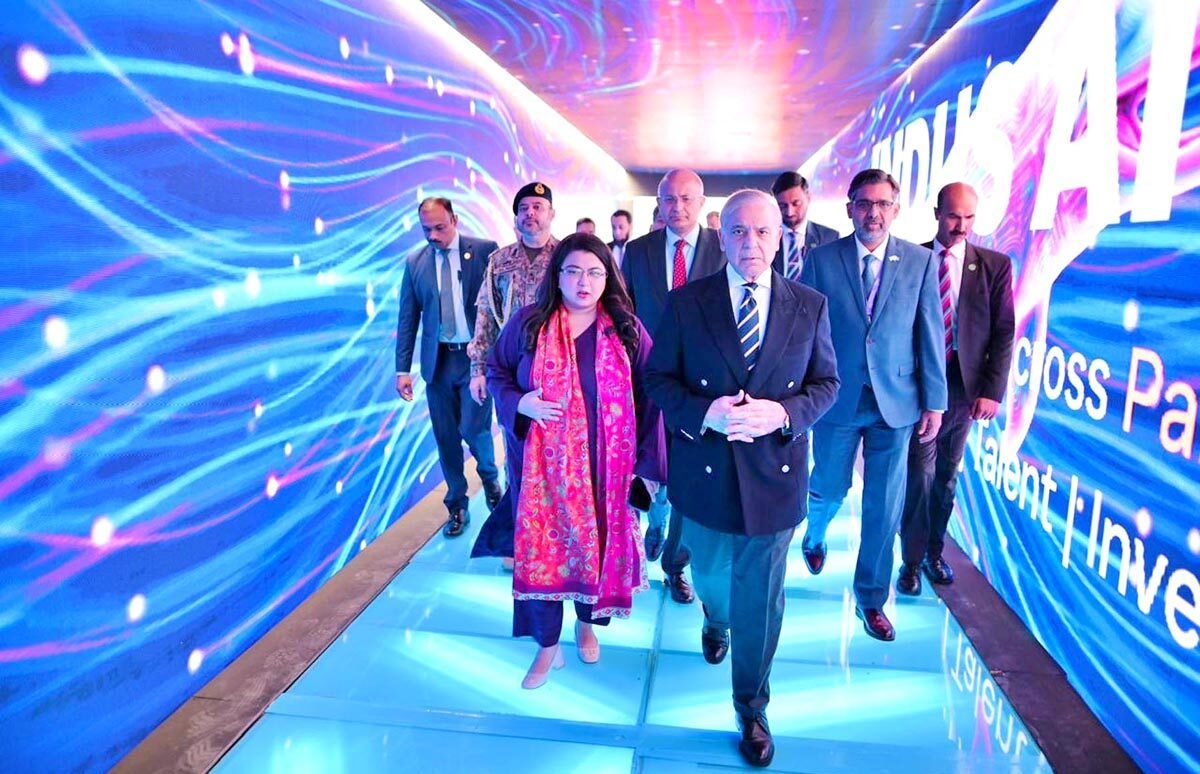
Prime Minister Shehbaz Sharif on Monday announced that Pakistan will invest $1 billion in artificial intelligence (AI) by 2030, outlining a wide-ranging plan to build a national AI ecosystem focused on education, skills development, and economic transformation.
Addressing the inauguration of Indus AI Week in Islamabad, the prime minister said the government’s investment would support policy development, talent creation, and innovation across sectors. Indus AI Week 2026 is being held from February 9 to 15 and is described by organisers as Pakistan’s official national platform for artificial intelligence, bringing together policymakers, academia, industry, and investors.
Also Read: PM Shehbaz Sharif recognises National Bank of Pakistan for economic contributions
Shehbaz said an AI curriculum would be introduced in all federally run schools, as well as in educational institutions across Azad Jammu and Kashmir and Gilgit-Baltistan. He added that the initiative would also be extended to remote areas of Balochistan to prepare young people for leadership roles in the digital economy.
Scholarships, training, and sectoral focus
The prime minister announced that the government plans to offer 1,000 fully funded PhD scholarships in artificial intelligence by 2030 to help develop world-class research capacity in Pakistan. In addition, a nationwide programme will be launched to train one million non-IT professionals in AI-related skills to enhance productivity and improve livelihoods.
Shehbaz said agriculture and mines and minerals would be among the priority sectors for AI adoption, noting that empowering youth — who make up about 60 per cent of Pakistan’s population — is central to the country’s economic future. He added that the government aims to help IT professionals transition from basic technical roles to advanced AI expertise, unlocking gains in agricultural productivity, industrial growth, and women’s empowerment.
National AI Policy and implementation challenges
Pakistan approved its National AI Policy in July 2025 with the aim of expanding access to artificial intelligence, improving public services, and creating new employment and innovation opportunities. However, officials acknowledge that implementation has slowed due to proposed changes in the composition of the AI Council and limited engagement from provincial governments.
According to officials, the “Awareness and Readiness” pillar is currently the only component being actively pursued, with Indus AI Week described as an initial step toward broader implementation.
Technology, governance, and past reforms
Calling Indus AI Week “nothing short of a game-changer,” the prime minister said Pakistan is ready to engage with global partners to keep pace with rapid technological change. He recalled earlier digital initiatives undertaken during his tenure as chief minister of Punjab, including laptop distribution schemes, e-libraries, e-stamping, and the computerisation of land records with support from the World Bank.
Shehbaz also cited the launch of Pakistan’s first Safe City project and IT university in Lahore, as well as ongoing digitalisation efforts at the Federal Board of Revenue, which he said have helped curb smuggling and improve tax recovery through modern scanning and digital tools.
Ministers highlight strategic importance of AI
IT Minister Shaza Fatima Khawaja said Indus AI Week aims to strengthen coordination between universities, government bodies, and international technology companies. She added that the Pakistan Digital Authority is preparing a nationwide digital master plan to guide future transformation.
Planning Minister Ahsan Iqbal said the global economy has entered a phase where intelligence itself has become a factor of production. He described artificial intelligence as a greater disruptor than electricity or the internet, noting that nations are now competing on ideas, talent, data, and technology rather than commodities.



 Today's E-Paper