
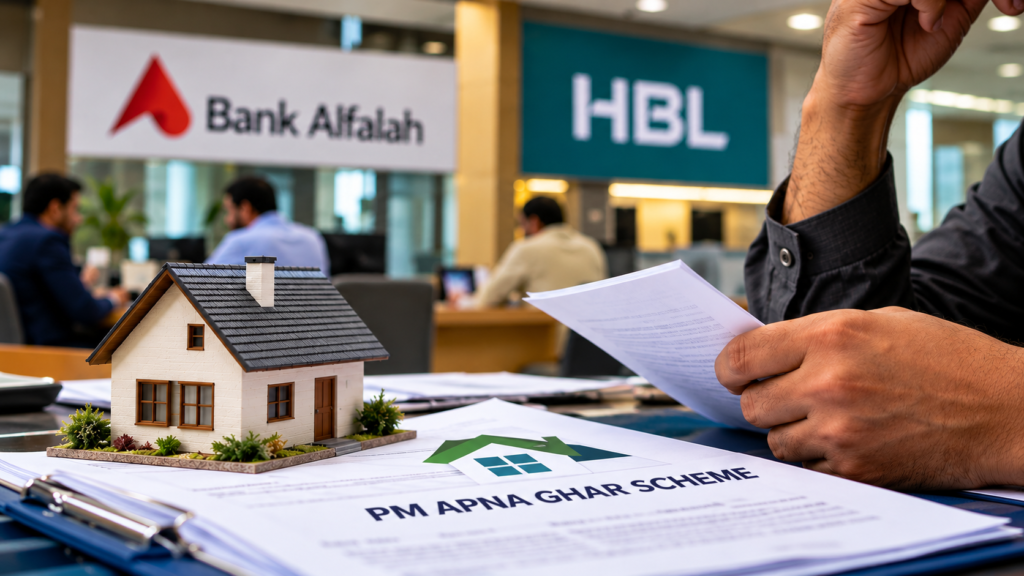
ISLAMABAD, September 29, 2026: Applicants seeking housing finance under the Wazir-e-Azam Apna Ghar Program have raised concerns about alleged non-cooperation by Bank Alfalah and Habib Bank Limited (HBL), citing limited services in rural areas, prolonged application delays, unavailable banking officials and repeated demands for fresh documentation.
The complaints have raised questions about customer facilitation at participating banks under Prime Minister Shehbaz Sharif’s affordable housing initiative, which aims to help low- and middle-income Pakistanis purchase or construct their first homes.
Applicants say Bank Alfalah does not provide housing finance services under the scheme in certain rural areas, including Murree, while HBL customers allege that their applications remain unresolved for two to three months despite repeated visits and telephone follow-ups.
Some HBL applicants also complain that after months of waiting, bank officials ask them to submit fresh applications and updated bank statements, forcing them to repeat the process without receiving a clear decision.
Bank Alfalah applicants complain of limited services in rural areas
Applicants approaching Bank Alfalah under the Wazir-e-Azam Apna Ghar Program have complained that the bank does not offer the relevant housing finance facility in certain rural areas, including Murree and its surrounding localities.
According to complainants, they have been informed that the facility is unavailable in their areas, leaving them uncertain about how to access the government-backed programme.
Applicants argue that such geographical limitations could undermine the scheme’s objective of helping financially struggling families secure affordable housing.
They maintain that rural and semi-urban communities often have a greater need for subsidised housing finance because of limited banking access, modest incomes and difficulties obtaining conventional home loans.
Complainants questioned how the programme could achieve its intended purpose if eligible families living outside major cities encounter barriers to accessing the facility.
They urged Bank Alfalah to clarify its geographical coverage and explain what arrangements are available for eligible applicants in underserved areas.
The complaints do not establish that Bank Alfalah has adopted a nationwide policy of excluding rural applicants. However, they highlight concerns about the accessibility of the programme beyond major urban centres.
HBL applicants allege months-long delays and unavailable officials
Applicants dealing with HBL have complained that officials responsible for processing applications under the Wazir-e-Azam Apna Ghar Program are frequently unavailable at their designated seats and often fail to answer telephone calls.
Some applicants allege that they have pursued their cases for two to three months without receiving clear updates or decisions.
They say that when contact is eventually established, they are sometimes instructed to submit fresh applications, updated bank statements and other documents, even though their earlier submissions have remained pending.
According to complainants, these repeated requirements create a cycle of delays in which documents become outdated while applicants wait for responses, forcing them to restart parts of the process.
For salaried employees and working families, repeated visits and documentation requirements can result in additional expenses and time away from work.
Applicants argue that banks should communicate outstanding requirements promptly rather than allowing applications to remain unresolved for extended periods.
HBL branches refer applicants to Blue Area office, complainants say
Applicants have also reported that several HBL branches refer customers seeking assistance under the housing scheme to the bank’s Blue Area office in Islamabad.
However, complainants allege that the relevant officials at the office are often unavailable or unresponsive, leaving them unable to obtain information about pending applications.
Some applicants claim that approaching supervisors responsible for the concerned HBL teams has also failed to resolve their difficulties.
They say that even after escalating their concerns, they continue to experience inadequate communication and a lack of clear guidance.
The allegations do not establish that HBL has an institutional policy of delaying housing finance applications. The reasons for the reported delays and repeated documentation requirements require examination by the bank.
Wazir-e-Azam Apna Ghar Program offers subsidised housing finance
The Wazir-e-Azam Apna Ghar Program, also known as Ghar Ho Tu Apna, is a federal government initiative designed to improve access to affordable housing finance for eligible first-time homebuyers.
Under revised terms announced in March 2026, eligible borrowers can obtain financing of up to Rs10 million at a fixed customer rate of 5 percent during the subsidy period.
The facility covers qualifying houses measuring up to 10 marlas and flats of up to 1,500 square feet, with financing tenure extending to 20 years.
Eligible applicants can use the financing to purchase a house or flat, construct a home on an already owned plot, or purchase a plot for construction.
The programme is particularly relevant to salaried individuals, working families and people living in rented accommodation who struggle to arrange conventional housing finance.
At a review meeting on September 9, Prime Minister Shehbaz Sharif reaffirmed the government’s commitment to providing affordable housing opportunities to low- and middle-income households.
According to figures presented at the meeting, 147,504 applications had been received under the programme, of which 53,127 had been approved. Financing worth Rs45.43 billion had been disbursed to 8,739 applicants.
The figures reflect substantial interest in the scheme and underline the importance of efficient implementation by participating financial institutions.
SBP’s 15-working-day approval requirement raises questions
The State Bank of Pakistan has introduced measures to facilitate implementation of the Wazir-e-Azam Apna Ghar Program, including a requirement that participating banks complete the credit approval process within 15 working days after receiving applications with complete information.
The reported delays of two to three months at HBL have raised concerns among applicants about whether their cases are being processed efficiently.
However, the requirement applies to complete applications and does not guarantee approval of every financing request. Incomplete documentation, property verification and other outstanding requirements may affect processing timelines.
Applicants maintain that banks should clearly communicate deficiencies in applications and explain any requests for updated documents, particularly where earlier submissions have remained pending for months.
Applicants urge SBP and bank managements to intervene
Applicants have called on the State Bank of Pakistan and the managements of Bank Alfalah and HBL to examine the complaints and improve customer facilitation under the housing programme.
They have urged Bank Alfalah to clarify the availability of financing in rural areas, including Murree, and provide guidance to eligible applicants in underserved localities.
HBL applicants have sought an examination of prolonged processing delays, repeated documentation demands and the alleged unavailability of designated officials and supervisors, particularly at the bank’s Blue Area office in Islamabad.
Complainants believe that accessible housing finance desks, responsive officials, clear processing timelines and effective complaint-resolution mechanisms could help address these difficulties.
The banks’ responses to the specific allegations had not been obtained for this story.
The Wazir-e-Azam Apna Ghar Program is intended to make homeownership more accessible to families facing financial barriers. Its effectiveness will depend not only on government subsidies and loan approvals but also on whether participating banks provide timely, transparent and accessible services to the people the initiative is designed to benefit.