
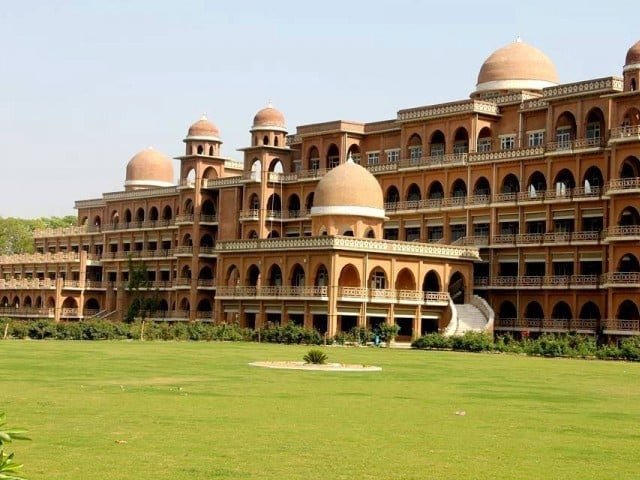
PESHAWAR — The Department of International Relations at the University of Peshawar held a special session to mark the International Day for Disarmament and Non-Proliferation Awareness, bringing together academics, students and policy experts to discuss global challenges related to arms control and nuclear security.
The event, organized by the International Relations Students Association (IRSA) at Naib Hall, focused on the role of disarmament, nuclear deterrence and international cooperation in maintaining global stability.
The session opened with welcome remarks by IRSA Coordinator Dr. Khurshaid Ahmad. Several scholars and experts participated virtually, including Dr. Rizwan Naseer, Senior Research Fellow and Director of the Centre for Critical Thinking and Policy Studies at the Institute of Regional Studies in Islamabad; Dr. Zafar Ali, Director Research at the Strategic Vision Institute; Dr. Zafar Nawaz Jaspal, Dean and Meritorious Professor at Quaid-i-Azam University; Dr. Rahman Allah from BBC; and Prof. Dr. Hussain Shaheed Soherwordi.
Experts discuss global arms control and nuclear deterrence
Speakers examined the evolving dynamics of global security and the challenges of preventing the spread of nuclear weapons.
Dr. Rizwan Naseer highlighted the realist perspective in international politics, noting that states often prioritize their own security interests. He said debates continue among scholars about the role of nuclear weapons, with some advocating disarmament to reduce risks of conflict while others argue that nuclear deterrence has helped maintain stability.
Dr. Zafar Ali discussed the significance of arms control frameworks such as the Nuclear Non-Proliferation Treaty (NPT), which entered into force in 1970 and was extended indefinitely in 1995. He described the treaty as a central element of global nuclear governance, while noting that several nuclear-armed states remain outside its framework.
Dr. Zafar Nawaz Jaspal spoke about what he described as the emerging “Fourth Nuclear Age,” characterized by multipolar power dynamics, technological change and evolving nuclear strategies.
Academic discussion on global security challenges
Dr. Rahman Allah addressed the deterrent role of nuclear weapons in international politics, while Prof. Dr. Hussain Shaheed Soherwordi offered a constructivist perspective, emphasizing how international norms and shared ideas shape arms control efforts, including the concept often referred to as the “nuclear taboo.”
Panelists also discussed regional and global security challenges, including developments in the Middle East, and reflected on the role of international institutions such as the United Nations in promoting disarmament and non-proliferation.
Students actively participated in an interactive question-and-answer session with the speakers.
The event concluded with remarks by Dr. Syed Sami Raza, Chairman of the Department of International Relations, who highlighted the importance of observing the UN-designated day and encouraging academic dialogue on global security issues. Certificates were later distributed to participants, followed by a group photograph.




 Today's E-Paper