

After several tense days of negotiations, Pakistan has taken a decision that balances principle with pragmatism, allowing its national cricket team to play the Twenty20 World Cup match against India. The move, announced after extensive dialogue with the International Cricket Council (ICC) and other stakeholders, reflects a broader commitment to the stability of world cricket while safeguarding Pakistan’s position within the sport’s governance structure.
Initially, Pakistan had resisted playing the high-profile fixture, citing concerns over fairness after Bangladesh withdrew from the tournament and Scotland was drafted in as a replacement. The Pakistan Cricket Board (PCB) argued that the ICC’s handling of the matter reflected undue influence from India, and the team was instructed to forfeit the match against its arch-rival. This stance placed the ICC in a precarious financial position, given that the Pakistan–India clash is traditionally the tournament’s most lucrative encounter.
Faced with mounting pressure, the ICC dispatched its director Imran Khawaja to Pakistan, while Bangladesh Cricket Board chief Aminul Islam also joined the discussions. PCB Chairman Mohsin Naqvi played a central role in the negotiations, with appeals from Sri Lanka and the UAE further urging Pakistan to reconsider. The talks ultimately produced a compromise that allowed Pakistan to participate fully in the tournament while ensuring Bangladesh was not penalized for its withdrawal. In fact, Bangladesh was granted hosting rights for a future ICC event, a gesture aimed at balancing the scales.
For Pakistan, the decision to play the match was not simply about cricketing rivalry. It was about asserting equality in the global cricketing order while recognizing the financial realities that sustain the game, particularly for associate nations. By agreeing to take the field, Pakistan demonstrated that it can uphold its principles while also acting in the collective interest of the sport.
The episode underscores the need for reforms in cricket governance. For too long, the game has been overshadowed by political maneuvering and unequal treatment of member boards. Pakistan’s firm stance highlighted these issues, and its eventual compromise showed that solutions are possible when dialogue is pursued in good faith. The ICC must now build on this moment to strengthen its credibility as a neutral body, ensuring that cricket remains above political agendas.
Looking ahead, the arrangement that sees Pakistan and India play at neutral venues cannot be a permanent solution. The ICC must work toward normalizing bilateral cricket ties between the two nations, which would not only enrich the sport but also reinforce its role as a bridge between communities. Such progress would mark a genuine step forward in depoliticizing cricket and restoring its essence as a game that unites rather than divides.
Pakistan’s decision was both sensible and strategic. It preserved the integrity of the World Cup, protected the financial ecosystem of global cricket, and reaffirmed Pakistan’s role as a responsible stakeholder. The hope now is that this moment becomes a turning point, ushering in a new era where cricket governance is guided by fairness, inclusivity, and respect for all members.




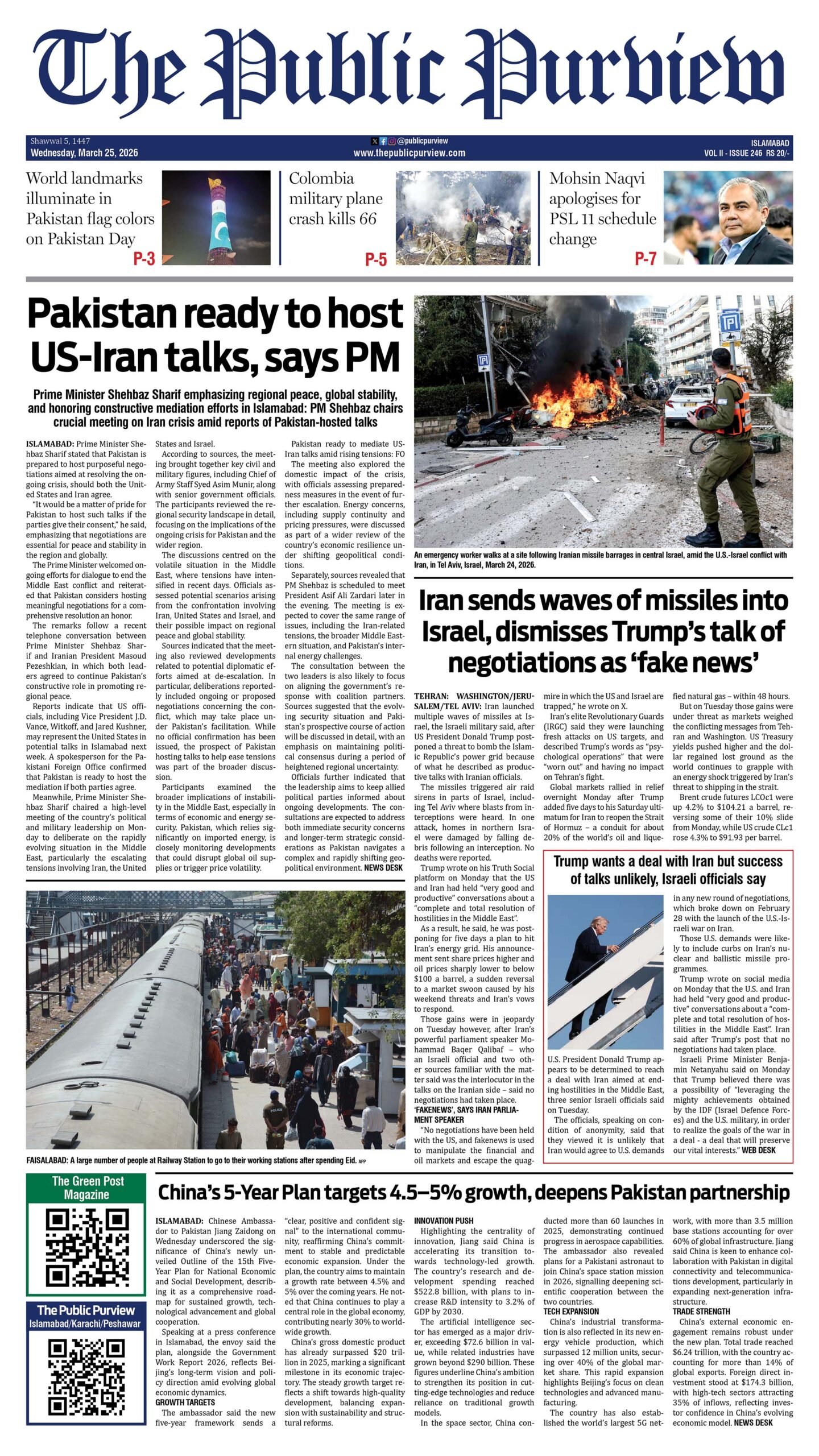 Today's E-Paper