
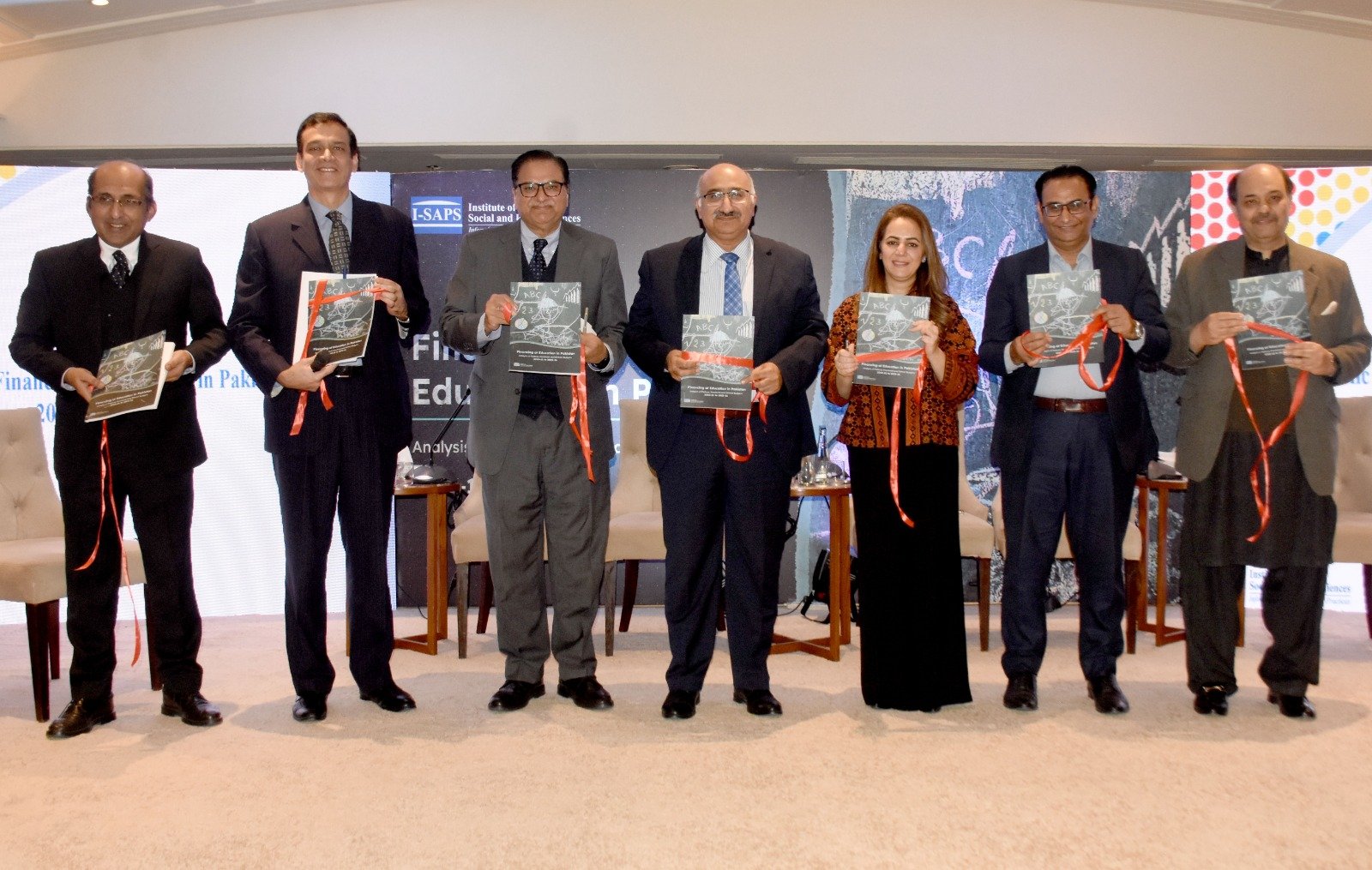
ISLAMABAD: Pakistan’s total education spending has reached Rs5.03 trillion, with household contributions surpassing government investment for the first time in the country’s history, raising serious concerns over equity and access, according to a new report released by the Institute of Social and Policy Sciences (I-SAPS).
The findings were unveiled during a National Policy Dialogue marking the launch of I-SAPS’s 15th annual report on Public Financing of Education, which highlights a major shift in Pakistan’s education financing landscape. According to the report, household spending on education has climbed to Rs2.80 trillion, exceeding public sector investment of Rs2.23 trillion.
Also Read: Pakistan, Canada discuss cooperation in medical education and specialist training
The report shows that households now account for 56 per cent of total education spending, while the public sector contributes 44 per cent. Private expenditure includes Rs1.31 trillion spent on private school fees, Rs613 billion on shadow education and tuition, and Rs878 billion in other out-of-pocket costs such as uniforms, transport, and learning materials.
I-SAPS said this is the first comprehensive analysis in Pakistan to capture both public education budgets and household-level education spending. The findings come at a time when an estimated 25 million children remain out of school, underscoring deepening inequalities in access to education.
“Families are financing education at a scale that raises fundamental equity concerns,” said Dr Salman Humayun, Executive Director of I-SAPS. “When household spending surpasses public investment, we must ask who is able to afford education and who is being excluded.”
Addressing the dialogue, Mazhar Siraj, Education Team Leader at the Foreign, Commonwealth and Development Office (FCDO), stressed the need to move beyond input-heavy spending models. He said outcome-based financing and efficiency reforms are essential but require strong data systems and governance frameworks to succeed.
Izzah Farrukh, Senior Education Specialist at the World Bank, observed that the rapid expansion of private schooling reflects public dissatisfaction with government-run schools. She said families are increasingly opting out of public education systems where responsiveness and accountability have weakened.
Meanwhile, Dr Shahid Soroya, Director General of the Pakistan Institute of Education, highlighted the importance of sustained evidence generation and acknowledged efforts by the federal ministry and development partners to strengthen annual education data consolidation.
Former Federal Secretary for Finance and current Federal Secretary for Health, Hamed Yaqoob Sheikh, praised I-SAPS for introducing analytical frameworks that enable more informed resource allocation across social sectors, particularly in fiscally constrained environments.
Concluding the dialogue, Ahmad Ali, Director Programmes at I-SAPS, called for a strong public policy response. He said rising private spending should be treated as a warning signal, urging the government to strengthen public education systems, improve efficiency, and develop financing models that protect equity—especially for girls and marginalised learners.
Participants broadly agreed that Pakistan’s education financing has reached a critical turning point, warning that decisions in upcoming budget cycles will determine whether increased spending improves learning outcomes or further entrenches inequality.

 Today's E-Paper