
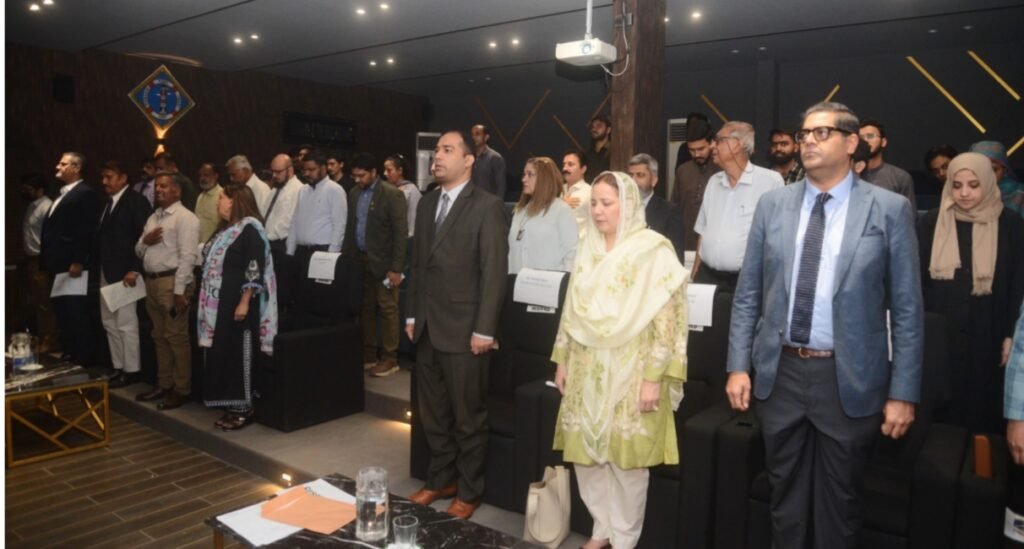
KARACHI, October 1, 2026: BlueNet+ organized a seminar in Karachi to mark World Maritime Day 2026, calling for stronger integration and implementation of Pakistan’s existing maritime, environmental and economic policies to unlock the country’s Blue Economy potential.
Held under the theme “From Policy to Practice: Powering Maritime Excellence,” the seminar was organized in collaboration with Karachi Port Trust (KPT) and the National Institute of Oceanography (NIO) at KPT Staff College, Lalazar.
The event brought together 13 speakers and representatives from 57 organizations, including government institutions, maritime organizations, academia, research bodies, environmental agencies, businesses, media, tourism and fisheries sectors, civil society, professionals, youth and students.
Dr. Nuzhat Khan, Founder and CEO of BlueNet+, said Pakistan does not simply need more policies but stronger integration and implementation of those already in place, with the Blue Economy becoming an integral component of national economic development.
She said maritime and Blue Economy considerations should be incorporated across economic, trade, investment, climate, tourism, fisheries, environmental, science and technology policies.
“The missing link is integration, from policy to investment, implementation and measurable impact,” she said.
Dr. Khan identified three interconnected pillars of a sustainable Blue Economy: economic prosperity, ecosystem health and human well-being, supported by science, policy, governance, finance and technology.
Speaking from the business perspective, Mr. Shabbir Hassan Mansha, Chairman PALIMA/Mansha Group and former Vice President of FPCCI, emphasized stronger links between policy, business, investment, trade and entrepreneurship.
He highlighted the importance of maritime trade and investment and stronger private-sector participation in converting Pakistan’s maritime potential into economic value. He also called for an enabling business environment, efficient ports and logistics, investment-friendly policies and stronger public-private partnerships.
Engr. Naimatullah Sohoo, Director General of the National Institute of Oceanography, stressed the importance of marine research, ocean data and stronger science-policy linkages.
He emphasized that scientific knowledge should support practical decision-making, investment and sustainable maritime development.
Ms. Iram Tanveer, Director General, Press Information Department (PID) Karachi, highlighted the role of media and strategic communication in bringing Blue Economy issues into the national discourse, raising public awareness and connecting maritime policies and opportunities with communities.
The seminar covered a wide range of issues, including maritime trade and investment, marine science, fisheries, coastal tourism, climate resilience, biodiversity conservation, marine pollution and waste management, digitalization, entrepreneurship, and greater participation of women and youth.
Participants also discussed the importance of responsible ocean governance and stronger collaboration among government, science, business, academia, media and communities.
The seminar outlined a collective pathway for advancing Pakistan’s maritime sector:
Research & Data → Evidence → Integrated Policy → Investment → Implementation → Impact
Concluding the event, Dr. Nuzhat Khan said the transition from policy to practice should become a collective national pathway, with Pakistan’s Blue Economy connecting economic prosperity, ocean health and human well-being while protecting maritime resources for future generations.
The seminar reaffirmed the need for coordinated action to build a resilient, inclusive and sustainable maritime future for Pakistan.