
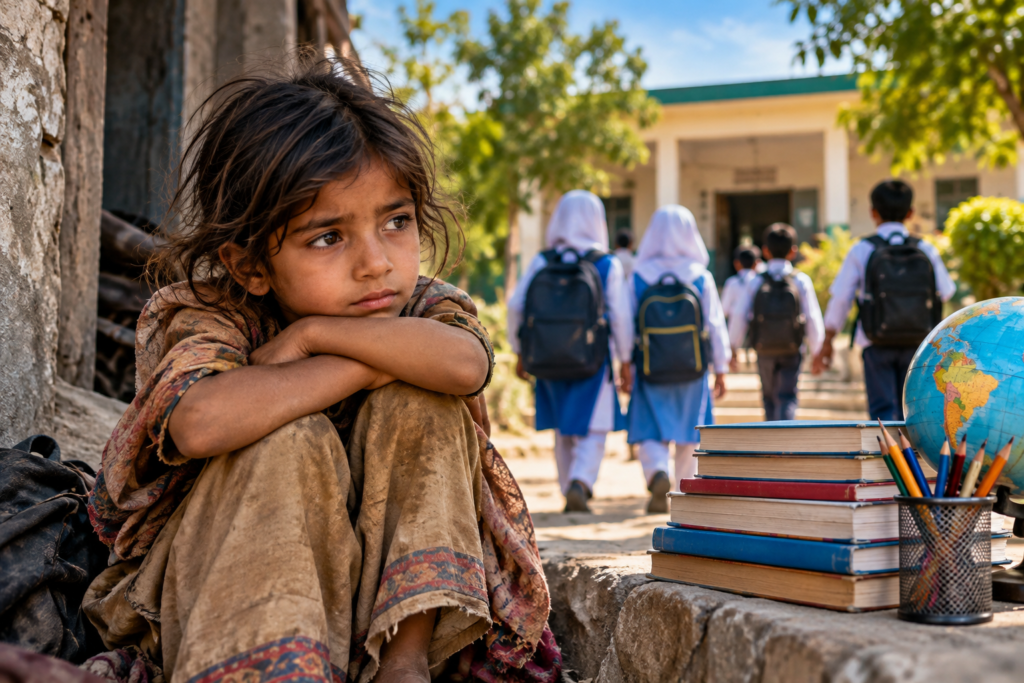
ISLAMABAD, September 8: Pakistan’s estimated 21.1 million out-of-school children highlight the urgent need for the state to make education a national priority and fulfill its constitutional responsibility to ensure access to schooling for all children, speakers at a policy discussion said.
The remarks were made during a discussion organized by the Institute of Policy Studies (IPS), Islamabad, to mark World Literacy Day on September 8. Participants expressed concern over the large number of children excluded from the education system and called for sustained policy attention to improve enrolment and access to quality education.
21.1 Million Children Remain Out of School
According to statistical estimates cited during the discussion, approximately 21.1 million children in Pakistan are out of school. The estimate is based on data from the Household Integrated Economic Survey and projected population figures from the National Institute of Population Studies.
Participants said the scale of the problem reflects a significant gap between Pakistan’s constitutional commitment to education and the reality faced by millions of children.
Article 25-A Places Responsibility on State
The discussion focused on Article 25-A of the Constitution of Pakistan, which establishes free and compulsory education for children between the ages of five and 16 as a state responsibility.
Speakers stressed that the constitutional provision makes education more than a development objective, placing an obligation on the state to establish effective institutional and policy mechanisms to ensure children can access schooling.
Participants also referred to the importance of acquiring knowledge through observation, reasoning and learning, emphasizing the broader intellectual and social value of education.
Education Linked to SDG 4
Pakistan’s international commitments were also discussed, particularly Sustainable Development Goal 4 (SDG 4), which calls for inclusive and equitable quality education and lifelong learning opportunities for all.
Participants said Pakistan’s constitutional and international commitments require effective measures to increase school enrolment, reduce educational exclusion and ensure children can exercise their right to education.
Enrolment Targets Alone Not Enough
Speakers emphasized that addressing the out-of-school children crisis requires more than setting enrolment targets. They called for sustained efforts to identify and address the structural factors that prevent children from entering or remaining in the formal education system.
Stronger policy implementation, institutional coordination and sustained attention from government bodies were identified as essential to improving educational access.
IPS Calls for Education to Become National Priority
The discussion formed part of IPS’s broader engagement with social development and public policy issues. The institute said its work on children’s education aims to contribute to informed policy debate on fulfilling Pakistan’s constitutional obligations and advancing its global education commitments.
In his concluding remarks, IPS Chairman Khalid Rahman emphasized the need to make education a vital national priority. He said universal and quality education would require coordinated efforts by governments at all levels, relevant institutions and society to ensure that no child remains deprived of education.