
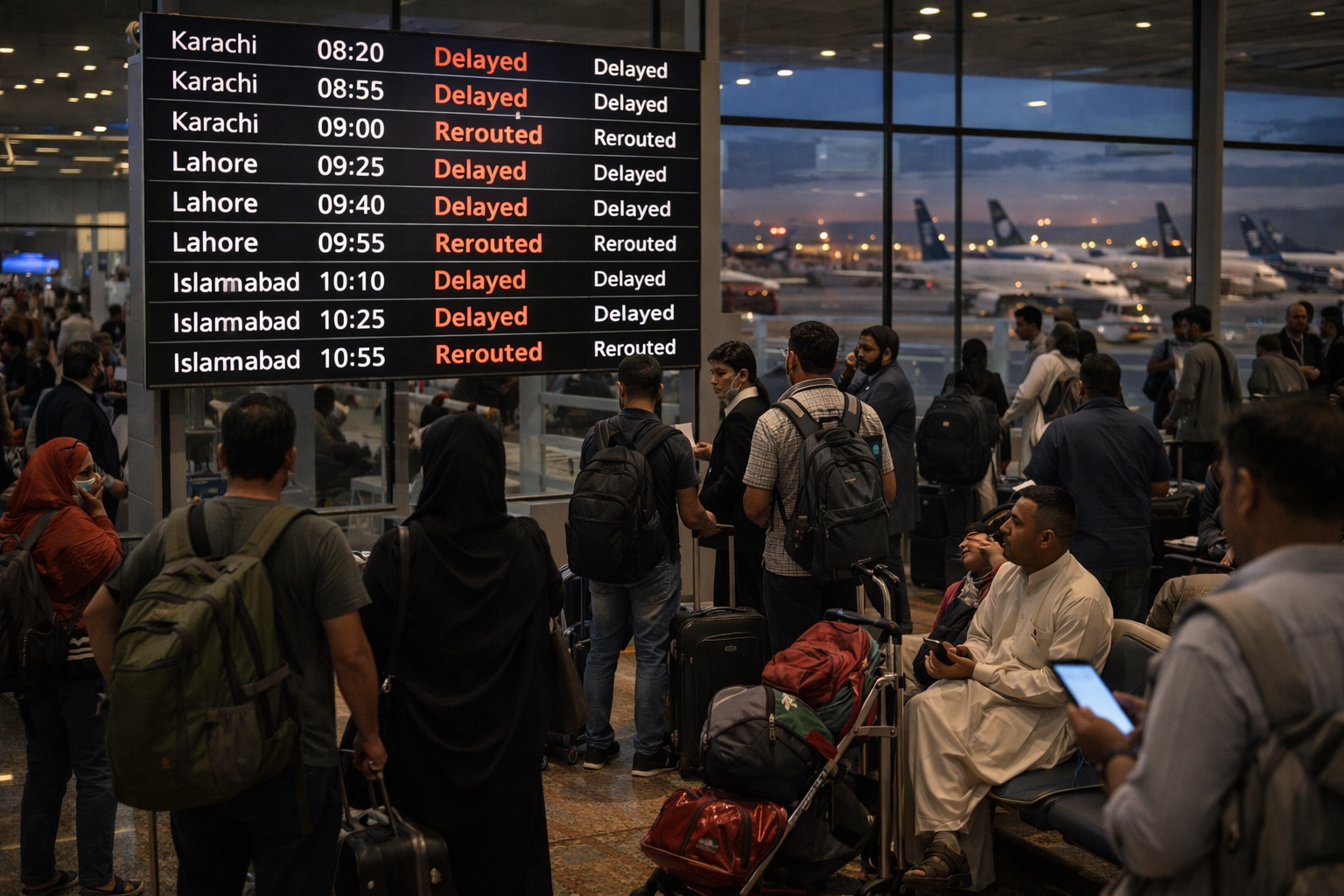
ISLAMABAD — Ongoing military tensions involving Iran have disrupted large parts of Middle Eastern airspace, affecting thousands of passengers and forcing airlines to cancel or reroute flights across the region. The situation has created uncertainty for many Pakistanis working in Gulf countries who are trying to travel home.
Several traditional flight corridors between the Gulf and South Asia have been restricted or temporarily closed due to security concerns. Airlines are now avoiding parts of Iranian, Iraqi and neighboring airspace, forcing flights to use longer routes through safer corridors. As a result, travelers are relying on alternative transit hubs and indirect routes to reach Pakistan.
This explainer outlines the available air routes, alternative transit countries, operational airlines, and practical options for Pakistanis returning from Gulf states during the ongoing aviation disruption.
Why flights between Pakistan and the Gulf are disrupted
The aviation disruption began after heightened regional tensions led several countries to restrict or close their airspace for security reasons. The affected airspace lies along the central Middle East aviation corridor that normally carries large volumes of international traffic between Asia, Europe and the Gulf.
Airspaces facing restrictions or closures include:
-
Iran
-
Iraq
-
Syria
-
Israel
-
Jordan
-
Qatar
-
Bahrain
-
Kuwait
Because these airspaces form the core of regional aviation routes, airlines have had to redesign flight paths or suspend operations temporarily.
The disruption has affected flights to and from major Pakistani airports including Karachi, Lahore and Islamabad, as well as Gulf hubs such as Dubai, Abu Dhabi and Doha.
Airspaces that remain operational
Despite widespread disruptions, several airspaces remain open and are being used for rerouted flights.
Pakistan
Pakistan’s airspace remains operational and has become an important corridor for aircraft avoiding restricted zones.
Oman
Oman has emerged as one of the most important alternative aviation hubs during the crisis. Muscat International Airport continues operating normally and is being used by airlines to reroute flights.
Saudi Arabia
Saudi Arabia’s airspace remains open, although flights are operating under revised routing plans to avoid nearby restricted zones.
Turkey
Turkey is outside the conflict zone and continues to operate normally, making Istanbul an important global transit hub.
Southeast Asia
Airports in Southeast Asia such as Bangkok continue to operate international flights and can be used as alternative transit points.
Transit countries Pakistanis can use to return home
Because direct flights may be limited, travelers may need to transit through other countries before reaching Pakistan.
Oman (Muscat)
Muscat has become one of the most reliable transit hubs because its airspace remains open and it connects with South Asian destinations.
Typical route:
Dubai or Abu Dhabi → Muscat → Karachi/Lahore/Islamabad
Saudi Arabia
Saudi Arabia’s airports continue handling international traffic and offer connections to Pakistan.
Common route:
UAE/Qatar → Riyadh or Jeddah → Pakistan
Turkey
Istanbul remains a major global hub with frequent flights to Pakistan.
Possible route:
Dubai/Abu Dhabi → Istanbul → Pakistan
Thailand
Bangkok’s Suvarnabhumi Airport is another option for long-distance rerouting.
Possible route:
Dubai → Bangkok → Pakistan
Central Asia
Some airlines are using northern corridors over Central Asia.
Possible transit points include:
-
Azerbaijan
-
Uzbekistan
-
Kazakhstan
Flights travel through these regions before heading south toward Pakistan.
Airlines operating limited flights
Several airlines continue to operate reduced or adjusted services despite regional disruptions.
Airlines currently running limited operations include:
-
Emirates
-
Etihad Airways
-
Qatar Airways
-
Oman Air
-
Turkish Airlines
-
FlyDubai
-
Pakistan International Airlines (PIA)
Schedules may change frequently depending on airspace restrictions.
Alternative travel options within the Gulf
Some travelers are using land travel within the Gulf region to reach airports where flights remain available.
Examples include:
-
UAE → Oman by road → Muscat flight to Pakistan
-
UAE → Saudi Arabia → flight to Pakistan
These options require valid visas and travel documentation for border crossings.
Routes airlines are currently avoiding
Most airlines are avoiding flying through several high-risk airspaces linked to the regional conflict.
These include:
-
Iran
-
Iraq
-
Syria
-
Israel
-
parts of the Persian Gulf
Flights are instead routed through safer corridors over the Arabian Sea, Saudi Arabia, Oman or Central Asia.
How airlines are rerouting flights to Pakistan
Typical rerouting patterns now include:
-
Gulf → Saudi Arabia → Arabian Sea → Pakistan
-
Gulf → Oman → Arabian Sea → Pakistan
-
Gulf → Turkey → Pakistan
-
Gulf → Southeast Asia → Pakistan
These routes are longer but allow aircraft to avoid restricted zones.
Advice for Pakistanis planning to travel
Travel experts recommend the following steps during the current disruption:
Confirm flights before leaving for the airport
Airlines may cancel or reschedule flights at short notice.
Monitor airline announcements
Airlines often issue updates about route changes or additional flights.
Allow extra travel time
Rerouted flights may take longer than usual.
Keep travel documents ready
Transit visas may be required for some countries.
Consider flexible bookings
Tickets that allow changes or refunds reduce financial risk.
Outlook for flight operations
Aviation analysts say disruptions could continue until regional security conditions improve and restricted airspaces reopen.
Even if tensions ease quickly, airlines may take time to restore normal routes because flight planning and safety clearances must be updated across the region.
For now, travelers returning to Pakistan from Gulf countries may need to rely on indirect routes and transit hubs such as Muscat, Riyadh, Istanbul or Bangkok until normal flight corridors reopen.




 Today's E-Paper