
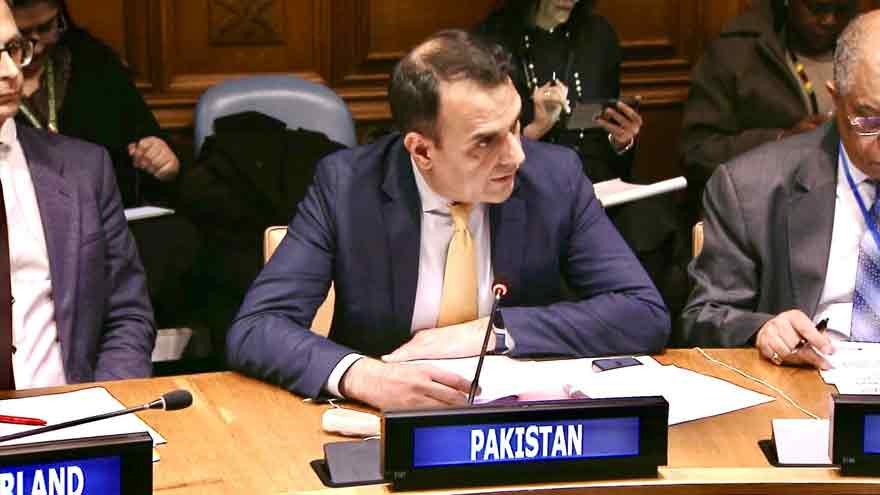
NEW YORK: Pakistan has warned the United Nations that India’s decision to place the Indus Waters Treaty (IWT) in abeyance and subsequent actions affecting downstream water flows have created a serious threat to Pakistan’s water security and regional stability.
Speaking at the Global Water Bankruptcy Policy Roundtable hosted by the Permanent Mission of Canada and the United Nations University, Pakistan’s acting Permanent Representative to the UN, Usman Jadoon, said India’s unilateral steps had undermined a long-standing framework governing shared water resources.
Jadoon said India’s move in April last year to suspend implementation of the treaty, along with unannounced disruptions of downstream water flows and the withholding of hydrological data, had created what he described as an unprecedented situation for Pakistan, a lower-riparian state heavily dependent on the Indus River system.
The ambassador stressed that Pakistan considers the Indus Waters Treaty of 1960 to remain legally binding and intact, adding that it does not permit unilateral suspension or modification. He noted that for more than six decades, the treaty has provided a predictable and equitable mechanism for managing the waters of the Indus basin.
Also Read: Pakistan Presses India to Uphold Indus Waters Treaty Amid Devastating Floods
According to Jadoon, the Indus River basin supports one of the world’s largest contiguous irrigation systems, meeting more than 80 percent of Pakistan’s agricultural water requirements and sustaining the livelihoods of over 240 million people.
He said water insecurity has emerged as a systemic global risk, affecting food production, energy systems, public health, livelihoods, and human security across regions. For Pakistan, he added, these risks are compounded by its semi-arid geography, climate vulnerability, floods, droughts, accelerated glacier melt, groundwater depletion, and rapid population growth.
Outlining Pakistan’s domestic response, Jadoon said the country is working to strengthen water resilience through integrated planning, flood protection measures, irrigation rehabilitation, groundwater recharge, and ecosystem restoration. He cited initiatives such as “Living Indus” and “Recharge Pakistan” as part of these efforts.
However, he cautioned that systemic water risks in shared river basins cannot be addressed by individual states acting alone. He said predictability, transparency, and cooperation in transboundary water governance are essential for the survival of downstream populations.
Jadoon urged the international community to recognise water insecurity as a global systemic risk ahead of the 2026 UN Water Conference and called for stronger cooperation and adherence to international water law to ensure the protection of vulnerable downstream communities.





 Today's E-Paper