
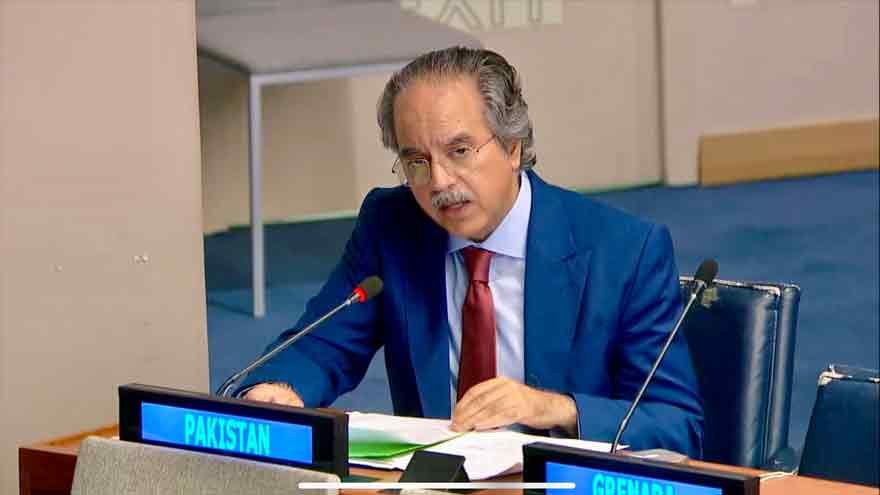
NEW YORK: Pakistan has called on the United Nations Security Council to move swiftly to designate the Balochistan Liberation Army (BLA) as a terrorist organisation under the UN sanctions regime, citing what it described as the group’s role in deadly attacks and external support networks.
Addressing a Security Council debate on threats to international peace and security caused by terrorist acts, Pakistan’s permanent representative to the UN, Asim Iftikhar Ahmad, said the BLA should be listed under the sanctions framework established by Resolution 1267. He noted that the United States has already designated the group as a foreign terrorist organisation.
The envoy said militant groups, including the Tehreek-e-Taliban Pakistan (TTP) and the BLA, had expanded their activities following political developments in Afghanistan, adding that Pakistan remained committed to eliminating terrorist threats from its territory.
Calling for a collective and coordinated international response, Ambassador Asim said counterterrorism efforts must be guided by the balanced implementation of the UN Global Counter-Terrorism Strategy. He raised concerns about militant groups operating from Afghan soil and said these networks posed risks not only to Pakistan but to regional stability.
Referring to recent violence, the Pakistani envoy said the BLA had claimed responsibility for attacks in Balochistan that resulted in civilian casualties. He added that Pakistani security forces had carried out counterterrorism operations in response, leading to the killing of a large number of militants.
Ambassador Asim also highlighted Pakistan’s broader counterterrorism record, stating that the country had suffered tens of thousands of casualties over the years while playing a key role in dismantling Al-Qaeda and countering ISIL-Khorasan.
He urged the UN’s counterterrorism architecture and sanctions mechanisms to address emerging and evolving threats in a fair and comprehensive manner, stressing the need to avoid double standards in global counterterrorism policies.
The debate also heard briefings from UN counterterrorism officials, who warned that groups such as ISIL and its affiliates continue to adapt despite sustained international pressure, underscoring the need for continued global cooperation.


 Today's E-Paper