
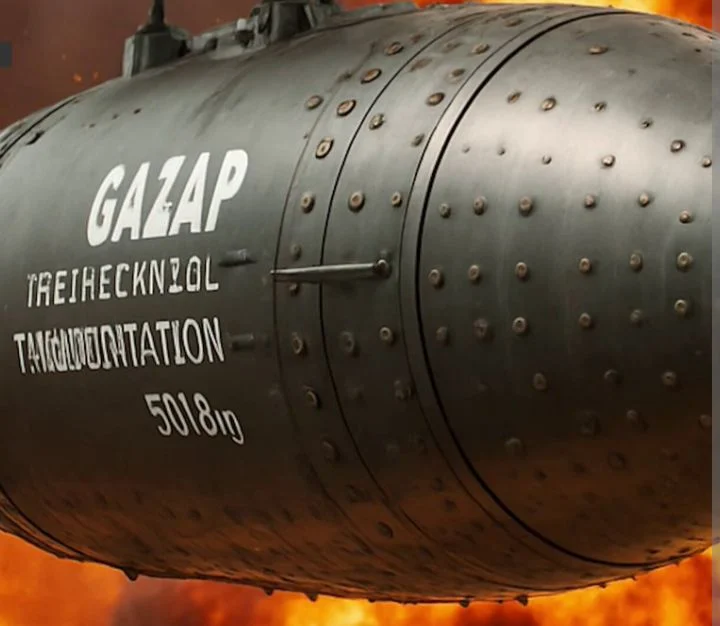
Defence analysts say Pakistan is assessing whether to integrate Turkey’s GAZAP high-explosive warhead into parts of its missile arsenal, a move that could expand its conventional strike capabilities in South Asia. The discussions follow the public unveiling of the GAZAP bomb at Turkey’s major defence exhibition in 2025 and come amid continued military cooperation between Islamabad and Ankara.
What is the GAZAP warhead?
The GAZAP is a 970-kilogram high-explosive aerial bomb developed by Turkey’s Ministry of National Defence research and development centre. It was formally introduced at the International Defence Industry Fair in Istanbul.
Turkish officials describe it as the country’s most powerful non-nuclear aerial bomb. It is broadly based on the Mk-84 class of general-purpose bombs but incorporates thermobaric and enhanced fragmentation features.
A thermobaric weapon disperses fuel in the air before detonation, creating a high-temperature blast wave that can produce sustained overpressure in enclosed spaces. According to publicly released specifications, the GAZAP disperses thousands of controlled fragments and is designed to increase blast and fragmentation density over a defined area.
How could Pakistan use it?
Analysts suggest Pakistan could explore adapting the GAZAP’s warhead design for use on surface-to-surface or cruise missile platforms rather than limiting it to aircraft delivery.
Pakistan operates several missile systems, including variants of the Babur cruise missile and the Ra’ad air-launched cruise missile. If adapted for missile integration, the warhead could theoretically be used for conventional precision strikes on fixed infrastructure targets.
There has been no official confirmation from Pakistani authorities that such integration has been approved or completed.
Why does it matter regionally?
Military analysts note that conventional long-range strike capability plays a role in deterrence strategies between India and Pakistan. Airbases, logistics hubs and fuel depots are often considered critical infrastructure in military planning.
Some assessments identify Indian Air Force facilities in northeastern India, such as Tezpur Air Force Station and Bagdogra Air Force Station, as being within range of certain Pakistani missile systems. Extended-range platforms could also theoretically reach strategic locations in the Andaman and Nicobar Islands.
Any shift in conventional strike capability could influence how both sides assess air defence, early warning systems and force protection measures.
What is the Pakistan–Turkey defence relationship?
Pakistan and Turkey have expanded defence cooperation over the past decade.
Turkey has supplied Bayraktar TB2 drones to Pakistan and collaborated on naval projects such as the MILGEM corvette program. Turkish firms have also been involved in modernization support for Pakistan’s F-16 fighter fleet.
The GAZAP bomb’s development is linked to Turkey’s broader effort to expand its domestic defence manufacturing base, including companies such as Roketsan.
Has anything been confirmed?
As of now, there is no official announcement confirming that Pakistan has integrated the GAZAP warhead into any missile system. Reports reflect defence analysis and assessments rather than declared procurement decisions.
Military modernization programs typically require testing, certification and compatibility studies before operational deployment. Any confirmed integration would likely involve technical modifications to ensure compatibility with guidance systems and delivery platforms.
What happens next?
If Pakistan proceeds with integration, analysts say it would represent an expansion of its conventional deep-strike options without altering its nuclear posture.
Regional observers will likely monitor official statements, defence procurement disclosures and future joint exercises for indications of whether such a capability moves from assessment to operational deployment.



 Today's E-Paper