
ISLAMABAD — Mishal Pakistan on Monday launched the Pakistan Reforms Report 2026, presenting the most extensive documentation to date of governance reforms undertaken across the country during 2025.
Released in Islamabad, the report records more than 600 reforms implemented across 135 federal ministries, divisions, and attached institutions, marking a fivefold increase compared to the previous edition. The publication is the second edition of Pakistan’s first systematic effort to track governance reforms on an annual basis and is designed to provide researchers, policymakers, investors, and international partners with a clearer picture of how state institutions are evolving.
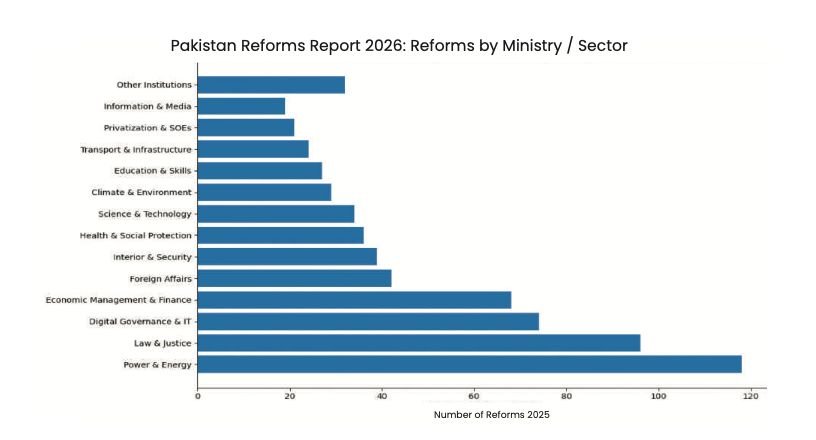
According to the report, reform priorities have shifted from short-term stabilization toward long-term state capacity building. The energy sector accounted for around 40 percent of total reform activity, followed by Law and Justice and Digital Governance and IT, indicating a strong emphasis on structural reform and digitization.
Energy, digital governance drive reform momentum
The report notes that more than 200 reforms were implemented through digital platforms, aimed at improving transparency, reducing administrative discretion, and strengthening service delivery. Fiscal and energy sector measures, including renegotiated independent power producer contracts, are projected to generate savings of approximately PKR 1.4 trillion in the power sector.
It also highlights progress in unlocking indigenous resources, citing developments related to the Reko Diq copper-gold project and new policies for tight gas and offshore exploration, which together target billions of dollars in potential investment.
Launch attended by federal minister
The launch ceremony was attended by Dr. Musadik Malik, Federal Minister for Climate Change and Environmental Coordination, as chief guest. Speaking at the event, the minister emphasized the role of credible and transparent documentation in strengthening public trust and enhancing Pakistan’s credibility with international partners.
He said the report helps shift attention from policy announcements to implementation and outcomes, enabling more informed public discourse on governance reforms.
Focus on institutions and SDG-16
The Pakistan Reforms Report 2026 clarifies that it is not a performance ranking or political assessment, but a documentation exercise intended to track how reforms are being institutionalized over time and how they may affect state capacity and citizen services.
A key finding is the concentration of reforms aligned with Sustainable Development Goal 16, which focuses on peace, justice, and strong institutions. The report highlights reforms related to rule of law, accountability, regulatory modernization, grievance redressal, digital justice, and public access to information, positioning institutional strengthening as a central reform priority.
Reform momentum amid constraints
The report situates these developments within the broader national context of 2025, marked by fiscal pressures, security challenges, and regional and geopolitical tensions. Despite these constraints, it notes that reform momentum remained steady, particularly in digitization, institutional coordination, and regulatory frameworks.
Mishal Pakistan, the Country Partner Institute of the World Economic Forum, said the annual documentation aims to support year-on-year comparison and promote an evidence-based understanding of governance change in Pakistan.




 Today's E-Paper