
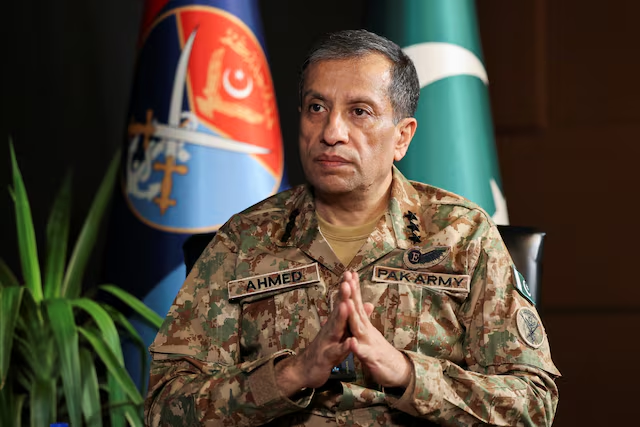
Pakistan’s military has expressed cautious optimism about its efforts to mediate between Iran and the United States, as Islamabad continues diplomatic engagements aimed at de-escalating the eight-month-old conflict.
Inter-Services Public Relations (ISPR) Director General Lieutenant General Ahmed Sharif Chaudhry made the remarks in an interview with Reuters on Friday, his first since a high-level Pakistani delegation visited Tehran earlier this week.
Pakistan’s Army Chief, Field Marshal Asim Munir, has travelled to Tehran twice this month as part of Islamabad’s mediation efforts, most recently on Monday alongside Saudi and Turkish officials.
Asked whether the visits indicated progress, Chaudhry said the army chief would not have travelled twice without some positive developments. However, he stressed that Pakistan remained “cautiously optimistic” about the process.
He also warned that influential actors continued to oppose efforts to end the conflict, suggesting that some parties believed the continuation of hostilities served their interests. He did not identify them.
Pakistan, Saudi Arabia and Türkiye Coordinate on Regional Security
Munir’s latest visit to Tehran included Saudi Defence Minister Prince Khalid bin Salman and Turkish intelligence chief Ibrahim Kalin. The discussions took place amid growing concerns that the Iran-US confrontation could trigger a wider regional conflict.
Pakistan, Saudi Arabia and Türkiye signed a joint defence agreement on August 7, under which an attack on any signatory would be treated as an attack on all. The agreement, known as the Mecca Joint Defence Agreement, has gained significance as regional powers seek to manage the conflict’s consequences.
Following Monday’s talks, Mohsen Rezaei, secretary of Iran’s Supreme National Security Council, said regional security should be maintained by countries in the region without foreign intervention.
Chaudhry said the agreement did not prohibit additional members and that Iran could potentially join, although the decision would rest with the political leadership of the three principal signatories.
He also said any additional deployment of Pakistani troops to Saudi Arabia would depend on the circumstances and decisions made by both countries’ political leadership.
Pakistan remained committed to defending Saudi Arabia and the holy sites of Mecca and Medina, he said. However, Chaudhry clarified that Pakistan was not involved in the conflict between Saudi Arabia and Yemen’s Iran-aligned Houthi group.
Military Signals Increased Counterterrorism Operations in KP
The ISPR chief also addressed Pakistan’s domestic security situation, particularly developments in Khyber Pakhtunkhwa, where the provincial government led by Pakistan Tehreek-e-Insaf (PTI) has faced federal government action.
The federal government suspended the provincial government on October 11 and detained Chief Minister Sohail Afridi, accusing the administration of failing to address militancy. PTI rejected the allegations, maintaining that its government had participated in counterterrorism efforts and describing the move as an attempt to suppress protests.
Asked whether the military would launch larger operations in the province, Chaudhry said the army’s counterterrorism strategy relied on intelligence-based operations rather than the approach suggested in the question.
He said the pace of these operations would increase, adding that intelligence-based operations remained central to the military’s counterterrorism efforts.
Regional Diplomacy Faces Significant Challenges
Pakistan’s mediation efforts are unfolding against a backdrop of shifting regional alliances, heightened security concerns and fears of further escalation across the Middle East.
While Islamabad remains hopeful that continued diplomatic engagement could help reduce tensions between Washington and Tehran, the military has acknowledged that significant obstacles remain.
The latest statements indicate that Pakistan intends to continue pursuing regional de-escalation while maintaining its defence commitments to Saudi Arabia and intensifying security operations at home.