
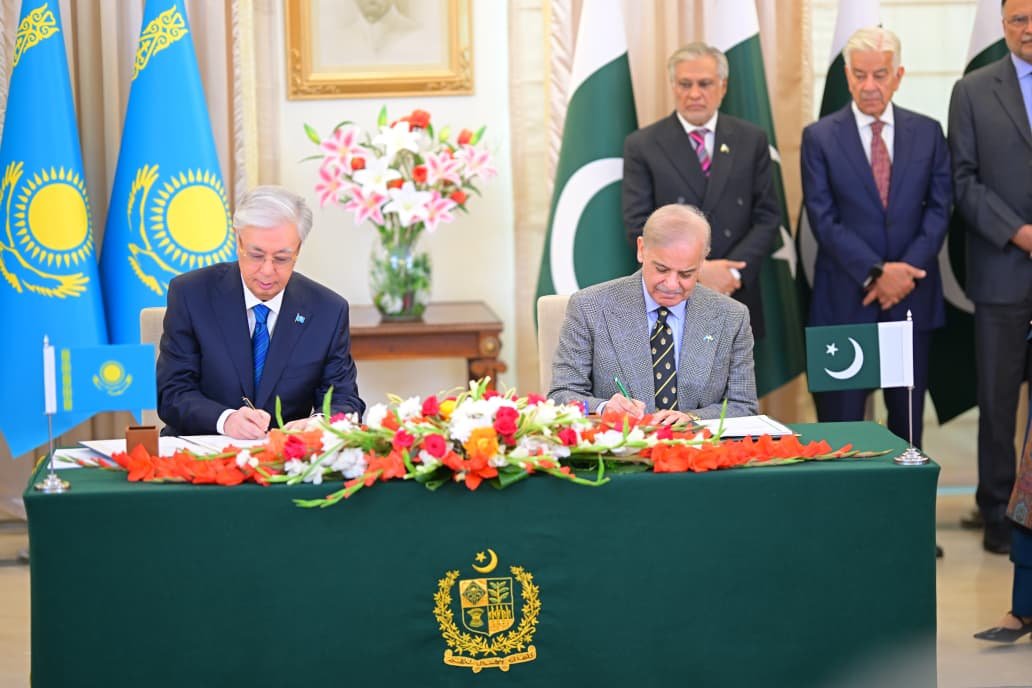
ISLAMABAD — Pakistan and Kazakhstan on Tuesday signed a joint declaration establishing a strategic partnership, marking a significant step toward deepening bilateral cooperation across trade, energy, connectivity, defence, and regional integration.
The declaration was signed by Shehbaz Sharif and Kassym-Jomart Tokayev following bilateral talks in Islamabad.
Addressing a joint press briefing, Prime Minister Shehbaz Sharif described the signing as a historic moment for the two countries, aimed at advancing shared goals of peace, progress, and prosperity. He said Pakistan and Kazakhstan currently have a trade volume of around $250 million, stressing the need for joint efforts to raise it to $1 billion within the next year.
Trade, connectivity, and energy cooperation
The prime minister said both sides agreed to encourage their business communities to invest in joint ventures and enhance economic collaboration. He added that Pakistan has offered Kazakhstan full access to its transit infrastructure and seaport facilities, including Karachi and Gwadar ports.
Sharif said the two countries also agreed to support the Belarus–Russia–Kazakhstan–Uzbekistan–Afghanistan–Pakistan transport corridor to strengthen regional connectivity. Highlighting the natural resource potential of both nations, he said cooperation in the energy sector would be mutually beneficial.
The prime minister reiterated that Pakistan views Kazakhstan as a strategic and highly valued partner in Central Asia and pledged close coordination to ensure swift implementation of the 37 memoranda of understanding (MoUs) signed during the visit.
Expanding cooperation across sectors
President Kassym-Jomart Tokayev said Pakistan is a reliable and important partner for Kazakhstan in South Asia and beyond. He noted that the two countries share centuries-old ties rooted in the legacy of the Silk Road, along with strong cultural and spiritual connections.
Describing the declaration as historic, Tokayev said elevating relations to a strategic partnership would open new opportunities across bilateral and multilateral agendas. He praised Pakistan’s role at the United Nations Security Council and acknowledged the country’s economic potential, industrial base, and transport and transit capabilities.
The Kazakh president said both sides agreed to expand cooperation in the defence industry, as well as between security and law enforcement agencies. He also confirmed agreement to work toward increasing bilateral trade to $1 billion and prioritising transport and logistics projects to support this goal.
Ports, air links, and regional projects
Tokayev said discussions included the potential use of Karachi and Gwadar ports, the possibility of resuming direct air links between the two countries, and cooperation in the energy sector, including prospects related to the TAPI gas pipeline.
Earlier, Pakistan and Kazakhstan signed 37 MoUs and agreements covering petroleum, mining and geosciences, maritime affairs, customs, railways, agriculture, artificial intelligence and digital development, health, education, science and technology, media cooperation, climate change, culture, crime prevention, and sports.
The two sides also signed a treaty on extradition and a transit trade agreement, further strengthening the legal and institutional framework for bilateral cooperation.

 Today's E-Paper