
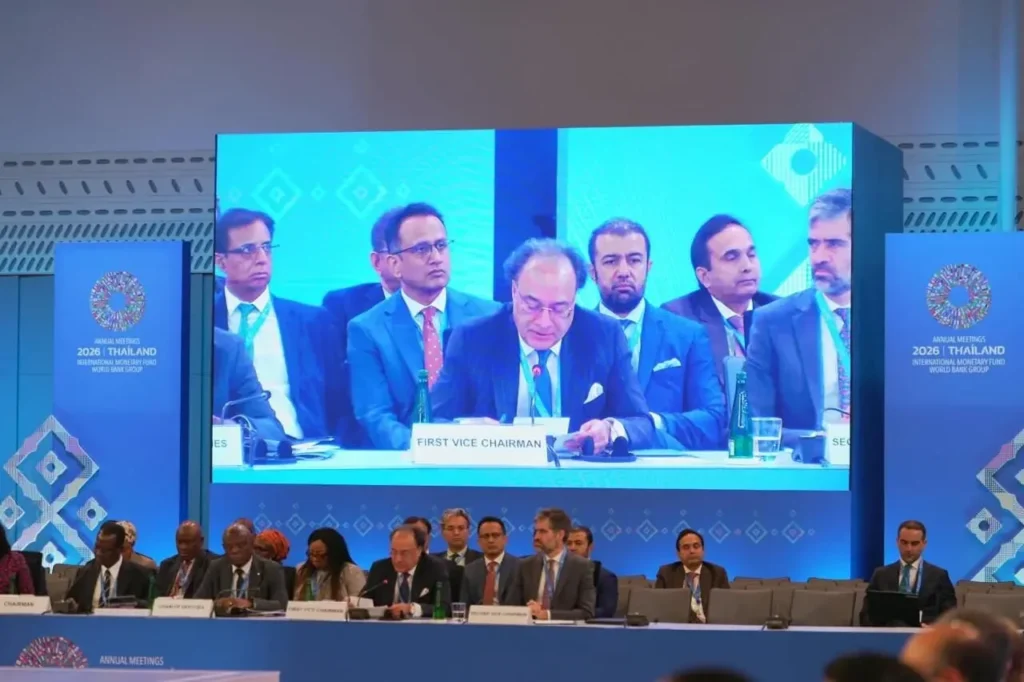
ISLAMABAD, November 1, 2026: Pakistan has assumed the chairmanship of the Group of 24 (G-24), reaffirming its commitment to strengthening the collective voice of developing economies and promoting a fairer, more inclusive and development-oriented international financial system.
According to a statement issued by the Finance Division on Sunday, Federal Minister for Finance and Revenue Senator Muhammad Aurangzeb outlined three strategic priorities for Pakistan’s chairmanship, focusing on growth-led economic policies, stronger representation of developing countries in global financial institutions and reforms to the international financial architecture.
Describing the chairmanship as a significant responsibility, the finance minister called for renewed international cooperation, stronger multilateral institutions and greater global commitment to addressing climate shocks, development financing gaps and widening economic inequalities.
He emphasised that the future of developing economies was not merely linked to the future of the global economy but was central to it.
Aurangzeb highlighted the immense potential of emerging and developing nations as drivers of investment, innovation, industrialisation and global economic growth.
Growth-led policies among key priorities
Outlining Pakistan’s agenda, the minister said the first priority would be placing economic growth at the centre of global policymaking.
He stressed that macroeconomic stability should serve as a foundation for investment, productivity, employment and shared prosperity, enabling developing and low-income economies to move beyond crisis management towards sustainable growth.
The second priority, he said, would be strengthening multilateral frameworks through more inclusive and representative institutions.
Pakistan would advocate fairer governance, meaningful participation in decision-making and greater responsiveness from Bretton Woods institutions, including the International Monetary Fund (IMF) and World Bank, to the changing needs of their member countries.
The third priority would focus on promoting a development-oriented international financial architecture, ensuring timely access to development financing, sustainable debt solutions, stronger global financial safety nets and improved climate resilience.
The minister also emphasised the importance of mobilising public and private capital to support long-term economic development.
“Our task is to ensure that the immense potential of developing economies is not constrained by an international financial architecture that has yet to fully adapt to a changing world,” he said.
Pakistan calls for fairer global financial system
Drawing on Pakistan’s experience of economic stabilisation, reforms and resilience, Aurangzeb highlighted the importance of aligning financial stability with long-term development objectives.
He said economies undergoing structural reforms must have access to adequate financial resources and sufficient policy space to achieve sustainable development.
The finance minister reaffirmed that Pakistan’s chairmanship would follow the G-24’s longstanding principles of consultation, consensus-building and collective advocacy.
He said Pakistan would work closely with member countries across Africa, Asia, Latin America and the Caribbean, as well as the IMF, World Bank and other international partners, to translate shared priorities into practical outcomes.
Aurangzeb also appreciated Nigeria’s leadership as the outgoing chair and expressed Pakistan’s determination to build on the group’s achievements.
He stressed that the effectiveness of collective leadership should be measured by tangible development outcomes rather than statements alone.
“The true measure of our collective leadership is not merely the strength of our voice, but the change that voice brings about,” he said.
Reaffirming Pakistan’s commitment to advancing the G-24’s mission, the minister said the country would strive to move the group from collective voice to collective influence and from collective influence to meaningful progress.