
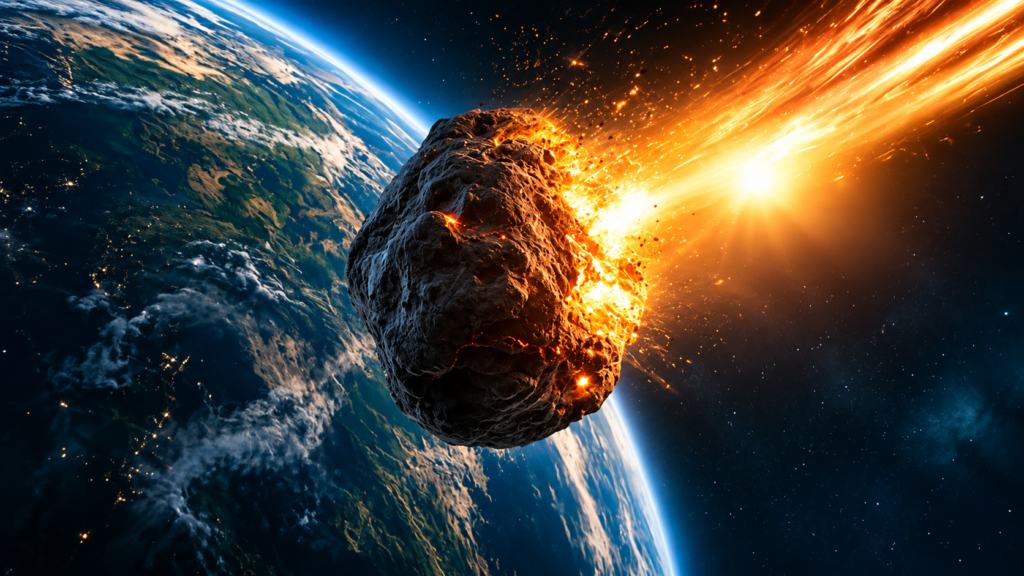
ISLAMABAD, November 10, 2026: A nuclear explosion could help protect Earth from a potentially dangerous asteroid, but a new scientific study suggests that the success of such a mission may depend heavily on which part of the asteroid receives the blast’s energy.
The research, published in the scientific journal Icarus, found that the direction of X-ray radiation striking an asteroid’s surface can significantly influence how much its trajectory changes, highlighting an important challenge for future planetary defence missions.
Scientists have long considered nuclear explosions as a possible last-resort method for redirecting large asteroids threatening Earth.
Rather than directly destroying an asteroid, the proposed technique involves detonating a nuclear device near its surface. Powerful X-rays released by the explosion would rapidly heat the asteroid’s outer layers, causing material to vaporise and escape into space.
This escaping material would generate a reaction force, pushing the asteroid in the opposite direction and potentially changing its path enough to avoid a collision with Earth.
However, researchers found that the effectiveness of this technique depends on the asteroid’s shape, surface features and the direction from which radiation reaches it.
Many computer simulations traditionally represent asteroids as relatively smooth, spherical objects. In reality, most asteroids have irregular shapes, uneven surfaces and complex geological structures.
These differences can influence how radiation interacts with the surface and how much momentum is transferred to the asteroid.
In the new study, researchers simulated X-ray exposure from different directions on the same asteroid model and observed substantial variations in the resulting velocity changes.
One simulation produced a velocity change of 3.9 millimetres per second, while another exposure direction generated a change of just 0.8 millimetres per second.
The results showed an almost fivefold difference in effectiveness, despite the simulations involving the same asteroid.
Nathan Moore, a physicist at Sandia National Laboratories who led the research, said scientists had expected the direction of radiation exposure to influence the outcome, but the magnitude of the difference was surprising.
Although the recorded velocity changes appear small, even a slight adjustment to an asteroid’s speed could produce a substantial change in its position over time, particularly if the intervention takes place years before a predicted Earth impact.
The findings suggest that future planetary defence missions may require detailed information about an asteroid’s three-dimensional shape and surface characteristics before selecting the most effective direction for an intervention.
Researchers believe these insights could improve computer models used to evaluate nuclear deflection strategies and help scientists design more reliable responses to potentially hazardous near-Earth objects.
The study is based on simulations rather than an actual nuclear deflection mission, meaning further research will be necessary to determine how effectively the findings translate to real-world conditions.
The research adds to ongoing efforts to develop technologies capable of preventing catastrophic asteroid impacts, particularly in scenarios where conventional deflection methods may not provide sufficient protection.