
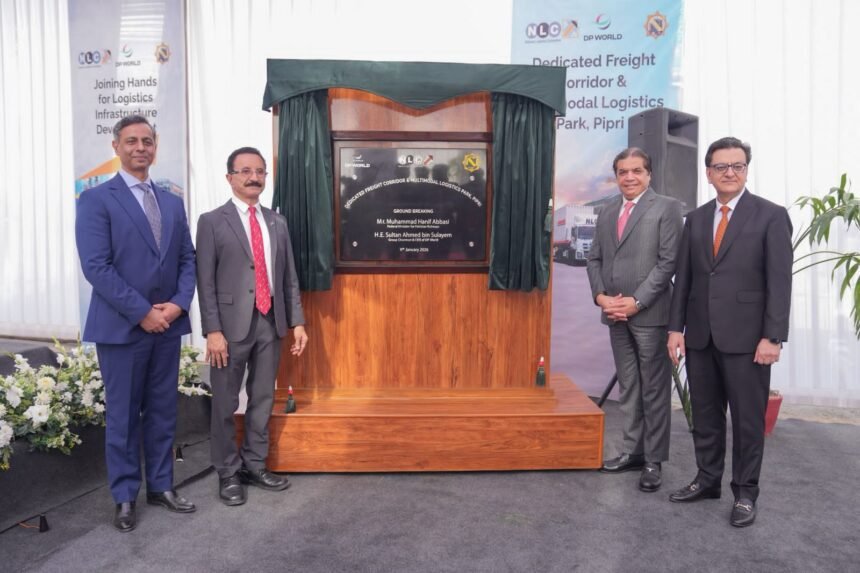
Karachi — In a major step toward resolving Karachi’s long-standing traffic congestion and port inefficiencies, the National Logistics Cell (NLC) has commenced work on a Dedicated Freight Corridor (DFC) and a state-of-the-art Multimodal Logistics Park at Pipri, aimed at transforming freight movement from Karachi Port.
The absence of an efficient rail-based freight transportation system at Karachi Port has long resulted in persistent container congestion, slow cargo clearance, and mounting pressure on the city’s road infrastructure. Heavy reliance on road transport has also contributed to increased environmental pollution and accelerated deterioration of urban roads, negatively impacting economic activity in Pakistan’s commercial hub.
The newly launched project offers a sustainable, long-term solution by shifting a significant portion of containerized cargo from roads to rail. The groundbreaking ceremony of the Dedicated Freight Corridor was attended by Federal Minister for Railways Hanif Abbasi and Group Chairman and CEO of DP World, Sultan Ahmed bin Sulayem, as chief guests, underscoring the project’s national and international importance.
According to officials, NLC will execute the project in multiple phases with an estimated Foreign Direct Investment (FDI) of USD 400 million. The first phase is scheduled to be completed within four months. Key components include the rehabilitation of a 52-kilometre railway corridor linking Karachi Port with Pipri Marshalling Yard, alongside the development of a modern Multimodal Logistics Park equipped to handle large-scale freight operations.
Also Read: Emirates expands Premium Economy rollout to Karachi and ten new cities
The initiative is aligned with the China–Pakistan Economic Corridor (CPEC) framework and Pakistan Railways’ flagship ML-1 project, reinforcing its strategic significance for regional connectivity. Once completed, import containers will be transported directly by rail from Karachi Port to Pipri and then onward to destinations across Pakistan, China, Central Asia, and other regional markets.
Project planners expect the Dedicated Freight Corridor to substantially reduce container congestion at Karachi Port, improve cargo turnaround times, and ease pressure on Karachi’s road network. Beyond logistics efficiency, the project is also projected to deliver environmental benefits through reduced vehicular emissions and to stimulate broader economic activity by enabling faster, more reliable trade flows.





 Today's E-Paper