
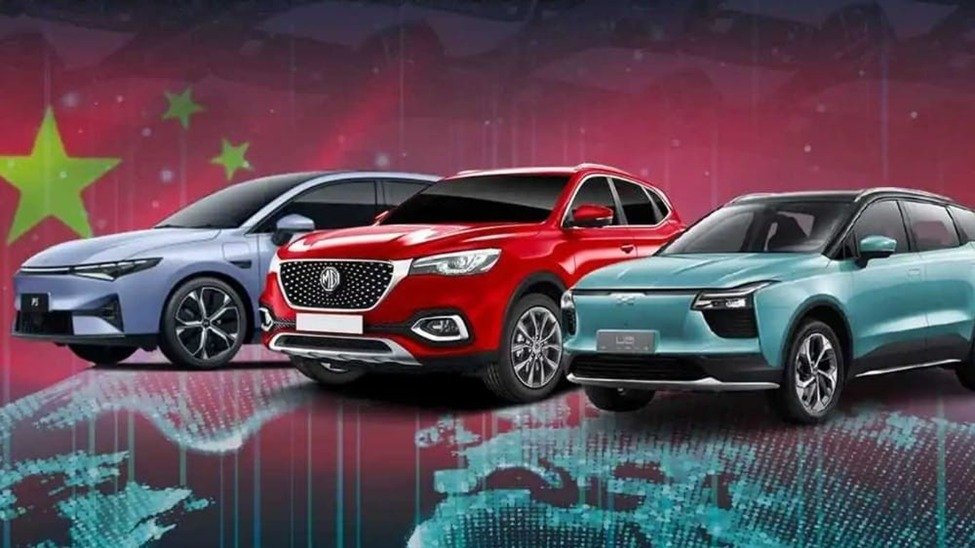
LAHORE, March 16: The entry of several Chinese automobile manufacturers into Pakistan’s market is expanding consumer choice and introducing new technologies, while increasing price competition in a sector long dominated by Japanese brands.
Industry experts say the arrival of new players is gradually reshaping the country’s automobile industry by offering technologically advanced vehicles, particularly in the sport utility vehicle (SUV) and electric vehicle segments.
Mian Muhammad Ali Hameed, Chief Executive Officer of Great Wall Motors Pakistan, said Chinese manufacturers have significantly diversified Pakistan’s auto market. Speaking to Wealth Pakistan, he noted that major Chinese brands operating in the country include Changan Automobile, Great Wall Motors, MG, Chery, Omoda & Jaecoo, BAIC, FAW Group and Jetour. Electric vehicle manufacturer BYD has also recently entered the market.
Also Read: China’s automobile production, sales both surpass 34 million units in 2025
Pakistan currently has around 20 major four-wheeler manufacturing and assembling companies. However, only five of these — three Japanese brands (Honda, Suzuki and Toyota) and two Korean brands (Hyundai and Kia) — are non-Chinese companies.
Despite the arrival of new entrants, Japanese brands still dominate the passenger vehicle market. Suzuki, Toyota and Honda together account for more than 70% of passenger vehicle sales, with Suzuki alone holding around 47% of the market share.
Chinese manufacturers currently hold an estimated 20% share of Pakistan’s passenger vehicle market, with strong growth in SUVs and “new energy vehicles,” including hybrids and electric models such as range-extended electric vehicles (REEVs).
Hameed said Japanese original equipment manufacturers remain dominant in traditional vehicle segments, while Chinese companies are expanding rapidly in higher-end and electric vehicle categories.
He added that the introduction of newer technologies and features has reduced demand for some previously popular models, including Toyota Corolla and Honda Civic, as consumers increasingly explore alternative options.
Impact on the vendor industry
Industry observers say the expansion of the automobile sector is also creating opportunities for local vendors.
Syed Nabeel Hashmi, former chairman of the Pakistan Association of Automotive Parts & Accessories Manufacturers, said the entry of Chinese companies has generated demand for components such as tooling, plastics, electronics and battery-related parts.
He said new investors are establishing local assembly facilities and completely knocked down (CKD) operations, which could help diversify the vendor ecosystem.
However, Hashmi noted that local vendors are not yet fully benefiting from these opportunities due to limited government support for localisation.
He added that the Malaysian car brand Proton may soon return to Pakistan’s market, possibly with vehicles in the internal combustion engine (ICE) or hybrid categories.
Hashmi said policies such as the National Electric Vehicle Policy, the Auto Industry Development Programme, tax reductions for electric vehicles and charging infrastructure, and incentives for localisation could play an important role in strengthening the country’s automotive sector.





 Today's E-Paper