
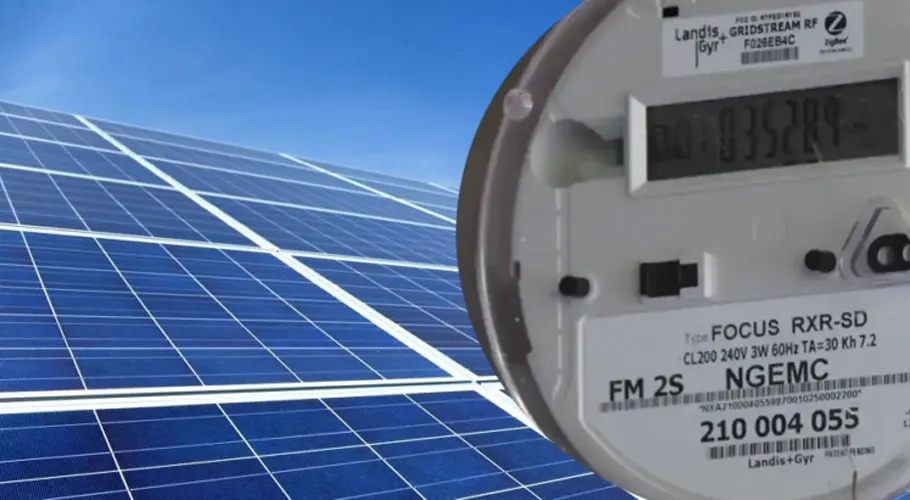
Pakistan’s power regulator, the National Electric Power Regulatory Authority (NEPRA), has approved sweeping changes to the country’s solar energy framework, replacing the existing net metering system with a new net billing mechanism. The decision, formalized under the NEPRA Solar Consumer Rules 2025, is set to reshape how rooftop solar users interact with the national grid, with far-reaching consequences for households, businesses, and the renewable energy sector.
From Net Metering to Net Billing
Under the old net metering regime, consumers with rooftop solar could “swap” electricity units with the grid. If a household exported 10 units during the day, it could consume 10 units at night without paying for them, effectively balancing usage like a bank account of units. This one-to-one adjustment made solar highly attractive, allowing bills to drop close to zero aside from fixed charges.
The new net billing system approved by NEPRA changes this equation entirely. Consumers will now sell surplus electricity to distribution companies (DISCOs) at a fixed buyback rate, while purchasing electricity at the prevailing retail tariff. NEPRA has set the buyback price at Rs. 11–11.5 per unit for new users, while existing users will receive Rs. 27 per unit until their current contracts expire. In contrast, retail tariffs remain between Rs. 55–65 per unit, meaning consumers will sell cheap and buy expensive.
The Financial Impact of Net Billing
The difference in pricing fundamentally alters the economics of solar investment. For example, a household exporting 100 units in the daytime and consuming 100 units at night would previously pay almost nothing under net metering. Under net billing, however, the same household would earn Rs. 2,700 (old users) or Rs. 1,150 (new users) from exports, but pay Rs. 6,000 for imports. The net result is a bill of Rs. 3,300 for old users and Rs. 4,850 for new ones.
Solar consumers, once nearly independent of DISCOs, effectively become paying customers again following the NEPRA-approved shift, reversing one of the strongest incentives behind rooftop solar adoption.
This change also extends the payback period for solar investments from an average of 3–4 years to as much as 8–10 years, making grid-tied systems far less financially attractive under the new NEPRA framework. Many households and businesses that invested heavily in rooftop solar may now struggle to justify the costs.
Why NEPRA Approved the Shift
NEPRA officials argue that the transition to net billing is necessary to protect the financial health of distribution companies, whose revenues have been eroded by the rapid uptake of solar power. By buying surplus electricity at lower rates and selling power at retail tariffs, DISCOs are expected to recover lost revenue under the NEPRA policy.
NEPRA has also reduced the duration of solar contracts from seven years to five, increasing regulatory oversight of the sector. Critics, however, view the move as a short-term financial fix that penalizes consumers instead of addressing structural inefficiencies in the power sector. They warn that the NEPRA decision risks undermining public trust, particularly among existing users who invested under the assurance of stable returns through net metering.
Likely Outcomes for the Solar Market
The revised rules issued by NEPRA are expected to trigger several shifts across the market. Battery adoption is likely to rise as households seek to store daytime solar power for nighttime use instead of selling electricity cheaply to the grid. Hybrid and off-grid systems may also gain popularity, reducing dependence on DISCOs altogether.
At the same time, public backlash could intensify, with calls for “grandfathering” protections that would allow existing net metering users to retain earlier benefits despite the NEPRA policy shift.
Conclusion
NEPRA’s transition from net metering to net billing marks a decisive turning point in Pakistan’s renewable energy trajectory. While NEPRA frames the move as necessary for grid stability and financial sustainability, the policy significantly weakens incentives for solar adoption. For consumers, it translates into higher bills, longer investment recovery periods, and renewed reliance on distribution companies. Without safeguards for existing users and broader reforms to improve sector efficiency, the net billing era introduced by NEPRA risks slowing solar momentum at a time when clean energy remains critically important.
Read related news here: https://thepublicpurview.com/business/
For more stories and insights, visit The Green Post





 Today's E-Paper