
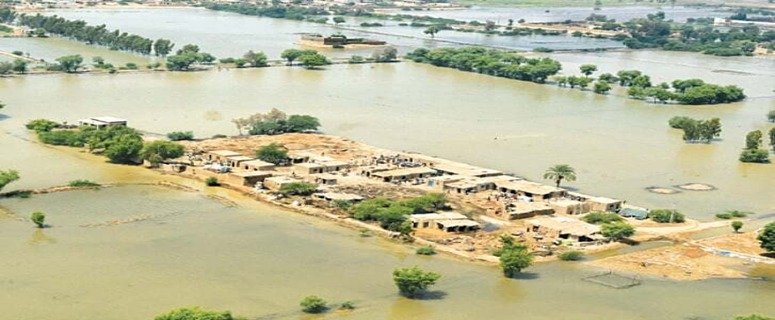
The National Disaster Risk Management Fund (NDRMF) has invested more than Rs7.2 billion in flood resilience, reconstruction and recovery initiatives in Balochistan, according to an official briefing submitted to the National Assembly Standing Committee. The funding supports disaster risk reduction, climate adaptation and infrastructure strengthening efforts in districts repeatedly affected by climate-induced disasters.
The briefing states that NDRMF’s mandate is to finance medium- and long-term resilience measures through disaster risk reduction, climate change adaptation and disaster risk financing interventions. The Fund follows a risk-informed approach based on probabilistic and deterministic assessments of natural hazards.
According to the document, Rs3.7 billion has been allocated to reconstruction and rehabilitation projects following major flood events. These include the construction and rehabilitation of 88 flood protection structures and 20 small dams and water conservation systems aimed at reducing future flood risks.
Fifteen public buildings, including schools and basic health units, have been retrofitted to improve resistance to climate-related disasters. An early warning system has also been installed to enhance preparedness and reduce response times during emergencies.
Health system strengthening and district focus
The briefing notes that Rs903 million was invested in strengthening health systems across 15 hospitals in Balochistan. The funding was directed toward improving emergency response capacity during health crises and climate-related disasters.
NDRMF-supported programmes have focused on severely affected districts, including Killa Saifullah, Loralai, Chagai, Quetta, Pishin, Naseerabad, Killa Abdullah, Kech, Khuzdar, Panjgur, Gwadar, Awaran, Washuk, Kachhi, Nushki, Kharan and Kalat.
In addition to direct NDRMF investments, the document highlights related national-level support in Balochistan, including Benazir Income Support Programme (BISP) cash grants for flood-affected households, medical equipment provision through the National Institute of Health, and participation in the national COVID-19 vaccination campaign. Together, these interventions bring the total value of NDRMF-linked support in the province to approximately Rs7.2 billion.
Risk modelling and future planning
The briefing references Post-Disaster Needs Assessment (PDNA) reports for the 2010 and 2022 floods, which documented extensive damage in Balochistan. The 2022 PDNA estimated national flood damages exceeding $14.9 billion, with significant impacts on housing, infrastructure and livelihoods in the province.
It also outlines the development of the NatCat risk modelling platform under NDRMF, with technical support from SUPARCO. The platform currently models flood hazards in the Nari River Basin using 2022 flood data and hydrometeorological information. Expansion to additional river basins and districts has been identified as a priority.
Historical flood damage and compensation data for districts such as Panjgur and Kech are maintained by the National Disaster Management Authority (NDMA) and Provincial Disaster Management Authority (PDMA), and are recommended for district-level planning and reporting.
Officials said the overall objective of these investments is to strengthen resilience, reduce disaster risks and support long-term recovery in Balochistan through infrastructure development, improved preparedness and health system support.





 Today's E-Paper