
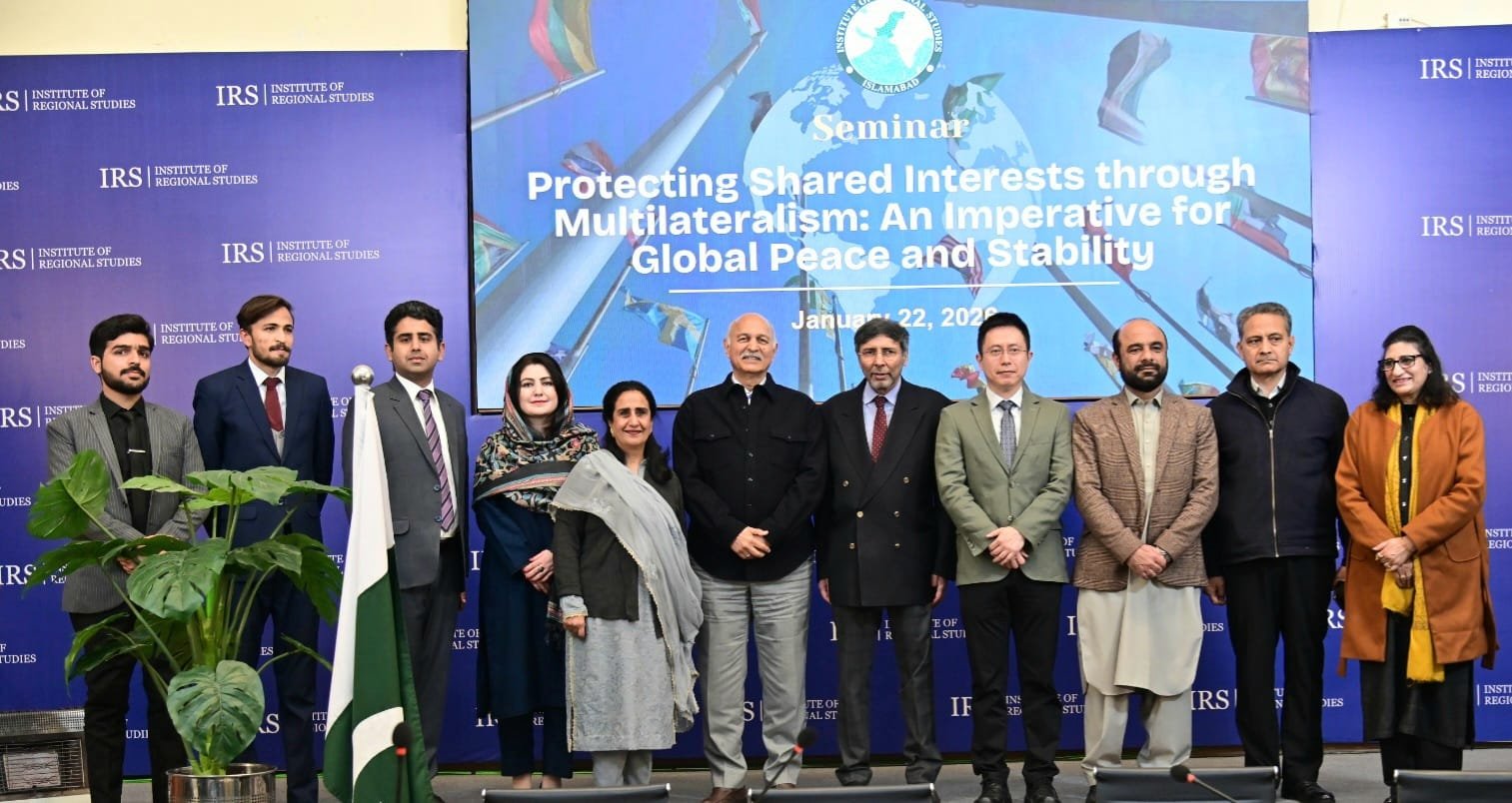
Islamabad: Multilateralism is no longer a policy choice but a strategic necessity in an increasingly fragmented global order, speakers said at a seminar hosted by the China Program of the Institute of Regional Studies (IRS) in Islamabad.
The seminar, titled “Protecting Shared Interests through Multilateralism: An Imperative for Global Peace and Stability,” examined the erosion of the rules-based international system and the growing impact of unilateral actions, protectionism, and geopolitical rivalries on global peace and security.
In his opening remarks, Jauhar Saleem, President of IRS, said traditional powers are increasingly resorting to unilateralism, conditional diplomacy, and transactional approaches that undermine international law and the principles of the UN Charter. He said the protection of shared global interests cannot depend on the discretion of a single power and instead requires collective action through multilateral mechanisms. Referring to China’s expanding institutional engagement, he described it as contributing to shared prosperity and strengthening the UN-based international order.
Board of Peace: separating facts from noise on Pakistan’s participation
Delivering the keynote address, Senator Mushahid Hussain Sayed emphasized that multilateral engagement is central to safeguarding global peace and stability. He described China as a leading proponent of multilateralism and globalization, citing wide participation in the Belt and Road Initiative as evidence. He also said Pakistan has consistently supported dialogue and mediation for conflict resolution, adding that multilateralism has been a core element of Pakistan’s foreign policy since independence.
Addressing the decline of the contemporary international order, Naela Chohan pointed to unilateral actions and conflicts, including regional military escalations and global tariff disputes, as factors destabilizing international peace and security. She said the current global system is under strain and described Chinese-led frameworks as more inclusive, with a greater emphasis on revitalizing multilateral diplomacy and strengthening international institutions.
Zafar Nawaz Jaspal, Meritorious Professor and Dean of the Faculty of Social Sciences at Quaid-i-Azam University, warned that intensifying great-power competition is increasingly affecting middle powers. He highlighted the importance of multilateral dialogue and cooperative initiatives in preventing further fragmentation of the international system.
Presenting a Chinese perspective, Qian Feng, Director of the Research Department at the National Strategy Institute, Tsinghua University, said China’s approach to global governance emphasizes inclusivity, equity, and respect for diverse viewpoints. He said China’s stance on multilateral institutions is grounded in universal security and the concept of a shared future for humanity.
From the perspective of the Global South, Manzoor Khan Afridi, Professor and Dean at International Islamic University Islamabad, said platforms such as the Shanghai Cooperation Organization and China-led development initiatives demonstrate cooperative models of international relations. He said these initiatives have contributed to sustainable development across developing countries.
Similarly, Noor Fatima, Associate Professor and Chairperson of the Department of Politics and International Relations at the same university, said China’s initiatives prioritize human security and development over ideological or geographic considerations. She described China’s approach as people-centric, pluralistic, and outcome-oriented, emphasizing participation and capacity building.
Talat Shabbir, Director of the China–Pakistan Study Centre at the Institute of Strategic Studies Islamabad, said China’s Global Development Initiative, Global Security Initiative, Global Civilization Initiative, and Global Governance Initiative are rooted in multilateral principles. He stressed the need to reinvent mediation mechanisms that are inclusive and preventive, citing erosion of trust due to veto politics and selective engagement.
Concluding the seminar, Wang Shengjie, Counsellor at the Embassy of the People’s Republic of China in Islamabad, said unilateralism, exceptionalism, and violations of sovereignty pose serious challenges to global stability. He said China advocates a multilateral system based on sovereign equality, openness, inclusivity, and tangible outcomes, aligned with the UN-based international order. Highlighting Pakistan–China relations as an example of mutual trust, he said multilateralism is a collective journey requiring shared responsibility and cooperation.


 Today's E-Paper