
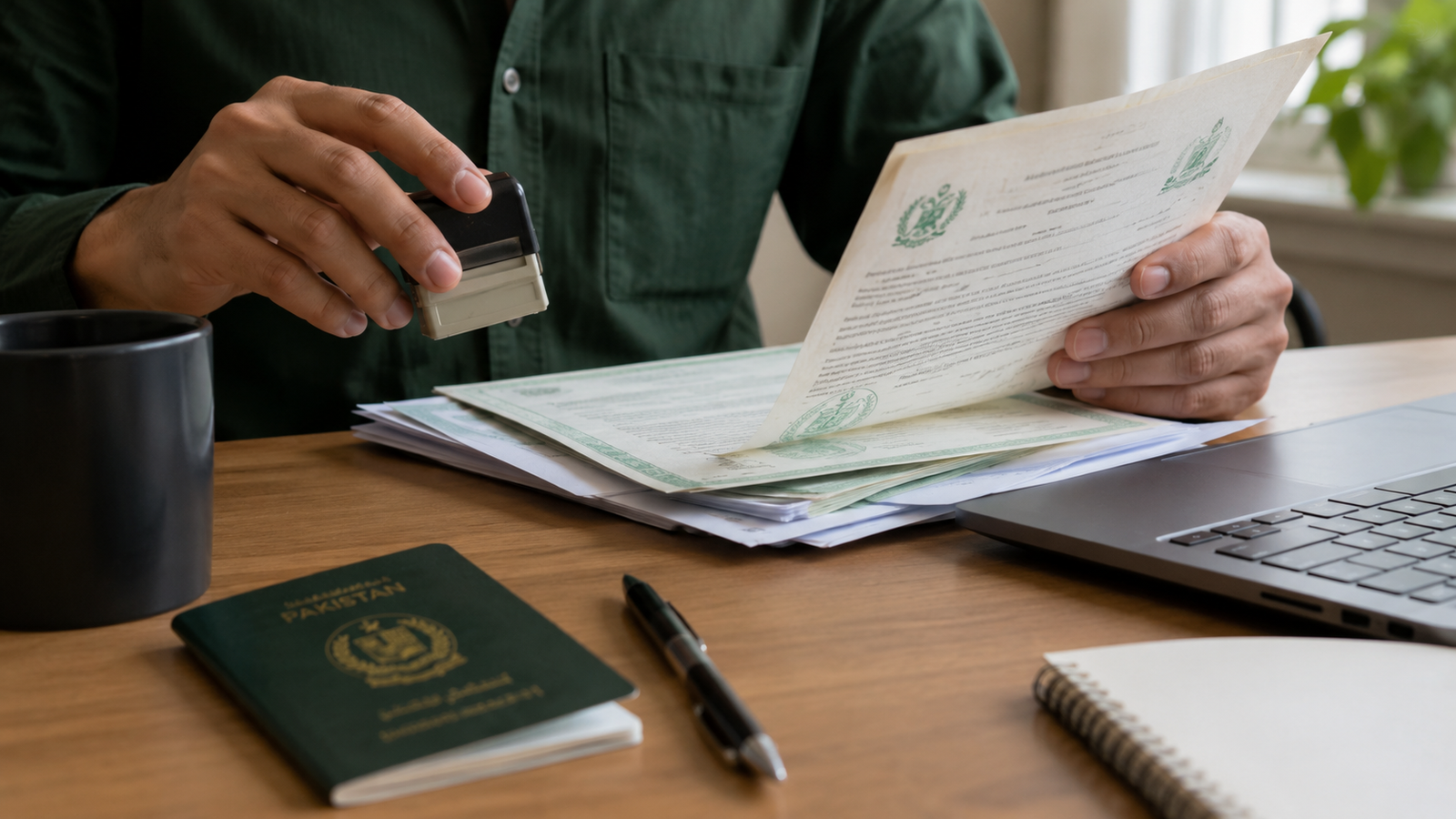
For Pakistani students applying to foreign universities, getting educational documents authenticated can be confusing. Terms such as HEC attestation, IBCC attestation, MOFA attestation and apostille are often used together, even though they are different stages of document authentication.
The good news is that students do not automatically need an expensive agent to complete the process. Pakistan’s Ministry of Foreign Affairs (MOFA) has an official apostille system through which eligible applicants can register and process their documents.
Here is a step-by-step guide for students who are dealing with the process for the first time.
What Is an Apostille?
An apostille is an official certificate used to authenticate a public document for use in another country that recognizes the Hague Apostille Convention.
Pakistan became a party to the 1961 Hague Apostille Convention in 2022, and the convention entered into force for Pakistan on March 9, 2023.
In simple terms, an apostille confirms the official origin of a document so that it can be presented to authorities in another participating country. It does not mean that the foreign university has approved the student’s qualification, nor does it guarantee admission or a visa.
Apostille and Attestation Are Not the Same
This distinction is important.
Attestation involves verification by the relevant Pakistani authority. An apostille is a standardized authentication certificate used under the Hague Convention.
For many students, the process therefore involves more than one authority.
A university degree generally goes through HEC before reaching MOFA, while Matric and Intermediate certificates issued by Pakistani education boards generally require IBCC countersignature.
The first step should always be checking exactly what the foreign university or relevant authority has requested.
Which Documents Need HEC or IBCC?
For university degrees, students generally need HEC attestation before MOFA processing.
For Matric and Intermediate certificates, MOFA’s requirements generally include IBCC countersignature.
Other qualifications can have different requirements. Technical, professional and medical documents may require verification from their respective authorities before MOFA processing.
Students should therefore avoid taking documents directly to MOFA without first checking the applicable requirements.
Step 1: Check Your Foreign University’s Requirements
Before paying anyone, read the document requirements provided by your university.
Find out:
- Which documents need authentication?
- Does the university require an apostille?
- Is an ordinary attestation sufficient?
- Are original documents required?
- Is a certified translation necessary?
- Does the destination country require any additional legalization?
Not every student needs to apostille every educational document.
Step 2: Complete HEC or IBCC Attestation
If you are submitting a university degree, complete the HEC degree-attestation process first.
HEC operates an online degree-attestation system through which applicants submit their academic information and documents for scrutiny and verification.
Students applying with Matric or Intermediate certificates should follow the IBCC attestation procedure and ensure that the relevant board verification requirements have been completed.
Check your name and other personal details carefully. Differences between your CNIC, passport and educational documents can create unnecessary delays.
Step 3: Register on the Official MOFA Apostille Portal
After completing the relevant prerequisite verification, use the official MOFA apostille portal:
apostille.mofa.gov.pk
MOFA’s current procedure requires applicants to register online before proceeding with an apostille application.
Applicants provide their personal information, upload the required identification documents and create an application for the documents they want apostilled.
Review all information carefully before submitting the application.
Step 4: Follow the Appointment Instructions
Once the application has been submitted, follow the processing and appointment information provided through the official system.
MOFA’s current instructions require applicants to appear according to their scheduled appointment details.
Students should be careful when relying on old YouTube videos, Facebook posts or screenshots because government procedures can change.
Always check the official MOFA portal for the latest instructions.
Step 5: Know the Official MOFA Fees
MOFA’s currently published apostille fee structure lists:
| Document | Official fee |
|---|---|
| Personal document | Rs3,000 |
| Educational document | Rs3,000 |
| Experience certificate | Rs3,000 |
| Legal document | Rs4,500 |
| Commercial document | Rs12,000 |
For a student, an educational document currently carries a MOFA apostille fee of Rs3,000 per document.
For example, three educational documents would mean Rs9,000 in MOFA apostille fees, before any separate courier or other service charges.
This is why students should always distinguish between the official government fee and money charged by private service providers.
Step 6: Submit Your Documents
Take the required original documents and supporting paperwork according to the instructions issued with your application.
MOFA verifies the authenticity of the document and the relevant issuing authority. Once the requirements are satisfied, the apostille is generated and attached to the document.
Students should keep digital copies of all documents for their records.
Step 7: Verify the Apostille
Pakistan’s apostille system provides electronic verification.
An apostille can be checked through its QR code and tracking number, allowing the receiving party to verify its authenticity.
This is particularly useful when documents are being submitted to a foreign university or government authority.
Do You Really Need an Agent?
This is perhaps the most important question for students.
No, an agent is not automatically required to obtain an MOFA apostille.
Students can begin with the official MOFA system and follow the published procedure themselves. MOFA also provides information about authorized courier arrangements.
Private agents may offer document preparation, courier handling or other facilitation services. Those services are separate from the government’s official apostille fee.
Students should therefore ask exactly what they are paying for.
What About Rs50,000 or Rs100,000 Charges?
Students may encounter individuals offering to arrange MOFA registration, appointments or document processing for tens of thousands of rupees.
A demand of Rs50,000 or Rs100,000 should not be confused with the official MOFA apostille fee. MOFA’s published fee for an educational document is currently Rs3,000.
That does not automatically mean every private service charging more is unlawful; a private provider may be charging for additional services. But students should demand a clear breakdown of those charges and an official receipt for government payments.
Be especially cautious if someone:
- Claims an agent is compulsory
- Says they have exclusive access to appointments
- Demands a large payment without a receipt
- Requests unnecessary original documents
- Guarantees approval without checking your documents
- Asks for your portal password or OTP
- Tells you to provide inaccurate information
The safest starting point is always the official government portal.
Does Every Foreign University Accept an Apostille?
No.
An apostille authenticates the origin of a document; it does not determine whether a university recognizes the qualification.
Students should confirm the requirements of both the destination country and the receiving institution.
Check whether the country is a party to the Hague Apostille Convention, whether the university accepts Pakistani apostilles, whether translations are required and whether additional embassy or consular procedures apply.
A Simple Roadmap for First-Time Applicants
For students who have never completed the process, the journey can be summarized as:
Check university requirements → Identify documents → HEC/IBCC or relevant verification → Register on MOFA portal → Submit application → Follow appointment instructions → Pay official fee → Submit documents → Receive and verify apostille → Send documents to the foreign university or authority.
Final Advice
The most important thing for students is to start with the university’s requirements, not with an agent.
Do not assume that every document needs an apostille. Do not confuse HEC or IBCC attestation with MOFA apostille. And do not assume that a large amount quoted by an intermediary represents an official government charge.
For students preparing to study abroad, understanding the process before paying anyone can save substantial money, reduce delays and make it easier to identify unnecessary or inflated charges.
Government procedures and fees can change, so applicants should always check the official MOFA, HEC and IBCC websites immediately before submitting an application.