

South Asia’s strategic landscape has hit a dangerous breaking point. For decades, the Pakistani military and intelligence establishment operated under a strict historical narrative—viewing Afghanistan as their ultimate “strategic depth.” Today, that concept is dead. Whatever faint hope for stability flickered into existence after the Taliban seized Kabul in August 2021 has been completely swallowed by proxy warfare, the rapid spread of asymmetric weapons, and volatile new alliances. Instead of building peace, the Afghan Taliban government is actively patronizing banned outfits, particularly the Tehreek-e-Taliban Pakistan (TTP) and the Kharijite fitna. This backing has crossed a red line, escalating into systematic attacks. Militant groups have taken ordinary commercial drones—like the DJI Matrice—and jury-rigged them into suicide weapons. Strapped with GP-25 grenade launchers and small mortar shells, these quadcopters hit targets with lethal accuracy in the dead of night. Worse still, these attacks aren’t just cross-border incursions. Sleeper cells embedded well inside Pakistan are pulling the trigger.
Just look at the absolute chaos that broke out at the tail end of February and into early March 2026. Out of nowhere, suicide drones took aim at the Nur Khan Airbase in Rawalpindi—a deeply sensitive military nerve center. Around the same time, makeshift kamikaze drones zeroed in on the Army Artillery School in Nowshera, hovered near Abbottabad’s Military Academy, and buzzed the Kohat military base. Falling debris from intercepted quadcopters didn’t just hit the dirt in Quetta and Swabi; it wounded innocent bystanders, including kids. Sure, the military managed to shoot down the bulk of the incoming threats. But the heavy coordination behind these launches lays Kabul’s real agenda bare. This wasn’t just another border skirmish—it pushed Islamabad to the edge. By late February 2026, Defense Minister Khawaja Asif flat-out declared an “open war” on the Afghan Taliban. Retaliation was swift. Dubbed “Operation Ghazib Lil-Haq,” Pakistani forces hammered 22 separate Taliban strongholds, taking out arms depots and military bases deep inside provinces like Kabul, Kandahar, Paktia, Paktika, and Laghman. The toll was undeniably heavy, leaving dozens of border outposts wiped out and hundreds of militants dead.
also read: Field Marshal’s Bold Diplomacy: Averting a Regional Catastrophe
It’s crucial to realize this isn’t a temporary lapse in judgment by the Afghan Taliban; it is a calculated, institutionalized nexus. The Doha Agreement, signed largely to pacify the international community, has been exposed as a massive optical illusion. The actual truth is buried in the covert “Mir Ali Agreement,” hammered out in North Waziristan long before Kabul fell. That pact brought together Sirajuddin Haqqani, the TTP leadership, al-Qaeda commanders, and Hafiz Gul Bahadur. Under this ideological charter, the Afghan Taliban swore to provide these fighters with unconditional backing and safe havens, promising to help them establish a Sharia system inside Pakistan. This bitter reality hit home in April 2022. Following Pakistani airstrikes, Taliban Defense Minister Mullah Yaqoob tried to rein in Hafiz Gul Bahadur. In a move of pure audacity, Bahadur simply pulled out the original Mir Ali Agreement, reminding the Taliban leadership of the legal and ideological commitments they had made to support his fighters.
Amid all this chaos, Pakistan is dealing with a massive strategic blow: the growing coziness between India and the Afghan Taliban. The Narendra Modi government played a highly cunning hand, laying down solid diplomatic and economic roots with the Taliban. Following a series of high-level meetings, the Taliban openly call India an “important regional partner.” For years, policymakers in Islamabad dreaded a very specific nightmare scenario, and it’s unfolding right now. India has a long track record of leveraging Afghan territory to pressure Pakistan. But this time, they’ve ignited a completely different breed of proxy conflict—one conveniently sheltered by the Taliban. If you ask Islamabad, the picture is glaringly obvious: the Modi government deeply infiltrated the Taliban’s upper echelons. They allegedly funnel cash, advanced weapons, and those exact drone technologies to the TTP, trapping Pakistan in a brutal two-front security crisis. Meanwhile, New Delhi plays a clever diplomatic game. By framing Pakistan’s anti-terror airstrikes as a blatant attack on Afghan sovereignty, India actively steps in to play the sympathizer and win Kabul’s favor.
With the security situation teetering on the edge, the role of refugees acting as facilitators for the Afghan regime emerged as a severe defense challenge. We have an eye-opening precedent for this right here in the region. Look at Iran: after suffering the assassination of its IRGC commanders at the hands of Israel, Tehran exposed the sinister role of Afghan refugees in intelligence leaks. Within weeks, they launched massive operations to deport alleged Mossad agents. Pakistan’s state narrative is now walking a remarkably similar path. With the “strategic depth” mirage shattered and the TTP monster mutating through drone technology into an existential threat, the Pakistani establishment ramped up the expulsion of hundreds of thousands of Afghan refugees. Make no mistake—this isn’t just administrative housekeeping. Authorities insist they hold concrete proof that hostile intelligence is grooming these local refugee populations to act as spotters and launch-pads for domestic drone terrorism.
If you zoom out and assess the wreckage of South Asia’s security framework, the reality is grim. Unless Islamabad figures out a way to jam or shoot down these cheap quadcopters fast, and unless global powers finally drag Kabul over the coals for hosting terror outfits, this region is doomed to bleed. We are looking at an endless cycle of shadowy proxy fights, forced migrations, and a tech-driven shadow war that respects no borders. Forget the Doha Agreement—right now, the Afghan Taliban is running its playbook entirely off the Mir Ali pact.



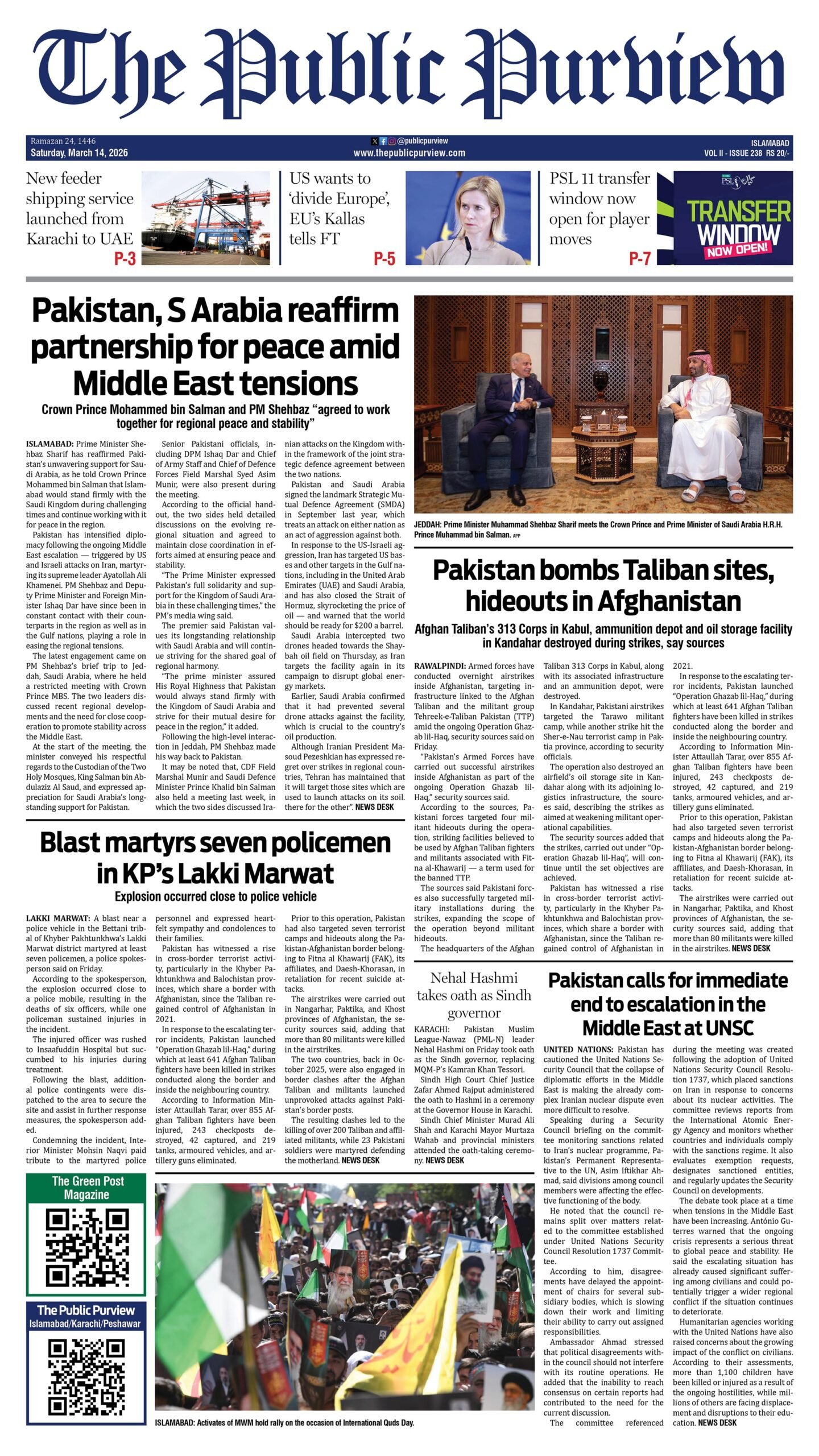 Today's E-Paper